The stablecoin market is booming again in 2025, with total market capitalization reaching a new all-time high of $228 billion, according to a report by CryptoQuant. That marks a $33 billion increase so far this year, a 17% rise, driven by renewed crypto trading activity, growing use in payments, and increased regulatory clarity in the United States under President Donald Trump. Source: CryptoQuant . USDT and USDC Lead $33B Market Cap Jump According to the report, Tether (USDT) and Circle’s USDC continue to lead the market. USDT now holds a $155 billion market cap, up $18 billion year-to-date. USDC has gained $17 billion, climbing to a record high of $61 billion, an increase of 39% since January. On centralized exchanges, stablecoin reserves are also surging. The total value of ERC-20 stablecoins held on exchanges has reached $50 billion. Stablecoins are booming again. Market cap hit a record $228B, up $33B (+17%) in 2025. Driven by rising trading activity, growing payment use, and clearer U.S. regulation under Trump. pic.twitter.com/76zKj49UWB — CryptoQuant.com (@cryptoquant_com) June 12, 2025 USDC reserves in particular have grown 1.6 times in 2025 alone, now totaling around $8 billion. This influx supports deeper liquidity for crypto markets. The report also noted that stablecoins are bouncing back in the yield-bearing segment. These are stablecoins that pay interest to holders, often used in DeFi. The value of staked stablecoins has reached $6.9 billion, up 28% since late May. Most of that growth has come from rising demand for sUSDe and sUSDs, which gained $1.23 billion and $700 million in market cap, respectively. A recent report from on-chain data platforms Artemis and Dune shows broader user adoption. According to the report, titled “The State of Stablecoins 2025,” active stablecoin wallets rose from 19.6 million to 30 million over the past year, a 53% increase. The report said the data “suggests wider user engagement” and pointed to stablecoins becoming a key part of digital finance. It also noted that stablecoins are increasingly used in decentralized finance (DeFi), gaming, and NFTs. “Stablecoins have emerged as a bridge between traditional finance and crypto,” it said, “and are becoming a core piece of payment and settlement infrastructure.” This surge in usage is also supported by the rise in real-world payment activity. Data from Artemis shows $94.2 billion in stablecoin transactions were settled between January 2023 and February 2025. Business-to-business (B2B) payments made up the largest chunk, reaching an annual run rate of $36 billion. Card-linked payments using stablecoins crossed $13 billion in volume. Stablecoin Legislation Gains Ground as Tech and Finance Giants Pile In Increased demand has also come alongside progress on the regulatory front. For example, the U.S. Senate advanced the “Guiding and Establishing National Innovation for U.S. Stablecoins Act” or GENIUS Act this week. Backed by President Trump, the bill is designed to create a federal framework for dollar-backed stablecoins. The legislation would require stablecoins to be fully backed by U.S. dollars or highly liquid assets. It would also mandate annual audits for issuers with over $50 billion in market cap, and include requirements for foreign issuers. 🚨 The U.S. Senate Set for Historic Stablecoin Showdown as GENIUS Act nears final vote. #Stablecoins #GeniusAct https://t.co/ZJ59XzuQcn — Cryptonews.com (@cryptonews) June 11, 2025 The Senate voted 68-30 to invoke cloture on the bill , clearing the way for final debate and vote. “This did not happen by accident,” said Senator Tim Scott, one of the bill’s co-sponsors. “To those who said Washington could not act… let’s prove them wrong.” Treasury Secretary Scott Bessent backed the legislation during a Wednesday Senate hearing. He said stablecoins could play a major role in expanding the use of the U.S. dollar globally. “I think $2 trillion is a very reasonable number,” Bessent said, referring to an estimate that the stablecoin market could exceed that level by 2028. “I could see it greatly exceeding that.” 🇺🇸 BREAKING – U.S. Treasury Secretary Bessent: – Stablecoin regulations backed by U.S. Treasuries will expand global USD usage – We could see stablecoin demand exceed $2 TRILLION This is massive for crypto. Regulated stablecoins = institutional trust Institutional trust =… pic.twitter.com/inZh9maAwW — @CryptoELlTES (@CryptooELITES) June 12, 2025 The GENIUS Act appears to be pushing traditional finance further into the stablecoin space. Large U.S. banks, including JPMorgan, Citigroup, Wells Fargo, and Bank of America, are reportedly exploring a joint stablecoin project. Meanwhile, USDC issuer Circle went public earlier this month, with shares jumping 160% on their first day of trading . 🔴 @Circle the company behind the USDC stablecoin, made a dramatic entrance on the NYSE with its shares surging as much as 160% during its trading debut. #Circle #NYSE https://t.co/EJQJ4Yy3m3 — Cryptonews.com (@cryptonews) June 5, 2025 Tech firms are also watching closely. According to Fortune , Apple, Google, Airbnb, and Elon Musk’s X are all exploring stablecoin integrations. Google has already processed two stablecoin payments. 🍎 Apple, X, and Airbnb are in early talks with crypto firms to integrate stablecoin payments. #apple #google #stablecoin https://t.co/gmEbx3i4PN — Cryptonews.com (@cryptonews) June 6, 2025 Airbnb has held talks with Worldpay to cut credit card fees using stablecoins. X is reportedly planning to include stablecoins in its X Money app.The stablecoin market is booming again in 2025, with total market capitalization reaching a new all-time high of $228 billion, according to a report by CryptoQuant. That marks a $33 billion increase so far this year, a 17% rise, driven by renewed crypto trading activity, growing use in payments, and increased regulatory clarity in the United States under President Donald Trump. Source: CryptoQuant . USDT and USDC Lead $33B Market Cap Jump According to the report, Tether (USDT) and Circle’s USDC continue to lead the market. USDT now holds a $155 billion market cap, up $18 billion year-to-date. USDC has gained $17 billion, climbing to a record high of $61 billion, an increase of 39% since January. On centralized exchanges, stablecoin reserves are also surging. The total value of ERC-20 stablecoins held on exchanges has reached $50 billion. Stablecoins are booming again. Market cap hit a record $228B, up $33B (+17%) in 2025. Driven by rising trading activity, growing payment use, and clearer U.S. regulation under Trump. pic.twitter.com/76zKj49UWB — CryptoQuant.com (@cryptoquant_com) June 12, 2025 USDC reserves in particular have grown 1.6 times in 2025 alone, now totaling around $8 billion. This influx supports deeper liquidity for crypto markets. The report also noted that stablecoins are bouncing back in the yield-bearing segment. These are stablecoins that pay interest to holders, often used in DeFi. The value of staked stablecoins has reached $6.9 billion, up 28% since late May. Most of that growth has come from rising demand for sUSDe and sUSDs, which gained $1.23 billion and $700 million in market cap, respectively. A recent report from on-chain data platforms Artemis and Dune shows broader user adoption. According to the report, titled “The State of Stablecoins 2025,” active stablecoin wallets rose from 19.6 million to 30 million over the past year, a 53% increase. The report said the data “suggests wider user engagement” and pointed to stablecoins becoming a key part of digital finance. It also noted that stablecoins are increasingly used in decentralized finance (DeFi), gaming, and NFTs. “Stablecoins have emerged as a bridge between traditional finance and crypto,” it said, “and are becoming a core piece of payment and settlement infrastructure.” This surge in usage is also supported by the rise in real-world payment activity. Data from Artemis shows $94.2 billion in stablecoin transactions were settled between January 2023 and February 2025. Business-to-business (B2B) payments made up the largest chunk, reaching an annual run rate of $36 billion. Card-linked payments using stablecoins crossed $13 billion in volume. Stablecoin Legislation Gains Ground as Tech and Finance Giants Pile In Increased demand has also come alongside progress on the regulatory front. For example, the U.S. Senate advanced the “Guiding and Establishing National Innovation for U.S. Stablecoins Act” or GENIUS Act this week. Backed by President Trump, the bill is designed to create a federal framework for dollar-backed stablecoins. The legislation would require stablecoins to be fully backed by U.S. dollars or highly liquid assets. It would also mandate annual audits for issuers with over $50 billion in market cap, and include requirements for foreign issuers. 🚨 The U.S. Senate Set for Historic Stablecoin Showdown as GENIUS Act nears final vote. #Stablecoins #GeniusAct https://t.co/ZJ59XzuQcn — Cryptonews.com (@cryptonews) June 11, 2025 The Senate voted 68-30 to invoke cloture on the bill , clearing the way for final debate and vote. “This did not happen by accident,” said Senator Tim Scott, one of the bill’s co-sponsors. “To those who said Washington could not act… let’s prove them wrong.” Treasury Secretary Scott Bessent backed the legislation during a Wednesday Senate hearing. He said stablecoins could play a major role in expanding the use of the U.S. dollar globally. “I think $2 trillion is a very reasonable number,” Bessent said, referring to an estimate that the stablecoin market could exceed that level by 2028. “I could see it greatly exceeding that.” 🇺🇸 BREAKING – U.S. Treasury Secretary Bessent: – Stablecoin regulations backed by U.S. Treasuries will expand global USD usage – We could see stablecoin demand exceed $2 TRILLION This is massive for crypto. Regulated stablecoins = institutional trust Institutional trust =… pic.twitter.com/inZh9maAwW — @CryptoELlTES (@CryptooELITES) June 12, 2025 The GENIUS Act appears to be pushing traditional finance further into the stablecoin space. Large U.S. banks, including JPMorgan, Citigroup, Wells Fargo, and Bank of America, are reportedly exploring a joint stablecoin project. Meanwhile, USDC issuer Circle went public earlier this month, with shares jumping 160% on their first day of trading . 🔴 @Circle the company behind the USDC stablecoin, made a dramatic entrance on the NYSE with its shares surging as much as 160% during its trading debut. #Circle #NYSE https://t.co/EJQJ4Yy3m3 — Cryptonews.com (@cryptonews) June 5, 2025 Tech firms are also watching closely. According to Fortune , Apple, Google, Airbnb, and Elon Musk’s X are all exploring stablecoin integrations. Google has already processed two stablecoin payments. 🍎 Apple, X, and Airbnb are in early talks with crypto firms to integrate stablecoin payments. #apple #google #stablecoin https://t.co/gmEbx3i4PN — Cryptonews.com (@cryptonews) June 6, 2025 Airbnb has held talks with Worldpay to cut credit card fees using stablecoins. X is reportedly planning to include stablecoins in its X Money app.

Stablecoin Surge: Market Cap Hits Record $228B in 2025 Amid Trading Boom and Trump-Era Clarity

4 min read

The stablecoin market is booming again in 2025, with total market capitalization reaching a new all-time high of $228 billion, according to a report by CryptoQuant.

That marks a $33 billion increase so far this year, a 17% rise, driven by renewed crypto trading activity, growing use in payments, and increased regulatory clarity in the United States under President Donald Trump.
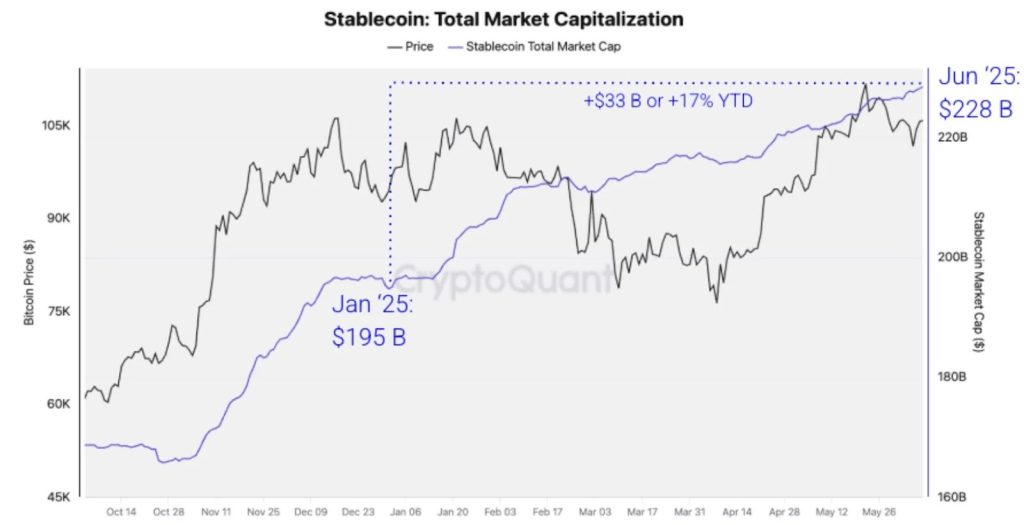
Source: CryptoQuant.

USDT and USDC Lead $33B Market Cap Jump

According to the report, Tether (USDT) and Circle’s USDC continue to lead the market. USDT now holds a $155 billion market cap, up $18 billion year-to-date. USDC has gained $17 billion, climbing to a record high of $61 billion, an increase of 39% since January.

On centralized exchanges, stablecoin reserves are also surging. The total value of ERC-20 stablecoins held on exchanges has reached $50 billion.

USDC reserves in particular have grown 1.6 times in 2025 alone, now totaling around $8 billion. This influx supports deeper liquidity for crypto markets.

The report also noted that stablecoins are bouncing back in the yield-bearing segment. These are stablecoins that pay interest to holders, often used in DeFi. The value of staked stablecoins has reached $6.9 billion, up 28% since late May.

Most of that growth has come from rising demand for sUSDe and sUSDs, which gained $1.23 billion and $700 million in market cap, respectively.

A recent report from on-chain data platforms Artemis and Dune shows broader user adoption. According to the report, titled “The State of Stablecoins 2025,” active stablecoin wallets rose from 19.6 million to 30 million over the past year, a 53% increase.

The report said the data “suggests wider user engagement” and pointed to stablecoins becoming a key part of digital finance. It also noted that stablecoins are increasingly used in decentralized finance (DeFi), gaming, and NFTs.

“Stablecoins have emerged as a bridge between traditional finance and crypto,” it said, “and are becoming a core piece of payment and settlement infrastructure.”

This surge in usage is also supported by the rise in real-world payment activity. Data from Artemis shows $94.2 billion in stablecoin transactions were settled between January 2023 and February 2025.

Business-to-business (B2B) payments made up the largest chunk, reaching an annual run rate of $36 billion. Card-linked payments using stablecoins crossed $13 billion in volume.

Stablecoin Legislation Gains Ground as Tech and Finance Giants Pile In

Increased demand has also come alongside progress on the regulatory front. For example, the U.S. Senate advanced the “Guiding and Establishing National Innovation for U.S. Stablecoins Act” or GENIUS Act this week.

Backed by President Trump, the bill is designed to create a federal framework for dollar-backed stablecoins.

The legislation would require stablecoins to be fully backed by U.S. dollars or highly liquid assets. It would also mandate annual audits for issuers with over $50 billion in market cap, and include requirements for foreign issuers.

The Senate voted 68-30 to invoke cloture on the bill, clearing the way for final debate and vote.

“This did not happen by accident,” said Senator Tim Scott, one of the bill’s co-sponsors. “To those who said Washington could not act… let’s prove them wrong.”

Treasury Secretary Scott Bessent backed the legislation during a Wednesday Senate hearing. He said stablecoins could play a major role in expanding the use of the U.S. dollar globally.

“I think $2 trillion is a very reasonable number,” Bessent said, referring to an estimate that the stablecoin market could exceed that level by 2028. “I could see it greatly exceeding that.”

The GENIUS Act appears to be pushing traditional finance further into the stablecoin space. Large U.S. banks, including JPMorgan, Citigroup, Wells Fargo, and Bank of America, are reportedly exploring a joint stablecoin project.

Meanwhile, USDC issuer Circle went public earlier this month, with shares jumping 160% on their first day of trading.

Tech firms are also watching closely. According to Fortune, Apple, Google, Airbnb, and Elon Musk’s X are all exploring stablecoin integrations. Google has already processed two stablecoin payments.

Airbnb has held talks with Worldpay to cut credit card fees using stablecoins. X is reportedly planning to include stablecoins in its X Money app.

Market Opportunity
Threshold Logo
Threshold Price(T)
$0.008154
$0.008154$0.008154
+0.24%
USD
Threshold (T) Live Price Chart
Disclaimer: The articles reposted on this site are sourced from public platforms and are provided for informational purposes only. They do not necessarily reflect the views of MEXC. All rights remain with the original authors. If you believe any content infringes on third-party rights, please contact [email protected] for removal. MEXC makes no guarantees regarding the accuracy, completeness, or timeliness of the content and is not responsible for any actions taken based on the information provided. The content does not constitute financial, legal, or other professional advice, nor should it be considered a recommendation or endorsement by MEXC.

You May Also Like

Galaxy Digital’s 2025 Loss: SOL Bear Market

Galaxy Digital’s 2025 Loss: SOL Bear Market

The post Galaxy Digital’s 2025 Loss: SOL Bear Market appeared on BitcoinEthereumNews.com. Galaxy Digital, a digital assets and artificial intelligence infrastructure
Share
BitcoinEthereumNews2026/02/04 09:49
Michael Saylor Pushes Digital Capital Narrative At Bitcoin Treasuries Unconference

Michael Saylor Pushes Digital Capital Narrative At Bitcoin Treasuries Unconference

The post Michael Saylor Pushes Digital Capital Narrative At Bitcoin Treasuries Unconference appeared on BitcoinEthereumNews.com. The suitcoiners are in town.  From a low-key, circular podium in the middle of a lavish New York City event hall, Strategy executive chairman Michael Saylor took the mic and opened the Bitcoin Treasuries Unconference event. He joked awkwardly about the orange ties, dresses, caps and other merch to the (mostly male) audience of who’s-who in the bitcoin treasury company world.  Once he got onto the regular beat, it was much of the same: calm and relaxed, speaking freely and with confidence, his keynote was heavy on the metaphors and larger historical stories. Treasury companies are like Rockefeller’s Standard Oil in its early years, Michael Saylor said: We’ve just discovered crude oil and now we’re making sense of the myriad ways in which we can use it — the automobile revolution and jet fuel is still well ahead of us.  Established, trillion-dollar companies not using AI because of “security concerns” make them slow and stupid — just like companies and individuals rejecting digital assets now make them poor and weak.  “I’d like to think that we understood our business five years ago; we didn’t.”  We went from a defensive investment into bitcoin, Saylor said, to opportunistic, to strategic, and finally transformational; “only then did we realize that we were different.” Michael Saylor: You Come Into My Financial History House?! Jokes aside, Michael Saylor is very welcome to the warm waters of our financial past. He acquitted himself honorably by invoking the British Consol — though mispronouncing it, and misdating it to the 1780s; Pelham’s consolidation of debts happened in the 1750s and perpetual government debt existed well before then — and comparing it to the gold standard and the future of bitcoin. He’s right that Strategy’s STRC product in many ways imitates the consols; irredeemable, perpetual debt, issued at par, with…
Share
BitcoinEthereumNews2025/09/18 02:12
HKMA Launches Fintech Blueprint with AI, DLT, Quantum and Cybersecurity Focus

HKMA Launches Fintech Blueprint with AI, DLT, Quantum and Cybersecurity Focus

The Hong Kong Monetary Authority (HKMA) published a Fintech Promotion Blueprint to support responsible innovation and fintech development in the banking sector.
Share
Fintechnews2026/02/04 10:20