A chaotic token launch on Solana has placed decentralized finance platform HumidiFi and Jupiter Exchange under intense scrutiny after blockchain investigatorsA chaotic token launch on Solana has placed decentralized finance platform HumidiFi and Jupiter Exchange under intense scrutiny after blockchain investigators

Exposed: “Ramarxyz” Sniped 70% of $WET Presale With 1,000+ Wallets – Then Demanded Refund

4 min read

A chaotic token launch on Solana has placed decentralized finance platform HumidiFi and Jupiter Exchange under intense scrutiny after blockchain investigators linked a single actor to the mass botting of the $WET public presale, capturing the majority of the allocation within seconds.

According to a detailed on-chain investigation published by Bubblemaps, one entity operating under the alias “Ramarxyz” used more than 1,000 wallets to claim roughly 70% of the $WET public presale allocation.

The sale, which took place through Jupiter’s Decentralized Token Formation (DTF) launchpad, sold out in just two seconds before most retail participants could interact.

HumidiFi Confirms Bot Attack as Blockchain Data Traces Sale to One Actor

HumidiFi later confirmed that a large bot farm had overwhelmed the public sale. Bubblemaps found that at least 1,100 of the 1,530 participating addresses were controlled by the same actor.

The wallets followed a repetitive funding pattern, with each receiving exactly 1,000 USDC from centralized exchanges shortly before the sale.
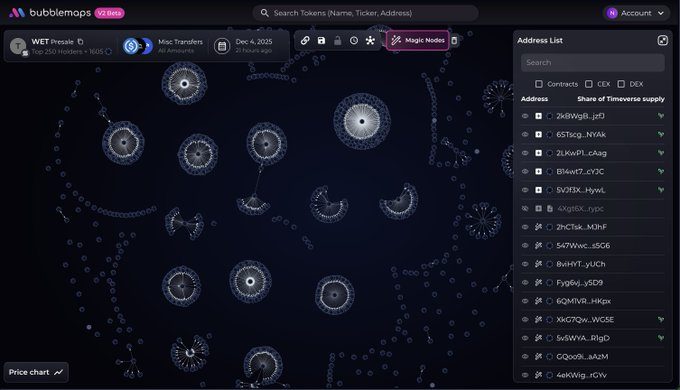
Source: Bubblemaps

One wallet allegedly broke the pattern by receiving funds from a private address that could be traced to the Twitter handle @ramarxyz through previous public blockchain activity.

Rather than acknowledging the activity, the individual later publicly suggested that HumidiFi should refund the sniper’s allocation, despite being linked to the exploit.

Shortly afterward, HumidiFi confirmed that all suspected bot allocations had been canceled and that legitimate presale participants would instead receive a prorated airdrop.

A separate on-chain analysis by trader Gautam Mgg showed that 4% of the public allocation went to just 10 wallets, with four wallets alone committing 40% of the entire public sale supply using bots.

The wallets were publicly listed using Solana explorers. Gautam also blamed Jupiter Exchange for failing to introduce basic bot protection measures, such as CAPTCHA or last-minute address rotation.

Jupiter had earlier announced that the $WET token sale was fully completed, raising $5.57 million across its Wetlist, JUP stakers, and public sale phases.

The public phase offered 30 million tokens at $0.069 per token, capped at $1,000 USDC per wallet. The token is scheduled to become claimable on December 9 alongside the launch of liquidity pools.

HumidiFi to Reissue Token After Aborting Disrupted $WET Launch

Following the incident, HumidiFi announced it would abandon the compromised launch and create a new token instead.

The protocol said all legitimate Wetlist and JUP staker participants would receive a pro-rata airdrop under a newly deployed contract that has been audited. A new public sale is now scheduled.

HumidiFi launched in mid-2025 and has grown into one of Solana’s most active decentralized exchanges, processing over $1 billion in daily trading volume and often accounting for more than one-third of all spot trading on the network.

According to DefiLlama, its Dex volume currently sits close to $30 billion over 30 days, while its cumulative volume sits at over $122 billion.

The $WET token was introduced as the protocol’s staking and fee-rebate asset and was promoted as a community-driven distribution using Jupiter’s DTF platform.

The incident has revived broader concerns over token distribution fairness across launchpads.

In September, Bubblemaps also flagged a separate Sybil attack linked to the MYX token airdrop, where roughly 100 newly created wallets claimed nearly $170 million in tokens after being funded simultaneously from OKX.

That case similarly raised questions about identity controls and launch design weaknesses.

Jupiter DTF was introduced as a transparent, trust-minimized alternative to traditional token launches, combining curation and on-chain verification. The $WET sale was its first live deployment, making the failure a major test for the model.

Neither Jupiter Exchange nor the individuals accused have issued a detailed technical breakdown of what failed at the infrastructure level.

Disclaimer: The articles reposted on this site are sourced from public platforms and are provided for informational purposes only. They do not necessarily reflect the views of MEXC. All rights remain with the original authors. If you believe any content infringes on third-party rights, please contact [email protected] for removal. MEXC makes no guarantees regarding the accuracy, completeness, or timeliness of the content and is not responsible for any actions taken based on the information provided. The content does not constitute financial, legal, or other professional advice, nor should it be considered a recommendation or endorsement by MEXC.

You May Also Like

Unlocking Massive Value: Curve Finance Revenue Sharing Proposal for CRV Holders

Unlocking Massive Value: Curve Finance Revenue Sharing Proposal for CRV Holders

BitcoinWorld Unlocking Massive Value: Curve Finance Revenue Sharing Proposal for CRV Holders The dynamic world of decentralized finance (DeFi) is constantly evolving, bringing forth new opportunities and innovations. A significant development is currently unfolding at Curve Finance, a leading decentralized exchange (DEX). Its founder, Michael Egorov, has put forth an exciting proposal designed to offer a more direct path for token holders to earn revenue. This initiative, centered around a new Curve Finance revenue sharing model, aims to bolster the value for those actively participating in the protocol’s governance. What is the “Yield Basis” Proposal and How Does it Work? At the core of this forward-thinking initiative is a new protocol dubbed Yield Basis. Michael Egorov introduced this concept on the CurveDAO governance forum, outlining a mechanism to distribute sustainable profits directly to CRV holders. Specifically, it targets those who stake their CRV tokens to gain veCRV, which are essential for governance participation within the Curve ecosystem. Let’s break down the initial steps of this innovative proposal: crvUSD Issuance: Before the Yield Basis protocol goes live, $60 million in crvUSD will be issued. Strategic Fund Allocation: The funds generated from the sale of these crvUSD tokens will be strategically deployed into three distinct Bitcoin-based liquidity pools: WBTC, cbBTC, and tBTC. Pool Capping: To ensure balanced risk and diversified exposure, each of these pools will be capped at $10 million. This carefully designed structure aims to establish a robust and consistent income stream, forming the bedrock of a sustainable Curve Finance revenue sharing mechanism. Why is This Curve Finance Revenue Sharing Significant for CRV Holders? This proposal marks a pivotal moment for CRV holders, particularly those dedicated to the long-term health and governance of Curve Finance. Historically, generating revenue for token holders in the DeFi space can often be complex. The Yield Basis proposal simplifies this by offering a more direct and transparent pathway to earnings. By staking CRV for veCRV, holders are not merely engaging in governance; they are now directly positioned to benefit from the protocol’s overall success. The significance of this development is multifaceted: Direct Profit Distribution: veCRV holders are set to receive a substantial share of the profits generated by the Yield Basis protocol. Incentivized Governance: This direct financial incentive encourages more users to stake their CRV, which in turn strengthens the protocol’s decentralized governance structure. Enhanced Value Proposition: The promise of sustainable revenue sharing could significantly boost the inherent value of holding and staking CRV tokens. Ultimately, this move underscores Curve Finance’s dedication to rewarding its committed community and ensuring the long-term vitality of its ecosystem through effective Curve Finance revenue sharing. Understanding the Mechanics: Profit Distribution and Ecosystem Support The distribution model for Yield Basis has been thoughtfully crafted to strike a balance between rewarding veCRV holders and supporting the wider Curve ecosystem. Under the terms of the proposal, a substantial portion of the value generated by Yield Basis will flow back to those who contribute to the protocol’s governance. Returns for veCRV Holders: A significant share, specifically between 35% and 65% of the value generated by Yield Basis, will be distributed to veCRV holders. This flexible range allows for dynamic adjustments based on market conditions and the protocol’s performance. Ecosystem Reserve: Crucially, 25% of the Yield Basis tokens will be reserved exclusively for the Curve ecosystem. This allocation can be utilized for various strategic purposes, such as funding ongoing development, issuing grants, or further incentivizing liquidity providers. This ensures the continuous growth and innovation of the platform. The proposal is currently undergoing a democratic vote on the CurveDAO governance forum, giving the community a direct voice in shaping the future of Curve Finance revenue sharing. The voting period is scheduled to conclude on September 24th. What’s Next for Curve Finance and CRV Holders? The proposed Yield Basis protocol represents a pioneering approach to sustainable revenue generation and community incentivization within the DeFi landscape. If approved by the community, this Curve Finance revenue sharing model has the potential to establish a new benchmark for how decentralized exchanges reward their most dedicated participants. It aims to foster a more robust and engaged community by directly linking governance participation with tangible financial benefits. This strategic move by Michael Egorov and the Curve Finance team highlights a strong commitment to innovation and strengthening the decentralized nature of the protocol. For CRV holders, a thorough understanding of this proposal is crucial for making informed decisions regarding their staking strategies and overall engagement with one of DeFi’s foundational platforms. FAQs about Curve Finance Revenue Sharing Q1: What is the main goal of the Yield Basis proposal? A1: The primary goal is to establish a more direct and sustainable way for CRV token holders who stake their tokens (receiving veCRV) to earn revenue from the Curve Finance protocol. Q2: How will funds be generated for the Yield Basis protocol? A2: Initially, $60 million in crvUSD will be issued and sold. The funds from this sale will then be allocated to three Bitcoin-based pools (WBTC, cbBTC, and tBTC), with each pool capped at $10 million, to generate profits. Q3: Who benefits from the Yield Basis revenue sharing? A3: The proposal states that between 35% and 65% of the value generated by Yield Basis will be returned to veCRV holders, who are CRV stakers participating in governance. Q4: What is the purpose of the 25% reserve for the Curve ecosystem? A4: This 25% reserve of Yield Basis tokens is intended to support the broader Curve ecosystem, potentially funding development, grants, or other initiatives that contribute to the platform’s growth and sustainability. Q5: When is the vote on the Yield Basis proposal? A5: A vote on the proposal is currently underway on the CurveDAO governance forum and is scheduled to run until September 24th. If you found this article insightful and valuable, please consider sharing it with your friends, colleagues, and followers on social media! Your support helps us continue to deliver important DeFi insights and analysis to a wider audience. To learn more about the latest DeFi market trends, explore our article on key developments shaping decentralized finance institutional adoption. This post Unlocking Massive Value: Curve Finance Revenue Sharing Proposal for CRV Holders first appeared on BitcoinWorld.
Share
Coinstats2025/09/18 00:35
Best Crypto To Buy Now: Pepeto vs BlockDAG, Layer Brett, Remittix, Little Pepe, Compared

Best Crypto To Buy Now: Pepeto vs BlockDAG, Layer Brett, Remittix, Little Pepe, Compared

Today we compare Pepeto (PEPETO), BlockDAG, Layer Brett, Remittix, Little Pepe (and how they stack up today) by the main […] The post Best Crypto To Buy Now: Pepeto vs BlockDAG, Layer Brett, Remittix, Little Pepe, Compared appeared first on Coindoo.
Share
Coindoo2025/09/18 02:39
Solana Price Plummets: SOL Crashes Below $90 in Stunning Market Reversal

Solana Price Plummets: SOL Crashes Below $90 in Stunning Market Reversal

BitcoinWorld Solana Price Plummets: SOL Crashes Below $90 in Stunning Market Reversal In a dramatic shift for one of cryptocurrency’s leading networks, Solana (
Share
bitcoinworld2026/02/05 06:45