The post Vitalik Buterin Proposes Ethereum Gas Futures Market for Long-Term Fee Predictability appeared on BitcoinEthereumNews.com. Vitalik Buterin proposes an on-chain futures market for Ethereum gas, allowing users to pre-buy and lock in fees before potential price surges. This mechanism would provide long-term predictability for BASEFEE, helping developers and businesses plan transactions amid network volatility. Buterin’s vision introduces futures trading for gas, securing costs in advance for future Ethereum transactions. This system generates market-driven signals for BASEFEE evolution, reducing uncertainty in fee planning. Early projects like Oiler have tested gas derivatives, but a mature market is needed; Ethereum’s BASEFEE has fluctuated up to 200% in past cycles, per network data. Ethereum gas futures: Vitalik Buterin’s plan to pre-buy fees and stabilize costs. Discover how this on-chain market could transform transaction predictability—explore Ethereum’s future now! What is Vitalik Buterin’s Proposal for Pre-Buying Ethereum Gas? Vitalik Buterin, Ethereum’s co-founder, is advocating for an on-chain futures market that enables users to pre-buy gas at fixed prices, addressing the network’s long-standing issue of unpredictable transaction fees. This approach shifts focus from immediate cost reductions to long-term fee stability, allowing individuals and organizations to hedge against future spikes in BASEFEE. By creating a dedicated trading platform within Ethereum, Buterin aims to make gas pricing more transparent and manageable, fostering greater confidence in the ecosystem’s economic model. How Would an Ethereum Gas Futures Market Function? Ethereum’s current gas fee system relies on dynamic pricing through the EIP-1559 mechanism, where BASEFEE adjusts based on network congestion, often leading to volatility that can surge by over 150% during peak periods, as observed in historical data from the Ethereum Foundation’s reports. Buterin’s proposed futures market would operate as a decentralized exchange for gas contracts, where traders buy and sell claims to future gas units at agreed-upon prices. This market-driven mechanism would aggregate collective expectations, providing real-time signals on anticipated BASEFEE trends—such as potential increases tied… The post Vitalik Buterin Proposes Ethereum Gas Futures Market for Long-Term Fee Predictability appeared on BitcoinEthereumNews.com. Vitalik Buterin proposes an on-chain futures market for Ethereum gas, allowing users to pre-buy and lock in fees before potential price surges. This mechanism would provide long-term predictability for BASEFEE, helping developers and businesses plan transactions amid network volatility. Buterin’s vision introduces futures trading for gas, securing costs in advance for future Ethereum transactions. This system generates market-driven signals for BASEFEE evolution, reducing uncertainty in fee planning. Early projects like Oiler have tested gas derivatives, but a mature market is needed; Ethereum’s BASEFEE has fluctuated up to 200% in past cycles, per network data. Ethereum gas futures: Vitalik Buterin’s plan to pre-buy fees and stabilize costs. Discover how this on-chain market could transform transaction predictability—explore Ethereum’s future now! What is Vitalik Buterin’s Proposal for Pre-Buying Ethereum Gas? Vitalik Buterin, Ethereum’s co-founder, is advocating for an on-chain futures market that enables users to pre-buy gas at fixed prices, addressing the network’s long-standing issue of unpredictable transaction fees. This approach shifts focus from immediate cost reductions to long-term fee stability, allowing individuals and organizations to hedge against future spikes in BASEFEE. By creating a dedicated trading platform within Ethereum, Buterin aims to make gas pricing more transparent and manageable, fostering greater confidence in the ecosystem’s economic model. How Would an Ethereum Gas Futures Market Function? Ethereum’s current gas fee system relies on dynamic pricing through the EIP-1559 mechanism, where BASEFEE adjusts based on network congestion, often leading to volatility that can surge by over 150% during peak periods, as observed in historical data from the Ethereum Foundation’s reports. Buterin’s proposed futures market would operate as a decentralized exchange for gas contracts, where traders buy and sell claims to future gas units at agreed-upon prices. This market-driven mechanism would aggregate collective expectations, providing real-time signals on anticipated BASEFEE trends—such as potential increases tied…

Vitalik Buterin Proposes Ethereum Gas Futures Market for Long-Term Fee Predictability

4 min read
  • Buterin’s vision introduces futures trading for gas, securing costs in advance for future Ethereum transactions.

  • This system generates market-driven signals for BASEFEE evolution, reducing uncertainty in fee planning.

  • Early projects like Oiler have tested gas derivatives, but a mature market is needed; Ethereum’s BASEFEE has fluctuated up to 200% in past cycles, per network data.

Ethereum gas futures: Vitalik Buterin’s plan to pre-buy fees and stabilize costs. Discover how this on-chain market could transform transaction predictability—explore Ethereum’s future now!

What is Vitalik Buterin’s Proposal for Pre-Buying Ethereum Gas?

Vitalik Buterin, Ethereum’s co-founder, is advocating for an on-chain futures market that enables users to pre-buy gas at fixed prices, addressing the network’s long-standing issue of unpredictable transaction fees. This approach shifts focus from immediate cost reductions to long-term fee stability, allowing individuals and organizations to hedge against future spikes in BASEFEE. By creating a dedicated trading platform within Ethereum, Buterin aims to make gas pricing more transparent and manageable, fostering greater confidence in the ecosystem’s economic model.

How Would an Ethereum Gas Futures Market Function?

Ethereum’s current gas fee system relies on dynamic pricing through the EIP-1559 mechanism, where BASEFEE adjusts based on network congestion, often leading to volatility that can surge by over 150% during peak periods, as observed in historical data from the Ethereum Foundation’s reports. Buterin’s proposed futures market would operate as a decentralized exchange for gas contracts, where traders buy and sell claims to future gas units at agreed-upon prices. This market-driven mechanism would aggregate collective expectations, providing real-time signals on anticipated BASEFEE trends—such as potential increases tied to upcoming upgrades like the Dencun hard fork. Experts like those from the Ethereum research community note that such a system could mirror traditional commodity futures, offering liquidity and hedging tools while integrating seamlessly with layer-2 solutions to minimize immediate on-chain costs. Short sentences highlight the benefits: it empowers users with cost certainty; it encourages efficient resource allocation; and it aligns incentives for network participants. Implementation would require robust oracle integrations for accurate BASEFEE forecasting, ensuring the market remains tamper-proof and reflective of genuine supply-demand dynamics.

Frequently Asked Questions

What Are the Benefits of Pre-Buying Ethereum Gas Through Futures?

Pre-buying Ethereum gas via futures offers users protection against fee volatility, enabling locked-in rates for transactions planned months ahead. This is particularly valuable for decentralized applications (dApps) and enterprises relying on consistent costs, as evidenced by surveys from the Ethereum developer community showing that 70% of builders cite fee uncertainty as a major barrier to scaling. Overall, it promotes economic stability without altering the core protocol.

Is Ethereum’s Gas Futures Market Ready for Adoption?

Ethereum’s gas futures market is in early stages, with prototypes like Oiler demonstrating viable derivative tools for hedging fees. Vitalik Buterin has emphasized the need for increased liquidity to make it practical, noting in recent discussions that maturation could take 12-18 months post-initial pilots. This setup would naturally integrate with voice searches for quick insights on gas trends, providing straightforward guidance on when to lock in prices during low-congestion periods.

Key Takeaways

  • Long-Term Fee Predictability: Buterin’s futures market would allow users to secure BASEFEE rates in advance, mitigating risks from network cycles that have historically caused 200% fee spikes.
  • Market-Driven Insights: Traders’ activities would generate reliable signals on future gas costs, drawing from Ethereum Foundation data on past congestion patterns.
  • Ecosystem Evolution: Adopting this could enhance Ethereum’s usability for businesses, with a call to developers to participate in pilots for faster rollout.

Conclusion

Vitalik Buterin’s push for an Ethereum gas futures market represents a pivotal step toward resolving the challenges of unpredictable transaction fees and BASEFEE volatility. By enabling users to pre-buy gas, this innovation could transform how developers, investors, and enterprises interact with the network, drawing on insights from Ethereum’s ongoing upgrades and community experiments. As Ethereum continues to scale in 2025, embracing such mechanisms promises a more stable and foreseeable economic landscape—stay informed and consider how these changes might impact your blockchain strategies.

Source: https://en.coinotag.com/vitalik-buterin-proposes-ethereum-gas-futures-market-for-long-term-fee-predictability


Market Opportunity
Belong Logo
Belong Price(LONG)
$0,002516
$0,002516$0,002516
+3,32%
USD
Belong (LONG) Live Price Chart
Disclaimer: The articles reposted on this site are sourced from public platforms and are provided for informational purposes only. They do not necessarily reflect the views of MEXC. All rights remain with the original authors. If you believe any content infringes on third-party rights, please contact [email protected] for removal. MEXC makes no guarantees regarding the accuracy, completeness, or timeliness of the content and is not responsible for any actions taken based on the information provided. The content does not constitute financial, legal, or other professional advice, nor should it be considered a recommendation or endorsement by MEXC.

You May Also Like

Once Upon a Farm Announces Pricing of Initial Public Offering

Once Upon a Farm Announces Pricing of Initial Public Offering

BERKELEY, Calif.–(BUSINESS WIRE)–Once Upon a Farm today announced the pricing of its initial public offering of 10,997,209 shares of its common stock, 7,631,537
Share
AI Journal2026/02/06 08:15
Forward Industries Bets Big on Solana With $4B Capital Plan

Forward Industries Bets Big on Solana With $4B Capital Plan

The firm has filed with the U.S. Securities and Exchange Commission to launch a $4 billion at-the-market (ATM) equity program, […] The post Forward Industries Bets Big on Solana With $4B Capital Plan appeared first on Coindoo.
Share
Coindoo2025/09/18 04:15
332M accounts and $28B TVL,

332M accounts and $28B TVL,

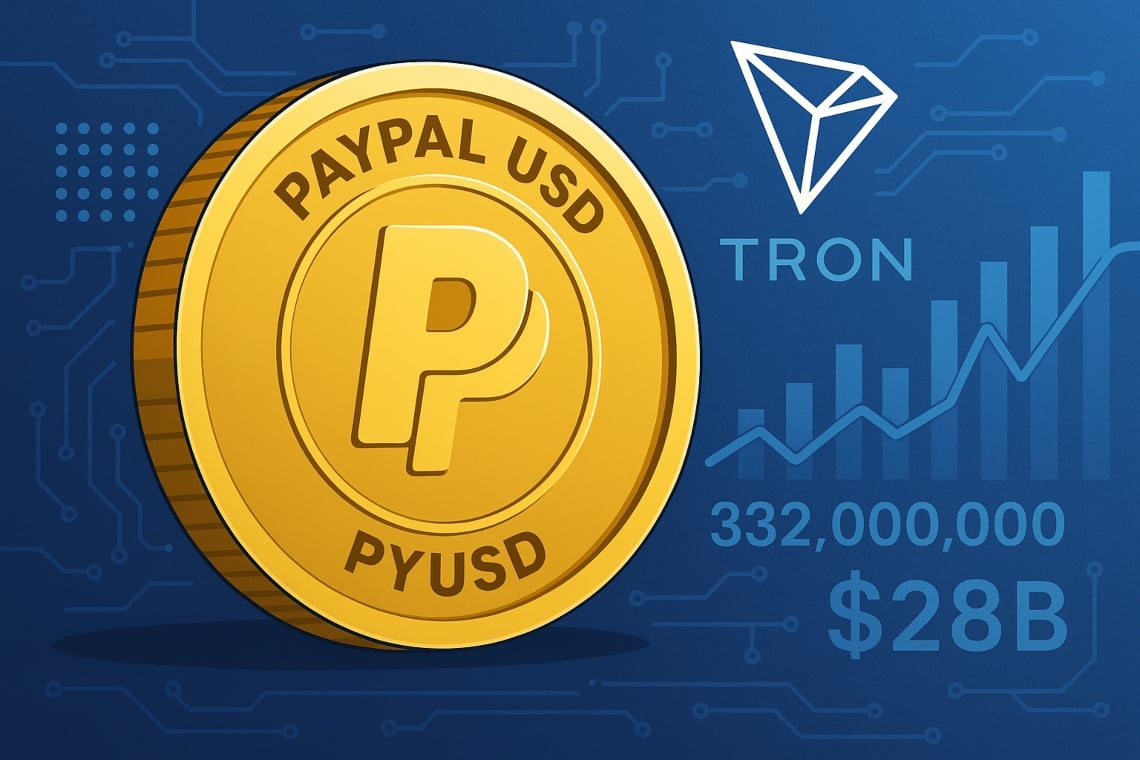
The post 332M accounts and $28B TVL, appeared on BitcoinEthereumNews.com. PayPal USD debuts on TRON as a permissionless token PYUSD0, enabled by LayerZero’s OFT standard and the Stargate Hydra extension. The announcement on September 18, 2025 (Geneva) introduces native interoperability between chains and transfers without manual steps for users; the news echoes elements already communicated by PayPal at the launch of PYUSD PayPal Newsroom. The move concerns an ecosystem that includes 332 million accounts and over $28 billion in TVL. In this context, the fungibility of a stablecoin regulated across multiple networks and the use of TRON as a settlement layer for payments and remittances is at stake. According to the data collected by TRONSCAN updated as of September 18, 2025, the network metrics confirm the cited volumes and highlighted traffic patterns. Our editorial team has verified the transaction logs and monitored the public chain metrics to corroborate the reported figures; the observations on daily flows and TVL are consistent with the network dashboards. Industry analysts observe that the entry of a regulated issuer like PayPal tends to increase institutional interest, provided there is transparency on reserves and compliance checks. What is PYUSD0 on TRON and why is it relevant PYUSD0 is the representation of PayPal USD on TRON. It is pegged one-to-one to PYUSD through the OFT standard: the two tokens remain a single stablecoin, fungible and reconciled across chains. The integration is made possible by Stargate Hydra, now operational through LayerZero. According to the founder of TRON, Justin Sun, the extension on TRON expands access and trust for users and institutions. For Bryan Pellegrino (CEO of LayerZero Labs), stablecoins represent a pillar of global payments and remittances, as the native compatibility between chains enables their operational scalability. It must be said that the alignment between issuer, cross-chain infrastructure, and settlement network is a key element. Key Numbers: TRON…
Share
BitcoinEthereumNews2025/09/19 08:18