

Must Read
SCHOOL OPENING. Students attend the first day of classes at Iloilo Central Elementary School in Iloilo City on July 29, 2024.SCHOOL OPENING. Students attend the first day of classes at Iloilo Central Elementary School in Iloilo City on July 29, 2024.
27% of Grade 5 students in PH have ‘very low’ reading proficiency, 16% in math
MANILA, Philippines – The Philippines continues to have Grade 5 students who exhibit “very low proficiency” in reading and mathematics, according to a learning assessment program conducted in Southeast Asia (SEA).
Based on the 2024 SEA Primary Learning Metrics (SEA-PLM) by the United Nations Children’s Fund (UNICEF) and the Southeast Asian Ministers of Education Organization (SEAMEO), 27% of Grade 5 students in the Philippines have “very low proficiency” in reading, and 16% also have “very low proficiency” in mathematics.
In reading, 27% of Grade 5 students were in Proficiency Band 2 and below, indicating that learners in this band – and possibly below it – “are typically able to match 1 of 4 given words to an illustration of a familiar object, place, or symbol, where the task is simple, direct, and repetitive.”
The remaining percentages in reading literacy are:
- 25% in Proficiency Band 3: students are able to read a range of everyday texts fluently and begin to engage with their meaning
- 21% in Proficiency Band 4: students are able to understand simple texts
- 13% in Proficiency Band 5: students are able to make connections to understand key ideas
- 14% in Proficiency Band 6 and above: students are able to understand texts with familiar structures and manage competing information
Compared to the 2019 record, 27% were also in Proficiency Band 2 and below; 29% in Band 3; 22% in Band 4; 12% in Band 5; and 10% in Band 6 and above.
“In the Philippines, the proportion of students in the higher bands increased while the proportion in the lowest bands remained unchanged, indicating a wider dispersion of scores and suggesting increased inequality in learning opportunities,” showed the report.
In mathematics, 16% of Grade 5 learners in the country were in Proficiency Band 2 and below, which means “some children might be able to add single-digit numbers together; others might only be able to count a small collection of objects or recognize numbers.”
The following are other percentages in mathematics literacy:
- 17% in Proficiency Band 3: students are able to understand place value and scales of measurement
- 21% in Proficiency Band 4: students are able to apply number properties and units of measurement
- 20% in Proficiency Band 5: students are able to fluently solve arithmetic problems
- 14% in Proficiency Band 6: students are able to perform mathematical operations, including with fractions, and interpret tables and graphs
- 8% in Proficiency Band 7: students are able to apply fractions and percentages and analyse data representations
- 3% in Proficiency Band 8: students are able to think multiplicatively and convert between units
- Less than 2% in Proficiency Band 9 and above: students are able to reason about triangles and solve problems using frequency distributions.
Based on the 2019 mathematics literacy, 18% were in Band 2; 23% in Band 3; 24% in Band 4; 18% in Band 5; 11% in Band 6; 5% in Band 7; less than 2% each in Band 8 and Band 9 and above.
“In two countries (Lao PDR and the Philippines) the average performance increased, with almost no change in the proportion of low performers between the 2019 and 2024 cohorts,” the report noted.
The SEA-PLM also checked whether Grade 5 students in the bottom bands struggled with reading only, mathematics only, or in both domains.
Figures showed that 14% have “very low proficiency” in reading only, 2% in math only, and 13% in both reading and mathematics.
The report said among the factors that affect literacy include socioeconomic status, linguistic background, school location, and textbook availability.
Aside from the Philippines, the SEA-PLM report also looked into the reading and mathematics literacy of Cambodia, Laos, Malaysia, Myanmar, and Vietnam.
Across the region, data showed “mixed progress” in which “reading skills have stagnated” while mathematics skills “have improved.” – Rappler.com
Disclaimer: The articles reposted on this site are sourced from public platforms and are provided for informational purposes only. They do not necessarily reflect the views of MEXC. All rights remain with the original authors. If you believe any content infringes on third-party rights, please contact [email protected] for removal. MEXC makes no guarantees regarding the accuracy, completeness, or timeliness of the content and is not responsible for any actions taken based on the information provided. The content does not constitute financial, legal, or other professional advice, nor should it be considered a recommendation or endorsement by MEXC.
You May Also Like

American Bitcoin’s $5B Nasdaq Debut Puts Trump-Backed Miner in Crypto Spotlight
The post American Bitcoin’s $5B Nasdaq Debut Puts Trump-Backed Miner in Crypto Spotlight appeared on BitcoinEthereumNews.com. Key Takeaways: American Bitcoin (ABTC) surged nearly 85% on its Nasdaq debut, briefly reaching a $5B valuation. The Trump family, alongside Hut 8 Mining, controls 98% of the newly merged crypto-mining entity. Eric Trump called Bitcoin “modern-day gold,” predicting it could reach $1 million per coin. American Bitcoin, a fast-rising crypto mining firm with strong political and institutional backing, has officially entered Wall Street. After merging with Gryphon Digital Mining, the company made its Nasdaq debut under the ticker ABTC, instantly drawing global attention to both its stock performance and its bold vision for Bitcoin’s future. Read More: Trump-Backed Crypto Firm Eyes Asia for Bold Bitcoin Expansion Nasdaq Debut: An Explosive First Day ABTC’s first day of trading proved as dramatic as expected. Shares surged almost 85% at the open, touching a peak of $14 before settling at lower levels by the close. That initial spike valued the company around $5 billion, positioning it as one of 2025’s most-watched listings. At the last session, ABTC has been trading at $7.28 per share, which is a small positive 2.97% per day. Although the price has decelerated since opening highs, analysts note that the company has been off to a strong start and early investor activity is a hard-to-find feat in a newly-launched crypto mining business. According to market watchers, the listing comes at a time of new momentum in the digital asset markets. With Bitcoin trading above $110,000 this quarter, American Bitcoin’s entry comes at a time when both institutional investors and retail traders are showing heightened interest in exposure to Bitcoin-linked equities. Ownership Structure: Trump Family and Hut 8 at the Helm Its management and ownership set up has increased the visibility of the company. The Trump family and the Canadian mining giant Hut 8 Mining jointly own 98 percent…

Share
BitcoinEthereumNews2025/09/18 01:33

Oracle’s Larry Ellison Loses $31 Billion, Falls To No. 3 Richest
The post Oracle’s Larry Ellison Loses $31 Billion, Falls To No. 3 Richest appeared on BitcoinEthereumNews.com. Topline Larry Ellison dropped among the ranks of
Share
BitcoinEthereumNews2025/12/12 01:27
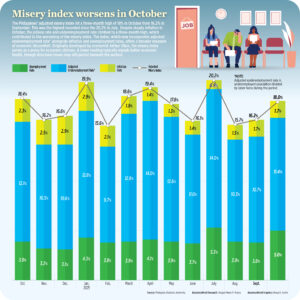
Misery index worsens in October
The Philippines’ adjusted misery index hit a three-month high of 18% in October from 16.2% in September. This was the highest recorded since the 20.2% in July.
Share
Bworldonline2025/12/12 00:00