The post Zcash Price Analysis: ZEC Rally Faces Its First Test After Fee Proposal Surge—Will it Reach $500? appeared first on Coinpedia Fintech News Zcash price has been one of the most followed tokens after it rebounded from its lows close to $300. The rally was followed by Shielded Labs’ dynamic fee proposal, which has shifted the narrative to a critical post-news phase. Currently, the market participants are looking into whether the ZEC price can hold gains or fade …The post Zcash Price Analysis: ZEC Rally Faces Its First Test After Fee Proposal Surge—Will it Reach $500? appeared first on Coinpedia Fintech News Zcash price has been one of the most followed tokens after it rebounded from its lows close to $300. The rally was followed by Shielded Labs’ dynamic fee proposal, which has shifted the narrative to a critical post-news phase. Currently, the market participants are looking into whether the ZEC price can hold gains or fade …

Zcash Price Analysis: ZEC Rally Faces Its First Test After Fee Proposal Surge—Will it Reach $500?
2025/12/10 18:38
Zcash Price Prediction 2025

The post Zcash Price Analysis: ZEC Rally Faces Its First Test After Fee Proposal Surge—Will it Reach $500? appeared first on Coinpedia Fintech News

Zcash price has been one of the most followed tokens after it rebounded from its lows close to $300. The rally was followed by Shielded Labs’ dynamic fee proposal, which has shifted the narrative to a critical post-news phase. Currently, the market participants are looking into whether the ZEC price can hold gains or fade once the reaction cools. 

ZEC surged nearly 12% after the proposal, briefly reclaiming levels lost during November’s correction. But with the announcement now widely digested, price action is increasingly being driven by positioning, liquidity, and technical confirmation rather than fresh catalysts.

Key Levels Traders Watching Now

The market has largely absorbed the initial optimism around the proposed dynamic fee system. This aims to reduce transaction costs and ease congestion. While the proposal is viewed positively, it remains unimplemented, meaning no immediate on-chain changes have occurred.

As a result, traders have begun rotating focus away from the headline itself and toward whether demand can sustain prices above recently reclaimed levels.
zcash price

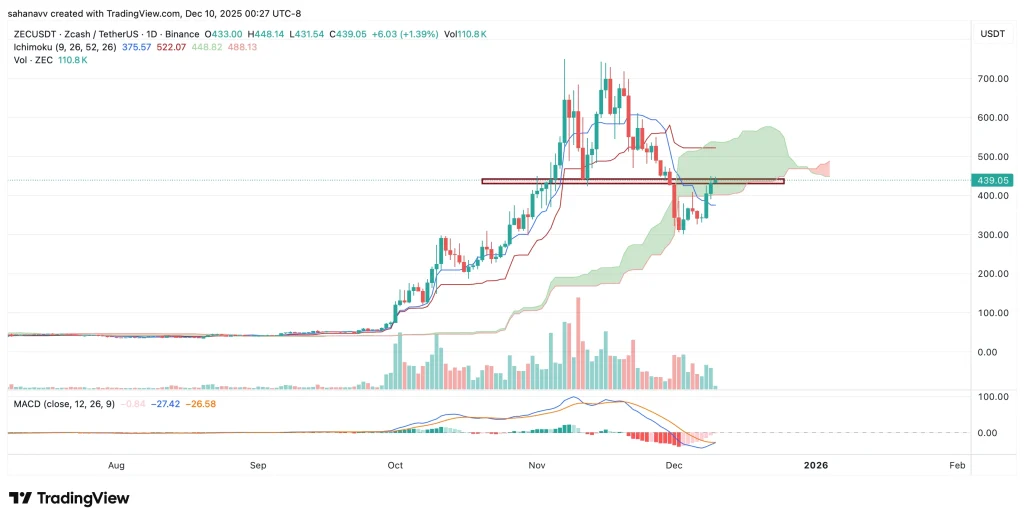
After bouncing from the $330 support zone, the ZEC price has entered a high-risk consolidation range between $435 and $442 — an area associated with prior distribution and short-term liquidation clusters.

  • Above $450: Opens upside toward $480, where prior supply remains heavy
  • Below $430: Increases risk of long liquidation cascades, with downside toward $400–$380
  • Invalidation zone: Sustained loss of $400 would weaken the post-news bullish setup

Until one of these levels breaks decisively, ZEC remains range-bound despite the recent surge. Momentum indicators show stabilization rather than acceleration. Selling pressure has eased, but follow-through remains limited—a common pattern after event-driven moves in low-to-mid liquidity assets like ZEC. Volume has cooled since the post-announcement spike, suggesting traders are waiting for confirmation rather than chasing price. This environment tends to favor mean reversion rather than aggressive trend continuation unless a clear breakout emerges.

Can ZEC Reach $500 Before the End of 2025?

A move to $500 is possible for the Zcash (ZEC) price before the end of 2025, largely dependent on post-news follow-through. The recent rally driven by the dynamic fee proposal has already been priced in, shifting the focus to whether buyers can sustain momentum above key resistance levels. A confirmed breakout above $450, followed by strong volume and broader strength in the privacy coin sector, would be required to open a realistic path toward $500. 

Disclaimer: The articles reposted on this site are sourced from public platforms and are provided for informational purposes only. They do not necessarily reflect the views of MEXC. All rights remain with the original authors. If you believe any content infringes on third-party rights, please contact [email protected] for removal. MEXC makes no guarantees regarding the accuracy, completeness, or timeliness of the content and is not responsible for any actions taken based on the information provided. The content does not constitute financial, legal, or other professional advice, nor should it be considered a recommendation or endorsement by MEXC.

You May Also Like

Headwind Helps Best Wallet Token

Headwind Helps Best Wallet Token

The post Headwind Helps Best Wallet Token appeared on BitcoinEthereumNews.com. Google has announced the launch of a new open-source protocol called Agent Payments Protocol (AP2) in partnership with Coinbase, the Ethereum Foundation, and 60 other organizations. This allows AI agents to make payments on behalf of users using various methods such as real-time bank transfers, credit and debit cards, and, most importantly, stablecoins. Let’s explore in detail what this could mean for the broader cryptocurrency markets, and also highlight a presale crypto (Best Wallet Token) that could explode as a result of this development. Google’s Push for Stablecoins Agent Payments Protocol (AP2) uses digital contracts known as ‘Intent Mandates’ and ‘Verifiable Credentials’ to ensure that AI agents undertake only those payments authorized by the user. Mandates, by the way, are cryptographically signed, tamper-proof digital contracts that act as verifiable proof of a user’s instruction. For example, let’s say you instruct an AI agent to never spend more than $200 in a single transaction. This instruction is written into an Intent Mandate, which serves as a digital contract. Now, whenever the AI agent tries to make a payment, it must present this mandate as proof of authorization, which will then be verified via the AP2 protocol. Alongside this, Google has also launched the A2A x402 extension to accelerate support for the Web3 ecosystem. This production-ready solution enables agent-based crypto payments and will help reshape the growth of cryptocurrency integration within the AP2 protocol. Google’s inclusion of stablecoins in AP2 is a massive vote of confidence in dollar-pegged cryptocurrencies and a huge step toward making them a mainstream payment option. This widens stablecoin usage beyond trading and speculation, positioning them at the center of the consumption economy. The recent enactment of the GENIUS Act in the U.S. gives stablecoins more structure and legal support. Imagine paying for things like data crawls, per-task…
Share
BitcoinEthereumNews2025/09/18 01:27
Bitcoin devs cheer block reconstruction stats, ignore security budget concerns

Bitcoin devs cheer block reconstruction stats, ignore security budget concerns

The post Bitcoin devs cheer block reconstruction stats, ignore security budget concerns appeared on BitcoinEthereumNews.com. This morning, Bitcoin Core developers celebrated improved block reconstruction statistics for node operators while conveniently ignoring the reason for these statistics — the downward trend in fees for Bitcoin’s security budget. Reacting with heart emojis and thumbs up to a green chart showing over 80% “successful compact block reconstructions without any requested transactions,” they conveniently omitted red trend lines of the fees that Bitcoin users pay for mining security which powered those green statistics. Block reconstructions occur when a node requests additional information about transactions within a compact block. Although compact blocks allow nodes to quickly relay valid bundles of transactions across the internet, the more frequently that nodes can reconstruct without extra, cumbersome transaction requests from their peers is a positive trend. Because so many nodes switched over in August to relay transactions bidding 0.1 sat/vB across their mempools, nodes now have to request less transaction data to reconstruct blocks containing sub-1 sat/vB transactions. After nodes switched over in August to accept and relay pending transactions bidding less than 1 sat/vB, disparate mempools became harmonized as most nodes had a better view of which transactions would likely join upcoming blocks. As a result, block reconstruction times improved, as nodes needed less information about these sub-1 sat/vB transactions. In July, several miners admitted that user demand for Bitcoin blockspace had persisted at such a low that they were willing to accept transaction fees of just 0.1 satoshi per virtual byte — 90% lower than their prior 1 sat/vB minimum. With so many blocks partially empty, they succumbed to the temptation to accept at least something — even 1 billionth of one bitcoin (BTC) — rather than $0 to fill up some of the excess blockspace. Read more: Bitcoin’s transaction fees have fallen to a multi-year low Green stats for block reconstruction after transaction fees crash After…
Share
BitcoinEthereumNews2025/09/18 04:07