dYdX introduces its first spot trading product on Solana, waiving fees for December to attract US users. The move capitalizes on evolving regulatory conditions.dYdX introduces its first spot trading product on Solana, waiving fees for December to attract US users. The move capitalizes on evolving regulatory conditions.

dYdX Launches Its First Solana Spot Trading Product in US: Will Solana Price Surge?

2025/12/12 04:47

Dousing the bearish sentiment, dYdX, one of the largest decentralized exchanges, made a major announcement that could further expand Solana SOL $137.2 24h volatility: 0.2% Market cap: $77.08 B Vol. 24h: $6.57 B adoption in the US.

According to a CoinDesk report, dYdX is rolling out its first-ever spot trading product. dYdX Labs said the move represents an expansion of its roadmap as it pushes deeper into the Solana ecosystem and broadens its user base.

The exchange, which has surpassed $1.5 trillion in cumulative trading volume since its debut, is positioning spot trading as a key new entry point to access the US market opening up amid positive swings in regulatory stance.

To entice new users, especially in the US, dYdX is waiving trading fees for the month of December.

dYdX emphasized that the expansion aligns with its plan to enhance market depth, deploy advanced trading tools while maintaining transparency and self-custody standards that define decentralized finance.

dYdX’s move aligns with major centralized exchange Robinhood which also announced new product launches for US residents in the past week.

Solana Price Forecast: Can Bulls Overcome the $147 Liquidity Wall?

Solana derivatives positioning remains predominantly bearish on Thursday, with traders trimming their bullish exposure market-wide. Coinglass’ liquidation map data, which tracks the sum of active futures contracts at each price level, highlights persistent bearish dominance.
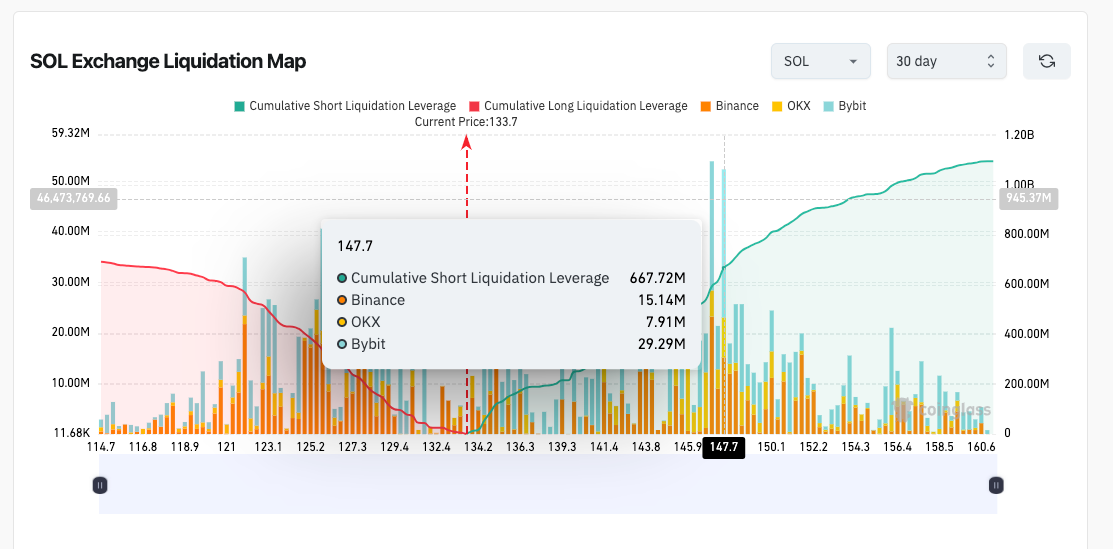
Solana Liquidation Map shows $667 million overhead leverage cluster at $147 | Coinglass, Dec. 11.

Solana Liquidation Map shows $667 million overhead leverage cluster at $147 | Coinglass, Dec. 11.

SOL long positions have dropped to $692 million at press time, while short positions remain elevated above the $1 billion mark.

A closer look shows that the $147 level is the most significant liquidity pocket Solana traders must watch as the market awaits recovery from the post-Fed-cut sell-off. Traders currently have $667 million positioned at this zone, accounting for nearly 70% of total active leverage. A move above that level could trigger a short-squeeze-driven rally toward $200, as resistance pockets above the threshold appear weaker.

However, with long positions nearly 30% lower than active shorts at press time, Solana’s rebound prospects remain limited.

On the downside, traders are watching $125 as the next support if the market extends its correction this week. Bulls currently hold $337 million in leverage, representing more than 50% of active long positioning at that level. If that support fails, Solana could slide toward the $100 psychological zone, where buyers may attempt to reestablish a stronger defense.

next

The post dYdX Launches Its First Solana Spot Trading Product in US: Will Solana Price Surge? appeared first on Coinspeaker.

Disclaimer: The articles reposted on this site are sourced from public platforms and are provided for informational purposes only. They do not necessarily reflect the views of MEXC. All rights remain with the original authors. If you believe any content infringes on third-party rights, please contact [email protected] for removal. MEXC makes no guarantees regarding the accuracy, completeness, or timeliness of the content and is not responsible for any actions taken based on the information provided. The content does not constitute financial, legal, or other professional advice, nor should it be considered a recommendation or endorsement by MEXC.

You May Also Like

Luxembourg adds Bitcoin to its wealth fund, but what does that mean for Europe?

Luxembourg adds Bitcoin to its wealth fund, but what does that mean for Europe?

The post Luxembourg adds Bitcoin to its wealth fund, but what does that mean for Europe? appeared on BitcoinEthereumNews.com. Key Takeaways Why does Luxembourg’s move matter? It’s the first Eurozone nation to include Bitcoin in a sovereign wealth fund. How does it fit into Europe’s bigger picture? The UK is opening crypto ETNs to retail investors, and the EU’s ESMA is expanding its oversight. Luxembourg has become the first Eurozone country to invest part of its sovereign wealth fund in Bitcoin. During the presentation of the 2026 Budget at the Chambre des Deputes, Finance Minister Gilles Roth confirmed that the Fonds Souverain Intergenerationnel du Luxembourg (FSIL) — the nation’s sovereign wealth fund — has allocated 1% of its portfolio to Bitcoin. Luxembourg’s Bitcoin play According to Bob Kieffer, Director of the Treasury, the decision reflects “the growing maturity of this new asset class” and “leadership in digital finance.” Under the FSIL’s revised investment policy, up to 15% of total assets can now be placed in alternative investments. This includes investments in private equity, real estate, and crypto assets. The Bitcoin exposure, roughly €8.5 million [around $9 million USD], is being made through ETFs to avoid custody and operational risks. Kieffer also acknowledged differing opinions about the move. He said,  “Some might argue that we’re committing too little too late; others will point out the volatility and speculative nature of the investment. Yet, given the FSIL’s mission, a 1% allocation strikes the right balance while sending a clear message about Bitcoin’s long-term potential.” A cautious, but symbolic shift The FSIL, created in 2014 to preserve wealth across generations, now manages roughly €850 million. The announcement also comes on the back of Luxembourg tightening its digital asset regulatory framework, while preparing to implement DAC8. This new move will expand tax and reporting standards for crypto service providers in 2026. If Bitcoin continues to gain acceptance among sovereign investors, Luxembourg’s decision could…
Share
BitcoinEthereumNews2025/10/10 02:02
XRP Fractal Signals $6–$7 Surge by November Amid DLT Disruption

XRP Fractal Signals $6–$7 Surge by November Amid DLT Disruption

The post XRP Fractal Signals $6–$7 Surge by November Amid DLT Disruption appeared on BitcoinEthereumNews.com. XRP Fractal Analysis Hints at $6–$7 Breakout by Mid-November According to renowned market analyst EGRAG CRYPTO, XRP may be on the verge of a significant price movement. In his latest analysis, he points to a fractal formation pattern that suggests XRP could reach the $6–$7 range by mid-November.  Source: EGRAG CRYPTO This projection has quickly caught the attention of traders and long-term investors, as XRP’s current price remains well below this target. Fractals, often used in technical analysis, are recurring chart patterns that can help predict future price action by identifying historical similarities in market behavior.  Therefore, EGRAG CRYPTO argues that XRP is currently mirroring a previous structure that led to a notable rally. If this fractal setup plays out as expected, it could mark one of the most significant price surges for the digital asset in recent years. If XRP reaches $6–$7 by mid-November, it would mark a major win for investors and a symbolic breakthrough for a token that has endured regulatory battles and market volatility, validating its resilience and cementing its relevance in the evolving digital finance ecosystem. Meanwhile, a recent cup-and-handle pattern signalled that XRP had the potential of soaring to $15 by year-end with the altcoin presently trading at $3.04 per CoinGecko data.  DLT-Based Solutions: How Ripple and Stellar are Redefining Cross-Border Banking According to crypto observer SMQKE, distributed ledger technology (DLT)-based solutions are increasingly challenging the traditional correspondent banking model.  For decades, cross-border payments have relied on a chain of intermediaries, often resulting in slow settlements, high costs, and limited transparency. But with the rise of blockchain networks such as Ripple and Stellar, the industry is experiencing a seismic shift. The correspondent banking model depends on trust and pre-funded accounts, locking up liquidity and exposing banks to counterparty risk.  Transactions often take days to…
Share
BitcoinEthereumNews2025/09/19 16:12