Grayscale has made its Bittensor trust publicly tradable, expanding regulated access to TAO for U.S. investors. The listing comes just before Bittensor’s first Grayscale has made its Bittensor trust publicly tradable, expanding regulated access to TAO for U.S. investors. The listing comes just before Bittensor’s first

Bittensor TAO Halving Nears as Grayscale Launches $GTAO for Investors

2025/12/12 18:57
  • Grayscale has made its Bittensor trust publicly tradable, expanding regulated access to TAO for U.S. investors.
  • The listing comes just before Bittensor’s first halving, which will reduce token emissions and tighten supply.

Grayscale has now expanded its portfolio of digital assets by making its Bittensor-focused investment product public and offering U.S. investors regulated access to the TAO market, just days before the network’s first halving event. 

The Grayscale Bittensor Trust is now trading on OTCQX under the ticker of GTAO, according to a company announcement. OTCQX is a regulated secondary market provided by OTC Markets Group Inc. that hosts securities that meet financial and disclosure standards. Grayscale described GTAO as the first publicly quoted U.S. investment product designed to provide exposure to TAO. Previously, the trust was only available through private placement since its launch in August 2024. 

Grayscale Opens Public Access To TAO 

Grayscale, a subsidiary of Digital Currency Group, remains one of the largest digital asset managers in the market. Its product range includes everything from single-asset trusts to diversified crypto index products and exchange-traded funds tracking assets like Bitcoin and Ethereum.

In recent years, the firm has gradually moved beyond the flagship cryptocurrencies. It has turned select altcoin trusts into exchange-traded products and recently launched a Chainlink-focused fund. Alongside these, Grayscale also continues to operate private investment vehicles with exposure to assets such as Avalanche and Zcash, as well as publicly traded trusts linked to tokens including Basic Attention Token, NEAR, and SUI.

Bittensor Prepares Supply Cut As Halving Approaches

The public debut of GTAO comes just before an important milestone for the Bittensor network. Bittensor will undergo its first halving on December 14, which will reduce the rate at which new TAO tokens are distributed to network participants.

TAO is the native asset of Bittensor, a decentralized, AI-focused network that is based around application-specific subnets. Participants earn TAO when they contribute computing resources to support and enhance these AI-driven chains. The protocol has a maximum supply of 21 million tokens, which are emitted at a decreasing rate every 4 years, similar to Bitcoin. The next halving is projected to actually tighten new supply while predictably maintaining the overall issuance structure for long-term participants.

With the public quoting, the Grayscale Bittensor Trust will now be filing regular reports and financial statements with the U.S. Securities and Exchange Commission. These disclosures contribute to increased transparency and bring the product into line with regulatory requirements of publicly traded investment vehicles. 

TAO Price Action Improves 

The upcoming halving is expected to cause more scarcity as it slows the supply of new TAO into circulation. There have already been signs of anticipation in market pricing. TAO was trading above $300 on Thursday, continuing a short-term upward trend that had sent the token up more than 5% in the previous 24 hours. Prices fluctuated from lows around $281 to highs around $306, and market capitalization surged to around $3.15 billion. 

Technical indicators show improving conditions. TAO has made a base between $270 and $290 before recovering $300. Momentum gauges such as the relative strength index and MACD histogram indicate the easing of bearish pressure. 
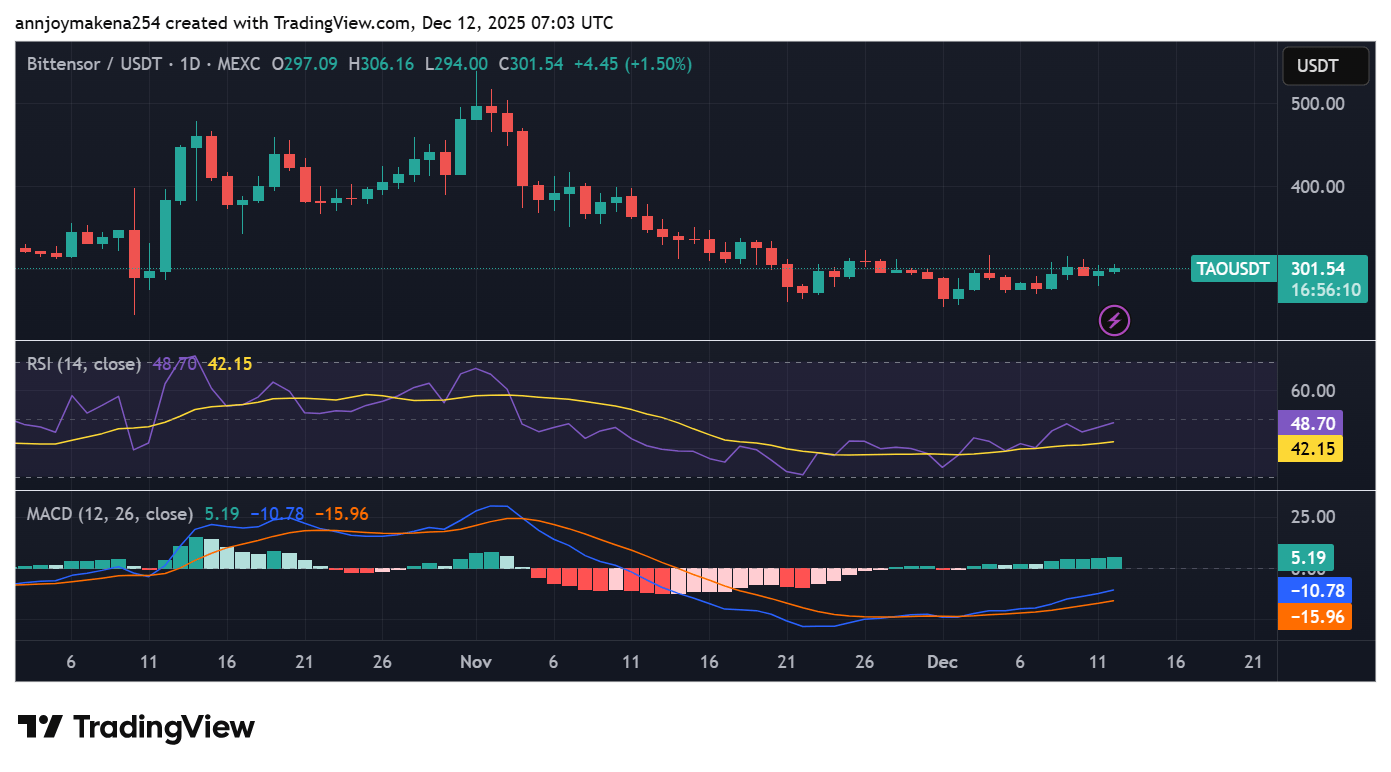
Source: Trading View

Crypto analyst Daniel Ramsey, in a post on X, noted that the structure of TAO is in a weekly channel and has potential for an upward retracement. Additionally, Whales_Crypto_Trading pointed to a breakout on the four-hour timeframe, indicating scope for further gains, provided strength continues.
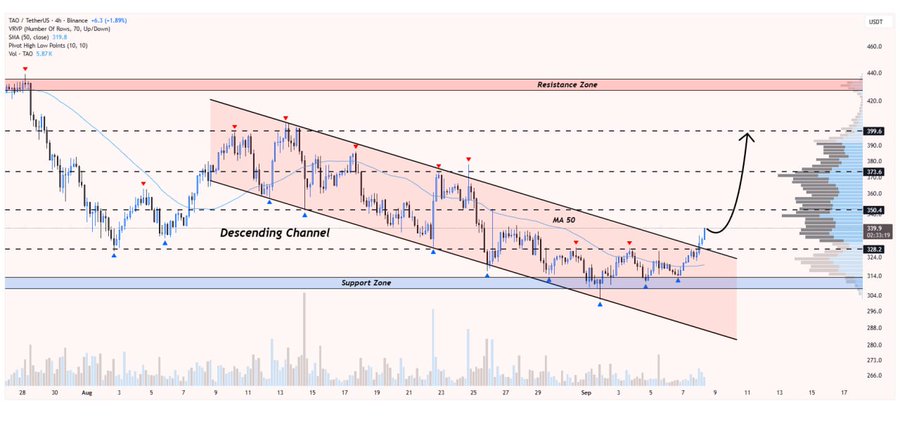
ImageSource : Whales_Crypto_Trading on X ]]>
Market Opportunity
Bittensor Logo
Bittensor Price(TAO)
$266.71
$266.71$266.71
-2.04%
USD
Bittensor (TAO) Live Price Chart
Disclaimer: The articles reposted on this site are sourced from public platforms and are provided for informational purposes only. They do not necessarily reflect the views of MEXC. All rights remain with the original authors. If you believe any content infringes on third-party rights, please contact [email protected] for removal. MEXC makes no guarantees regarding the accuracy, completeness, or timeliness of the content and is not responsible for any actions taken based on the information provided. The content does not constitute financial, legal, or other professional advice, nor should it be considered a recommendation or endorsement by MEXC.

You May Also Like

Son of filmmaker Rob Reiner charged with homicide for death of his parents

Son of filmmaker Rob Reiner charged with homicide for death of his parents

FILE PHOTO: Rob Reiner, director of "The Princess Bride," arrives for a special 25th anniversary viewing of the film during the New York Film Festival in New York
Share
Rappler2025/12/16 09:59
Addressing the sustainability question: The Web3 energy narrative

Addressing the sustainability question: The Web3 energy narrative

The post Addressing the sustainability question: The Web3 energy narrative appeared on BitcoinEthereumNews.com. contributor Posted: September 22, 2025 The environmental impact of blockchain technology remains a significant public concern in September 2025. For Web3 to achieve widespread legitimacy, it must present a credible narrative and technological path towards sustainability. The models pioneered by Oraichain, Pinlink, and RSS3 showcase how decentralized networks can be designed for efficiency and can contribute to a more sustainable digital economy. Oraichain, as a sovereign Layer 1, is built on a Delegated Proof-of-Stake (DPoS) consensus mechanism. This is inherently more energy-efficient than the Proof-of-Work systems that drew early criticism. By design, its security model relies on economic staking rather than raw computational power, allowing the network to process complex AI computations with a minimal energy footprint compared to its predecessors, aligning its operations with a greener Web3. Pinlink’s DePIN model promotes a more efficient use of existing hardware resources. The relentless construction of massive, power-hungry data centers by tech giants is a major source of energy consumption. Pinlink’s approach is to unlock the value in dormant or underutilized GPUs already in circulation around the world. This “recycling” of computing capacity reduces the need for new hardware manufacturing and makes the overall digital infrastructure ecosystem more resource-efficient. RSS3 contributes to sustainability through its distributed and lightweight design. Unlike a centralized data indexer that requires massive, concentrated server farms, the RSS3 network is run by a global collection of independent nodes. These nodes can be operated on low-power, consumer-grade hardware, distributing the energy load and avoiding the inefficiencies of large-scale, centralized data centers. This architectural choice makes its information layer inherently more sustainable and resilient. Disclaimer: This is a paid post and should not be treated as news/advice. Next: As Bitcoin’s sell pressure grows, are investors seeking safety in altcoins? Source: https://ambcrypto.com/addressing-the-sustainability-question-the-web3-energy-narrative/
Share
BitcoinEthereumNews2025/09/23 09:02
Alcohol Still Leads Restaurant Beverage Orders, According To Harris Poll

Alcohol Still Leads Restaurant Beverage Orders, According To Harris Poll

The post Alcohol Still Leads Restaurant Beverage Orders, According To Harris Poll appeared on BitcoinEthereumNews.com. A new Harris Poll reveals millennials and Gen X still drive alcohol sales in restaurants, while Gen Z mixes drinks, formats, and expectations. Alcohol may still be the default for many American diners, but the latest Harris Poll suggests drinking habits are shifting. While older generations continue to reach for beer, wine, and cocktails, Gen Z is redefining what it means to drink out, focusing more on flexibility, aesthetics, and mood than tradition. Millennials are still loyal alcohol buyers when dining out, but Gen Z’s beverage habits are harder to pin down, according to new Harris Poll data. getty What the new Harris Poll reveals about U.S. beverage behavior In a nationally representative survey conducted by Harris in partnership with eMarketer, 36 percent of Americans reported that alcohol is their preferred restaurant beverage, slightly ahead of soda at 29 percent and water at 21 percent. But in practice, the most commonly ordered items are still non-alcoholic: 89 percent said they ordered water in the past 30 days, and 78 percent ordered soda. Alcohol remains a strong presence, with 69 percent of diners saying they ordered at least one alcoholic drink recently. Cocktails topped the alcohol category, followed by beer, spirits, and wine. While the overall preference is clear, the details begin to diverge once you look at generational breakdowns. Millennials still drive alcohol sales, especially with repeat orders Millennials continue to be the most reliable customers for restaurants selling alcohol. Fifty percent say alcohol is their default drink when dining out, compared to just 25 percent of Gen Z. They also reported significantly more repeat orders over the past month—especially for beer, spirits, and wine. This makes millennials a priority for alcohol brands and on-premise sales strategies. Libby Rodney, the Chief Strategy Officer at The Harris Poll, explained it this…
Share
BitcoinEthereumNews2025/09/24 02:21