Although the White House crypto summit and Bitcoin reserve news did not meet market expectations, current macro uncertainty is still the main reason for the recent market crash.Although the White House crypto summit and Bitcoin reserve news did not meet market expectations, current macro uncertainty is still the main reason for the recent market crash.

Viewpoint: It is not advisable to "buy at the bottom" at the moment, wait for these three situations to occur

2025/03/14 12:23
4 min read

Author: The DeFi Investor

Compiled by: Felix, PANews

Almost every coin has been experiencing a multi-week decline.

If you have lost a lot of money recently, I would personally recommend taking a break from trading, making a new plan, and doing whatever you can to avoid revenge trading.

The goal now is to survive and preserve remaining capital.

As long as you don't lose everything and continue to stay at the "gambling table", there will be another chance.

Why does the market continue to fall?

In my opinion, there are two main reasons:

1. There is a lot of macro uncertainty: The stock market has also been crashing, and cryptocurrencies have always been closely correlated with the stock market.

As crazy as it may sound, these uncertainties are likely created intentionally by the US government.

Why?

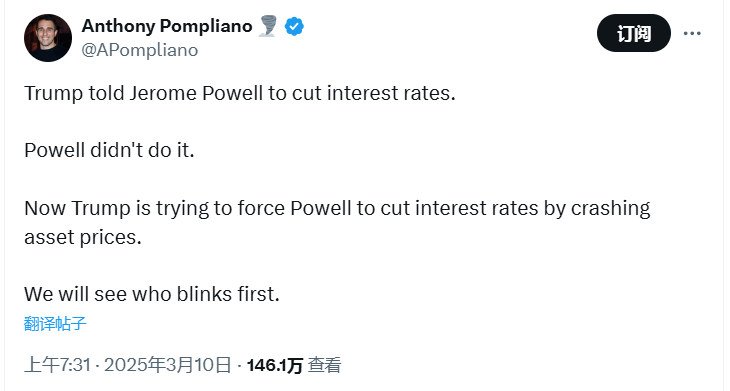
Because Trump wants to force the Fed Chairman to cut interest rates.
Viewpoint: It is not advisable to "buy at the bottom" at the moment, wait for these three situations to occur

The Trump administration's constant threats to impose tariffs and then reversals at the last minute created a lot of panic in the market.

The Trump administration is destroying the market in this way and putting pressure on Federal Reserve Chairman Jerome Powell to cut interest rates because Powell is more likely to cut interest rates when market conditions are bad.

Unfortunately, unless the Trump administration stops fearmongering or Powell agrees to cut rates, financial markets will continue to suffer.

Cryptocurrencies, which are considered a high-risk asset class, were particularly affected by the news.

2. The White House’s first cryptocurrency summit and the national Bitcoin reserve did not achieve the expected hype effect.

(Don’t get me wrong, the US establishing a national Bitcoin reserve will still have a huge impact in the long run)

This good news has long been digested by the market. It was a long time ago that Trump first stated that the Bitcoin currently held by the United States will be stored in the national reserve.

However, many expect Trump to also announce a specific strategy for the U.S. government to increase its holdings of Bitcoin over time.

But such strategic moves were not announced, and the Trump administration only announced that it would not sell the confiscated Bitcoins. This is why the launch of the US Bitcoin Reserve ultimately became a selling event.

Nevertheless, current macro uncertainty remains the main reason for the recent market plunge.

When to buy the dip?

Before buying aggressively on dips, expect to see the following happen (not investment advice):

  1. The Fed cuts rates - historically, rate cuts are good news for financial markets, and the Trump administration may stop creating so much market uncertainty once the dust settles
  2. A new upcoming major crypto catalyst emerges - the biggest rally seen in this cycle was driven by two major events in the past: the launch of a spot Bitcoin ETF and Trump’s victory
  3. BTC and altcoins show strength even amid bearish news — a sign that sellers are running out of tokens

Before that, individuals would rather use idle funds for yield mining and airdrops. The market has been "bleeding" for several weeks, and it is wise to wait for signs of recovery in the market before buying.

I am very confident that the crypto market will make a comeback.

If the collapse of FTX, Three Arrows Capital, and Terra Luna wasn’t enough to destroy crypto, what else could?

Sometimes it makes sense to take high risks, but sometimes the best thing to do is to sit back and protect your hard-earned money.

Related reading: Trump 2.0: What new changes are coming to cryptocurrency regulation? A review of key policy adjustments in the eight weeks since he took office

Disclaimer: The articles reposted on this site are sourced from public platforms and are provided for informational purposes only. They do not necessarily reflect the views of MEXC. All rights remain with the original authors. If you believe any content infringes on third-party rights, please contact [email protected] for removal. MEXC makes no guarantees regarding the accuracy, completeness, or timeliness of the content and is not responsible for any actions taken based on the information provided. The content does not constitute financial, legal, or other professional advice, nor should it be considered a recommendation or endorsement by MEXC.

You May Also Like

Cashing In On University Patents Means Giving Up On Our Innovation Future

Cashing In On University Patents Means Giving Up On Our Innovation Future

The post Cashing In On University Patents Means Giving Up On Our Innovation Future appeared on BitcoinEthereumNews.com. “It’s a raid on American innovation that would deliver pennies to the Treasury while kneecapping the very engine of our economic and medical progress,” writes Pipes. Getty Images Washington is addicted to taxing success. Now, Commerce Secretary Howard Lutnick is floating a plan to skim half the patent earnings from inventions developed at universities with federal funding. It’s being sold as a way to shore up programs like Social Security. In reality, it’s a raid on American innovation that would deliver pennies to the Treasury while kneecapping the very engine of our economic and medical progress. Yes, taxpayer dollars support early-stage research. But the real payoff comes later—in the jobs created, cures discovered, and industries launched when universities and private industry turn those discoveries into real products. By comparison, the sums at stake in patent licensing are trivial. Universities collectively earn only about $3.6 billion annually in patent income—less than the federal government spends on Social Security in a single day. Even confiscating half would barely register against a $6 trillion federal budget. And yet the damage from such a policy would be anything but trivial. The true return on taxpayer investment isn’t in licensing checks sent to Washington, but in the downstream economic activity that federally supported research unleashes. Thanks to the bipartisan Bayh-Dole Act of 1980, universities and private industry have powerful incentives to translate early-stage discoveries into real-world products. Before Bayh-Dole, the government hoarded patents from federally funded research, and fewer than 5% were ever licensed. Once universities could own and license their own inventions, innovation exploded. The result has been one of the best returns on investment in government history. Since 1996, university research has added nearly $2 trillion to U.S. industrial output, supported 6.5 million jobs, and launched more than 19,000 startups. Those companies pay…
Share
BitcoinEthereumNews2025/09/18 03:26
Trump foe devises plan to starve him of what he 'craves' most

Trump foe devises plan to starve him of what he 'craves' most

A longtime adversary of President Donald Trump has a plan for a key group to take away what Trump craves the most — attention. EX-CNN journalist Jim Acosta, who
Share
Rawstory2026/02/04 01:19
Why Bitcoin Is Struggling: 8 Factors Impacting Crypto Markets

Why Bitcoin Is Struggling: 8 Factors Impacting Crypto Markets

Failed blockchain adoption narratives and weak fee capture have undercut confidence in major crypto projects.
Share
CryptoPotato2026/02/04 01:05