

Behind the U.S. stock chain: the narrative is lively, but the market is quiet. Can new wine in old bottles become the engine of the second curve of the bull market?
Author: Frank, PANews
The listing of U.S. stocks on the blockchain has become a hot topic in the recently quiet market.
On March 8, Swiss tokenization issuer Backed launched Coinbase stock token wbCOIN on the Base chain. Users can trade with USDC through CoWSwap, and claim that it is 1:1 anchored to the value of $COIN stock and has legal claims. Although Backed emphasized that it has no official connection with Coinbase, this move has sparked heated discussions in the community: Will the tokenization of US stocks usher in a new growth cycle? In the context of the continued sluggish market, can the "old wine in a new bottle" of stock tokenization become a new narrative to build a bottom?
Narratives come first, value comes later: the hot and cold contrast of US stock tokenization
With the pro-crypto Trump administration taking office, the litigation relationship between the US SEC and Coinbase also ended. In early 2025, Jesse Pollak, head of the Base protocol, said at X that Coinbase was considering introducing tokenized $COIN stocks to the Base network for US users. But it will take some time for Coinbase to launch this business in compliance.
Backed's quick action has taken it a step ahead. According to official data, Backed was founded in 2021 and initially received investment support from institutions such as Gnosis and Semantic. Backed's headquarters and operations are mainly aimed at the global market. Its products are issued under the EU regulatory framework, comply with MiFID II compliance requirements, and have passed the EU prospectus.
However, wbCOIN is not Backed's first stock tokenization product. As early as July 2024, Backed launched NVIDIA's tokenized stock trading in cooperation with INX. In addition, Backed has also launched tokenized products for a variety of stock assets such as S&P 500 and Tesla. However, when these products were launched, the market's focus was not on the topic of securities tokenization, and today's market urgently needs some reasonable narratives to rebuild confidence.
However, it is not just because Backed's products are not available in the US market or because of the market downturn. After wbCOIN went online, the trading popularity was obviously not as high as the topic popularity. As of March 11, wbCOIN's TVL was about 4.42 million US dollars.
Aerodrome data shows that its trading volume is only $3,352, which is not even as popular as the newly issued MEME coin.
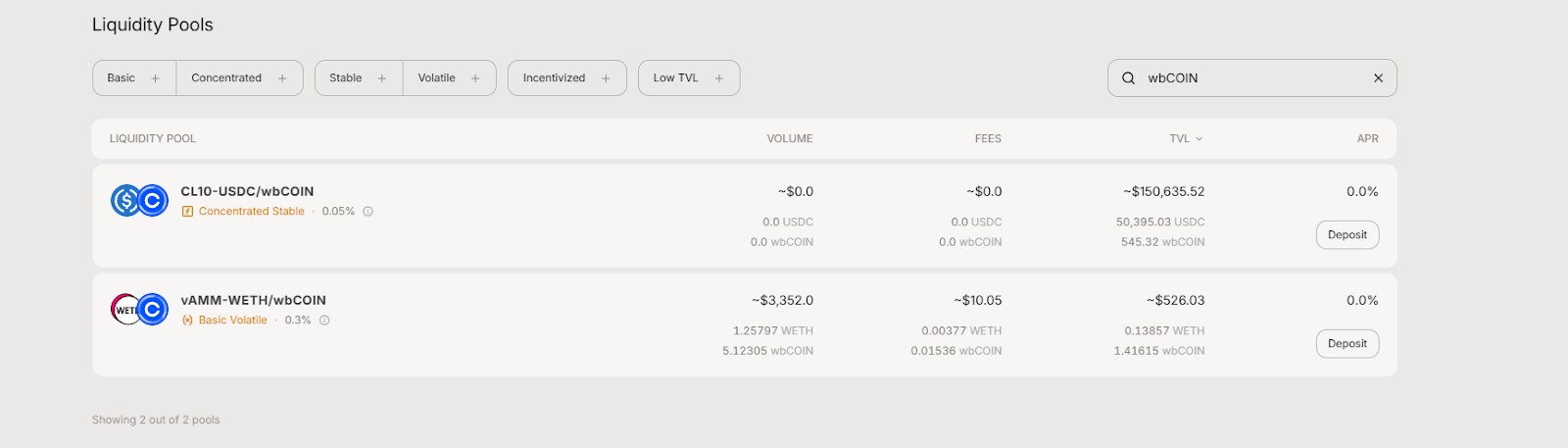
This sluggish performance is not only due to the short time wbCOIN has been online - another product that was launched earlier, BNVDA, has a trading volume of only US$113 and is also not popular.
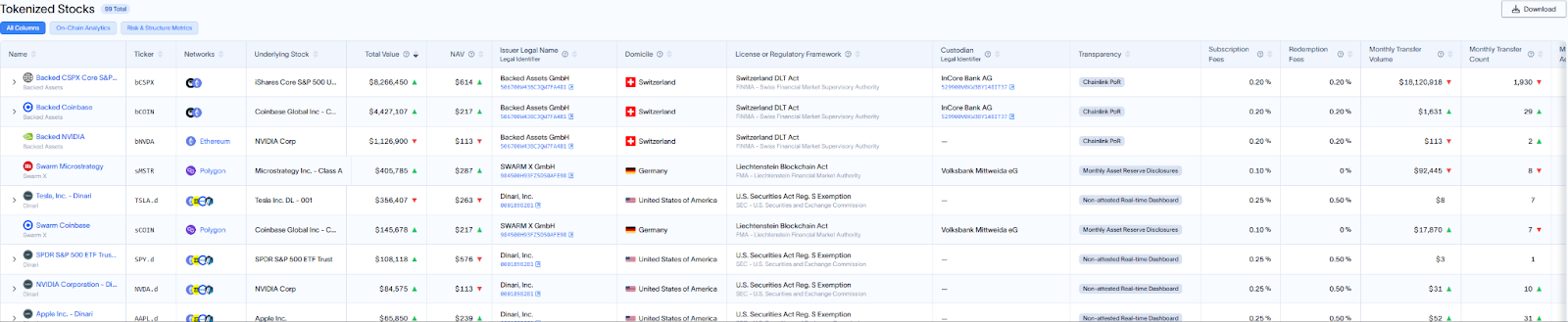
Despite the hot concept, the current US stock tokenization market is still in its early stages, with limited scale and activity. Perhaps, tokenization products from Coinbase may trigger greater trading enthusiasm.
Tokenized US stocks: old wine in new bottles, compliance is the first hurdle
In fact, putting U.S. stocks on the blockchain is not a new idea. Before the recent wave of attempts, the crypto industry and traditional financial institutions had already explored it, but most of them ended in failure.
The once-popular FTX exchange also provided tokenized trading services for US stocks including Tesla and GameStop between 2020 and 2022. However, the collapse of FTX in 2022 brought this business to an abrupt end. Afterwards, rumors questioned whether FTX's stock tokens held the corresponding stocks in full, further undermining the market's trust in the exchange's issuance of tokenized stocks.
In 2021, Binance also tried to launch tokenized stock products corresponding to US stocks such as Tesla, Coinbase, and Apple, where users can purchase fragmented shares of these stock tokens. However, with the tightening of supervision in various countries, within a few weeks of Binance launching stock tokens, financial regulators in the UK and Germany warned that these products may violate securities regulations. In less than three months, Binance announced the removal of all stock tokens.
In addition, Bittrex Global, an exchange that once featured tokenized stock trading, also chose to close its trading platform and go through bankruptcy liquidation after experiencing regulatory pressure and SEC litigation.
It can be seen that in the last round of attempts, compliance barriers were the main reason for the failure of exchanges to issue U.S. stock tokens. Now the market is revisiting the issue of U.S. stock tokens, and there are several factors:
1. With the Trump administration's emphasis on and support for encryption, the tension between cryptocurrency and regulation has also eased.
2. The market has entered a period of weakness and needs the return of some narratives that are supported by real value.
3. Technology and compliance solutions are more mature. Compared with the previous wild growth, today's crypto market pays more attention to compliance design and technical assurance. Take Backed as an example. Each of its tokens obtained a prospectus approved by the European Union before issuance, clarifying the rights and interests of token holders in the underlying stocks. In terms of technology, the performance of oracles and public chains has been improved by an order of magnitude.
One-thousandth of a share and trillion-dollar expectations: the reality dilemma of tokenized stocks
Despite the impressive growth rate, the actual market size of tokenized stocks is still far from what institutions predict. In essence, whether it is the tokenization of U.S. stocks or other securities products, they can all be classified as RWA assets. It’s just that cryptocurrencies and U.S. stocks are both highly volatile and highly liquid financial assets, and the trading scale and capital volume of U.S. stocks, as well as the high-quality fundamentals of U.S. stock assets, are what the crypto world desires.
The industry is extremely optimistic about the future of stock tokenization. Some authoritative institutions predict that the tokenized asset market will reach trillions of dollars around 2030: for example, Boston Consulting Group (BCG) estimates that global tokenized assets will reach 16 trillion US dollars in 2030. The Security Token Market report even predicts that 30 trillion US dollars of assets will be tokenized in 2030, with stocks, real estate, bonds and gold as the main driving forces.
As of March 11, the total global RWA on-chain assets were approximately $17.8 billion, of which the total value of stock assets was approximately $15.43 million, accounting for less than one thousandth of the total, and the transaction volume for the entire month was only $18 million. Obviously, in the RWA track, stock tokenization is still an immature market.
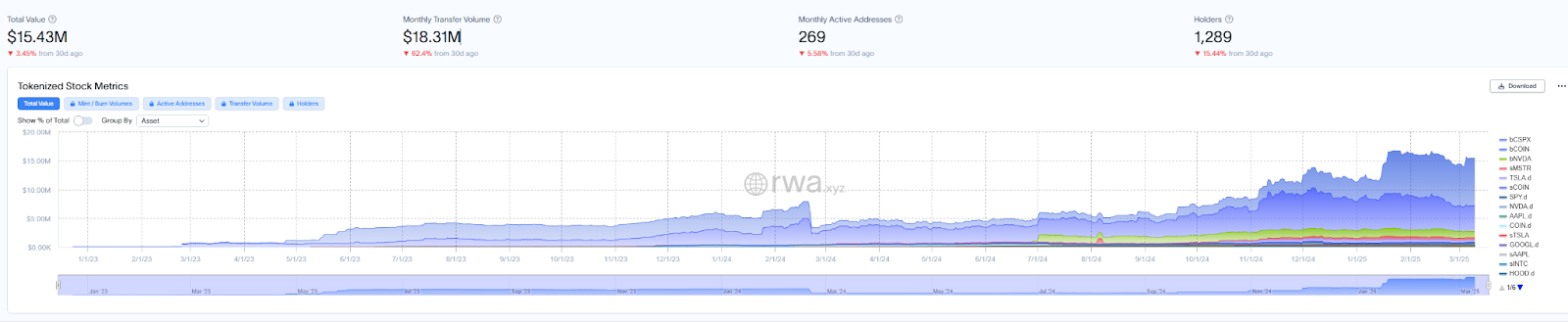
However, in terms of growth rate and risk resistance, tokenized stocks still have certain competitiveness. In July 2024, the total on-chain value of tokenized stocks was only about 50 million US dollars, which increased by about 3 times in half a year. This growth rate is significantly higher than the growth rate of other copycat assets in the same period.
Recently, the crypto market has experienced a sharp correction, with Bitcoin falling below 80,000. The market value of the entire crypto market has been adjusted back to the level of the first half of 2024, with a decline of 30% in the past three months. However, the performance of tokenized stocks in the same period is obviously much better, and it still maintains a historical high level. It can be seen that the overall volatility of the US stock market is far less affected by a single asset than the crypto market. The volatility patterns of different categories of assets are not synchronized, which makes the overall market look more stable. This also provides a new value anchor for tokenized stocks.
For current investors, the tokenization of US stocks is neither a bear market savior nor a flash-in-the-pan concept. It is more like a seed that needs to wait patiently for its seed to break through the soil. With the support of compliance, technology and market sentiment, whether this seed can grow into a towering tree, the answer may lie in the next policy release of the SEC, the next compliance action of Coinbase, or the flow of funds from retail investors and institutions in the next bull market. The only thing that is certain is that this experiment is far from over.
You May Also Like

Best Crypto to Buy as Saylor & Crypto Execs Meet in US Treasury Council

BlackRock boosts AI and US equity exposure in $185 billion models
