Quantum disruption may not arrive with warning. AI acceleration, stealth progress, and HNDL risks compress cryptographic timelines.Quantum disruption may not arrive with warning. AI acceleration, stealth progress, and HNDL risks compress cryptographic timelines.

Quantum Risk: Closer Than You Think?

\ “Quantum Day is coming - are you ready?” The question gets asked often. The answers usually assume long timelines and orderly transitions. Emerging signals, including AI-accelerated research, suggest that such assumptions may be fragile. We could be closer than expected. This article shares several factors that support that perspective.

January 1, 2027

The NSA has a line in the sand. As of 2027, the vast majority of newly acquired NSA systems must be compliant with post-quantum cryptography (PQC). The requirement was published in April 2025 in the CSfC Post Quantum Cryptography Guidance Addendum 1.0. \n \n NSA timelines usually lead institutional adoption by a few years. In the case of quantum computing, that precedent isn’t particularly comforting. Today’s technological and geopolitical conditions introduce risks, some of which lack historical analogues, and timelines could shift with little or no warning.

AI + Quantum = Acceleration

Advances in AI are feeding back into quantum research at an increasing pace. Improvements in neural network design, reinforcement learning, and optimization techniques are being applied to practical problems like qubit control, calibration, error correction, and hardware layout. The result is a development curve that can compound, allowing progress to stack faster than the familiar step-wise path from theory to working systems. The feedback loop is already visible in literature.

Sources: National Science Review (2025), Nature Communications (2025), and Physical Review X (2022).

This small sample is also enough to suggest that quantum progress can transpire unevenly, and in capability-specific bursts.

What You Don’t See is What Should Concern You

University labs and many corporate research programs frequently demonstrate their love for announcing milestones. That said, nation-states and the private sector are really under no obligation to do so, and in some cases they don’t. Governments have been known to quietly absorb private efforts and classify progress, and strategic players may deliberately choose stealth over publicity. There are often real advantages - such as the option to deploy quietly while competitors, adversaries, or potential targets, operate under false assumptions and fail to react in time.

History gives precedent: from Bletchley Park’s WWII cryptanalysis, through Cold War efforts like Operation Ivy Bells, to modern cyber operations like Stuxnet, powerful capabilities have frequently been deployed quietly long before public disclosure.

Quite a few organizations are currently racing to build large-scale facilities for AI training and inference. These environments of dense compute, specialized cooling, and restricted access overlap in important ways with the infrastructure required for advanced quantum-computing research. As a result, the rapid expansion of AI-focused facilities adds signal noise, making it harder to infer the pace or scale of parallel developments elsewhere.

The Economics of HNDL (Harvest-Now, Decrypt-Later)

In 2022, the WEF published a white paper titled Transitioning to a Secure Quantum Economy, co-authored with Deloitte. It asserts that harvest-now, decrypt-later (HNDL) risks—particularly for data with long exposure—require organizations to act early by building awareness, educating leadership, and developing migration roadmaps toward quantum-safe strategies.

I’ll be explicit. A well-funded organization does not need universal, faultless, economy-of-scale quantum to compromise widely used cryptography. They only need sufficient density and efficiency to push infrastructure, bootstrapping, and operational costs into a range where brute-force investment becomes viable.

Unlike many commercial systems, Bitcoin in particular faces adversaries whose motivations may not be stymied by typical economics. Strategic, political, or ideological considerations can justify investments that would otherwise appear uneconomical under standard models.

Background: Readers who want to know more about the Bitcoin community’s current response to the challenge of quantum will find BIP-360: Bitcoin’s Quantum Wild West interesting.

For adversaries already in possession of encrypted datasets, the strategy is straightforward: store now, decrypt later. At some point, the economic balance shifts, and when it does, years (or decades) of sensitive data become exploitable.

The risk becomes more apparent when you consider that exploitation isn’t binary. It could unfold on a spectrum, ranging from subtle activity that flies under the radar like selectively targeted exposed signatures misattributable to poor key management or even seen as a normal activity, to bold events that disrupt whole industries and upend established security norms.

Global Warnings Issued

Organizations like the World Economic Forum (WEF) have warned of the possibility of a large-scale cyber event with impacts exceeding COVID-19. Based on the results of their tabletop exercises and follow-on analyses, society remains poorly prepared for systemic cyber shocks.

Quantum-enabled cryptographic compromise is a credible candidate for such a disruption, and it doesn't necessarily depend on universal quantum capability. The WEF’s planning should be read as a signal to prepare for a form of discontinuity that existing cyber risk models don’t fully capture.

Don’t Be Surprised When Dates Move

NIST and other standards bodies are deliberately cautious and responsible, trying to signal appropriate urgency while avoiding panic or premature commitment. They will be left with very little wiggle-room if events accelerate unexpectedly, when compressed timelines will start resulting in fragile implementations.

The Bottom Line

Yes, Quantum Day is coming. It’s likely to arrive sooner, under more opaque circumstances, and with higher stakes than most organizations expect. Waiting for public announcements is a dangerous strategy.

Those who adapt beforehand will be in a better position.

Support the Author

BTC: bc1qsmlpjg8n24m4ufnvd2tsgutuc0cpy4a04jrwml

\n \n \n \n

\n

\

Market Opportunity
QUANTUM Logo
QUANTUM Price(QUANTUM)
$0.003188
$0.003188$0.003188
+0.22%
USD
QUANTUM (QUANTUM) Live Price Chart
Disclaimer: The articles reposted on this site are sourced from public platforms and are provided for informational purposes only. They do not necessarily reflect the views of MEXC. All rights remain with the original authors. If you believe any content infringes on third-party rights, please contact [email protected] for removal. MEXC makes no guarantees regarding the accuracy, completeness, or timeliness of the content and is not responsible for any actions taken based on the information provided. The content does not constitute financial, legal, or other professional advice, nor should it be considered a recommendation or endorsement by MEXC.

You May Also Like

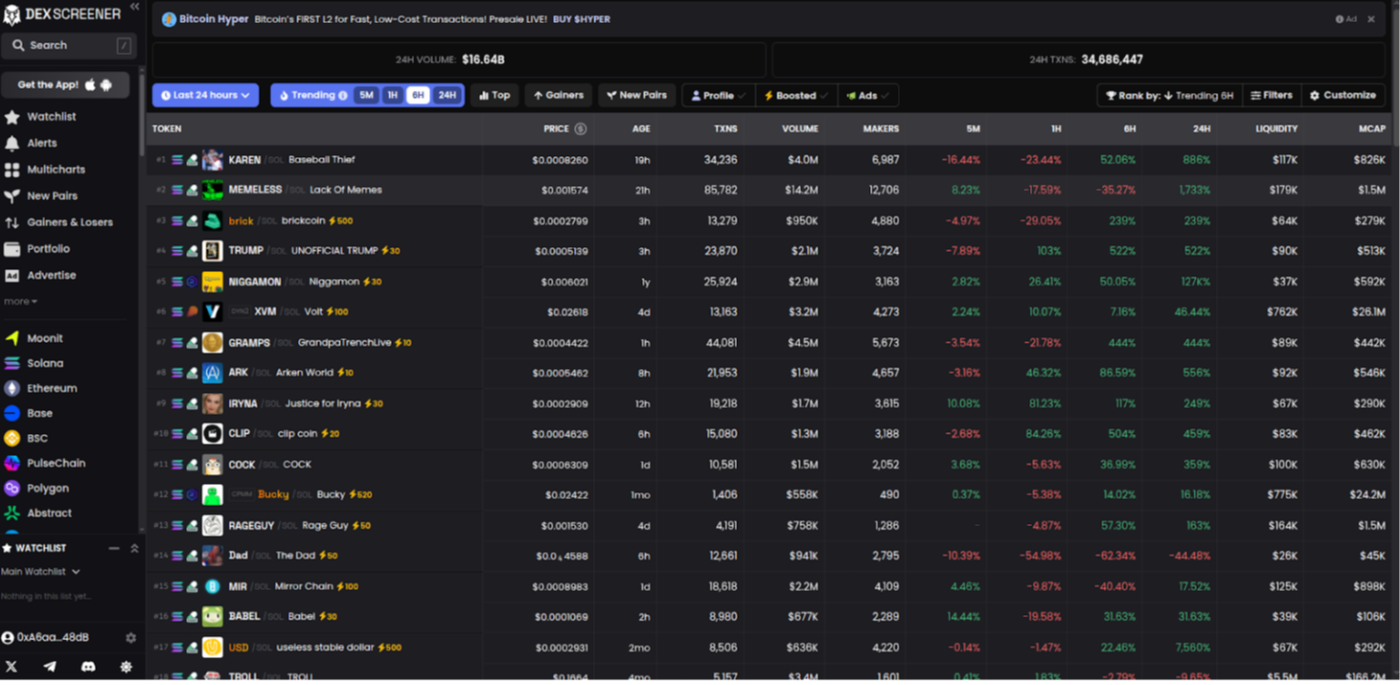
Building a DEXScreener Clone: A Step-by-Step Guide

Building a DEXScreener Clone: A Step-by-Step Guide

DEX Screener is used by crypto traders who need access to on-chain data like trading volumes, liquidity, and token prices. This information allows them to analyze trends, monitor new listings, and make informed investment decisions. In this tutorial, I will build a DEXScreener clone from scratch, covering everything from the initial design to a functional app. We will use Streamlit, a Python framework for building full-stack apps.
Share
Hackernoon2025/09/18 15:05
Which DOGE? Musk's Cryptic Post Explodes Confusion

Which DOGE? Musk's Cryptic Post Explodes Confusion

A viral chart documenting a sharp decline in U.S. federal employment during President Trump's second term has sparked unexpected confusion in cryptocurrency markets
Share
Coinstats2025/12/20 01:13
Google's AP2 protocol has been released. Does encrypted AI still have a chance?

Google's AP2 protocol has been released. Does encrypted AI still have a chance?

Following the MCP and A2A protocols, the AI Agent market has seen another blockbuster arrival: the Agent Payments Protocol (AP2), developed by Google. This will clearly further enhance AI Agents' autonomous multi-tasking capabilities, but the unfortunate reality is that it has little to do with web3AI. Let's take a closer look: What problem does AP2 solve? Simply put, the MCP protocol is like a universal hook, enabling AI agents to connect to various external tools and data sources; A2A is a team collaboration communication protocol that allows multiple AI agents to cooperate with each other to complete complex tasks; AP2 completes the last piece of the puzzle - payment capability. In other words, MCP opens up connectivity, A2A promotes collaboration efficiency, and AP2 achieves value exchange. The arrival of AP2 truly injects "soul" into the autonomous collaboration and task execution of Multi-Agents. Imagine AI Agents connecting Qunar, Meituan, and Didi to complete the booking of flights, hotels, and car rentals, but then getting stuck at the point of "self-payment." What's the point of all that multitasking? So, remember this: AP2 is an extension of MCP+A2A, solving the last mile problem of AI Agent automated execution. What are the technical highlights of AP2? The core innovation of AP2 is the Mandates mechanism, which is divided into real-time authorization mode and delegated authorization mode. Real-time authorization is easy to understand. The AI Agent finds the product and shows it to you. The operation can only be performed after the user signs. Delegated authorization requires the user to set rules in advance, such as only buying the iPhone 17 when the price drops to 5,000. The AI Agent monitors the trigger conditions and executes automatically. The implementation logic is cryptographically signed using Verifiable Credentials (VCs). Users can set complex commission conditions, including price ranges, time limits, and payment method priorities, forming a tamper-proof digital contract. Once signed, the AI Agent executes according to the conditions, with VCs ensuring auditability and security at every step. Of particular note is the "A2A x402" extension, a technical component developed by Google specifically for crypto payments, developed in collaboration with Coinbase and the Ethereum Foundation. This extension enables AI Agents to seamlessly process stablecoins, ETH, and other blockchain assets, supporting native payment scenarios within the Web3 ecosystem. What kind of imagination space can AP2 bring? After analyzing the technical principles, do you think that's it? Yes, in fact, the AP2 is boring when it is disassembled alone. Its real charm lies in connecting and opening up the "MCP+A2A+AP2" technology stack, completely opening up the complete link of AI Agent's autonomous analysis+execution+payment. From now on, AI Agents can open up many application scenarios. For example, AI Agents for stock investment and financial management can help us monitor the market 24/7 and conduct independent transactions. Enterprise procurement AI Agents can automatically replenish and renew without human intervention. AP2's complementary payment capabilities will further expand the penetration of the Agent-to-Agent economy into more scenarios. Google obviously understands that after the technical framework is established, the ecological implementation must be relied upon, so it has brought in more than 60 partners to develop it, almost covering the entire payment and business ecosystem. Interestingly, it also involves major Crypto players such as Ethereum, Coinbase, MetaMask, and Sui. Combined with the current trend of currency and stock integration, the imagination space has been doubled. Is web3 AI really dead? Not entirely. Google's AP2 looks complete, but it only achieves technical compatibility with Crypto payments. It can only be regarded as an extension of the traditional authorization framework and belongs to the category of automated execution. There is a "paradigm" difference between it and the autonomous asset management pursued by pure Crypto native solutions. The Crypto-native solutions under exploration are taking the "decentralized custody + on-chain verification" route, including AI Agent autonomous asset management, AI Agent autonomous transactions (DeFAI), AI Agent digital identity and on-chain reputation system (ERC-8004...), AI Agent on-chain governance DAO framework, AI Agent NPC and digital avatars, and many other interesting and fun directions. Ultimately, once users get used to AI Agent payments in traditional fields, their acceptance of AI Agents autonomously owning digital assets will also increase. And for those scenarios that AP2 cannot reach, such as anonymous transactions, censorship-resistant payments, and decentralized asset management, there will always be a time for crypto-native solutions to show their strength? The two are more likely to be complementary rather than competitive, but to be honest, the key technological advancements behind AI Agents currently all come from web2AI, and web3AI still needs to keep up the good work!
Share
PANews2025/09/18 07:00