This article will delve into the impact of this attack on Aave, Ethena, and USDe, analyze how the DeFi system responded to this incident, and explore whether Proof of Reserves can prevent liquidations of more than $20 million.This article will delve into the impact of this attack on Aave, Ethena, and USDe, analyze how the DeFi system responded to this incident, and explore whether Proof of Reserves can prevent liquidations of more than $20 million.
After the Bybit hack, how can DeFi effectively cope with market turmoil?

2025/02/24 11:33
4 min read

Original article: Omer Goldberg , Founder of Chaos Labs

Compiled by: Yuliya, PANews

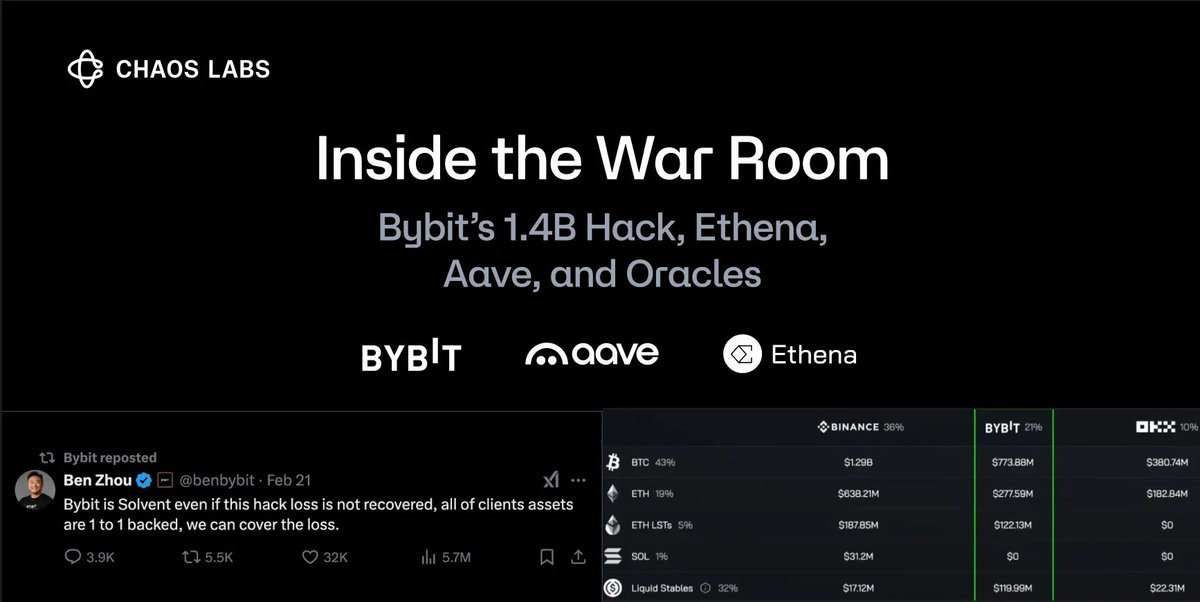
After Bybit suffered a $1.4 billion hack, the cryptocurrency market faced a serious impact. How DeFi (decentralized finance) platforms responded to this largest hack in history, as well as potential contagion risks and USDe price fluctuations, has become the focus of attention in the crypto field. This article will explore the impact of this attack on Aave, Ethena, and USDe, analyze how the DeFi system responded to this incident, and explore whether Proof of Reserves can prevent liquidations of more than $20 million.

After the Bybit hack, how can DeFi effectively cope with market turmoil?

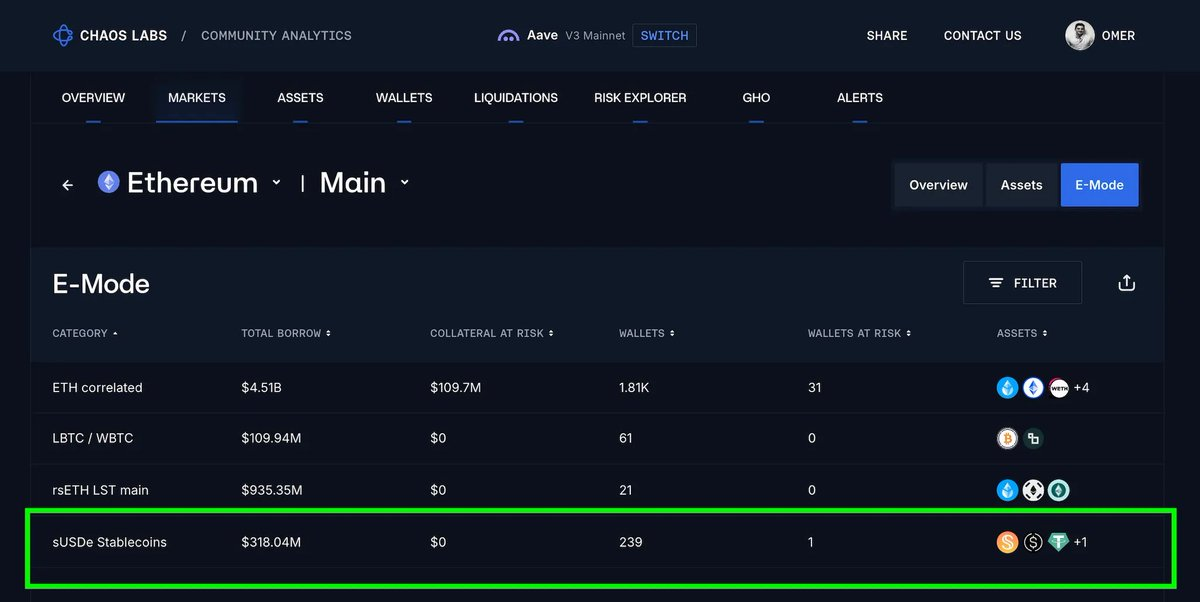
After the attack, the Chaos Labs team, together with bgdlabs, AaveChan and LlamaRisk, formed an emergency response team to assess the risks and systemic risks that Aave may face.
After the Bybit hack, how can DeFi effectively cope with market turmoil?

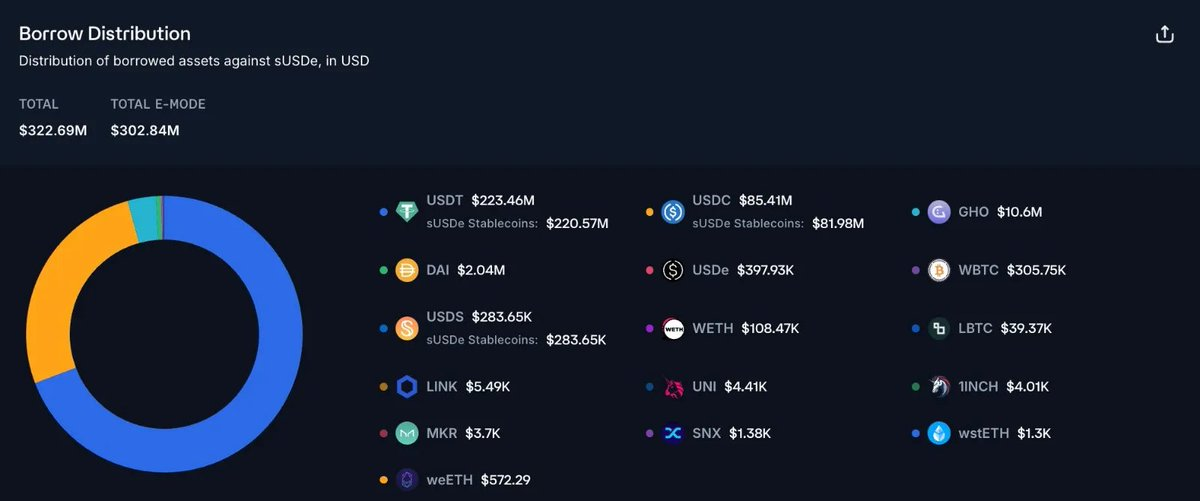
The emergency response team focused on several core issues: Bybit’s solvency status, whether there is a possibility of a larger attack, and the impact any bankruptcy or write-down might have on Aave given its exposure to sUSDe.
After the Bybit hack, how can DeFi effectively cope with market turmoil?

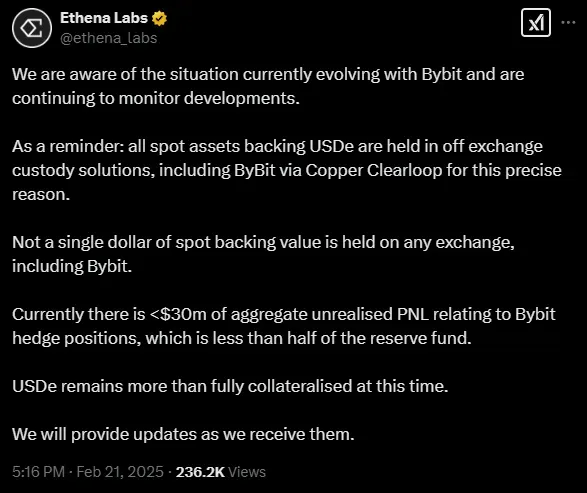
Ethena Labs confirmed that its funds are held in custody through Copper.co , but the market is still concerned about the chain reaction that may be caused by Bybit’s inability to realize profits and losses, and whether USDe will face a deeper risk of decoupling.
After the Bybit hack, how can DeFi effectively cope with market turmoil?

An analysis of Bybit’s bankruptcy risk shows that there are three main hidden dangers: exposure risk caused by USDe hedging failure, chain liquidation risk caused by ETH price decline, and potential DeFi contagion risk.

This prompted the relevant parties to accurately quantify the losses in order to decide whether to take measures such as freezing the sUSDe market. The transparency dashboard shows Ethena's ETH configuration on Bybit, while Ethena Labs' collateral is safely stored over-the-counter at Copper.co . This custody solution and over-the-counter settlement mechanism effectively avoids the bankruptcy risk of exchanges like FTX.

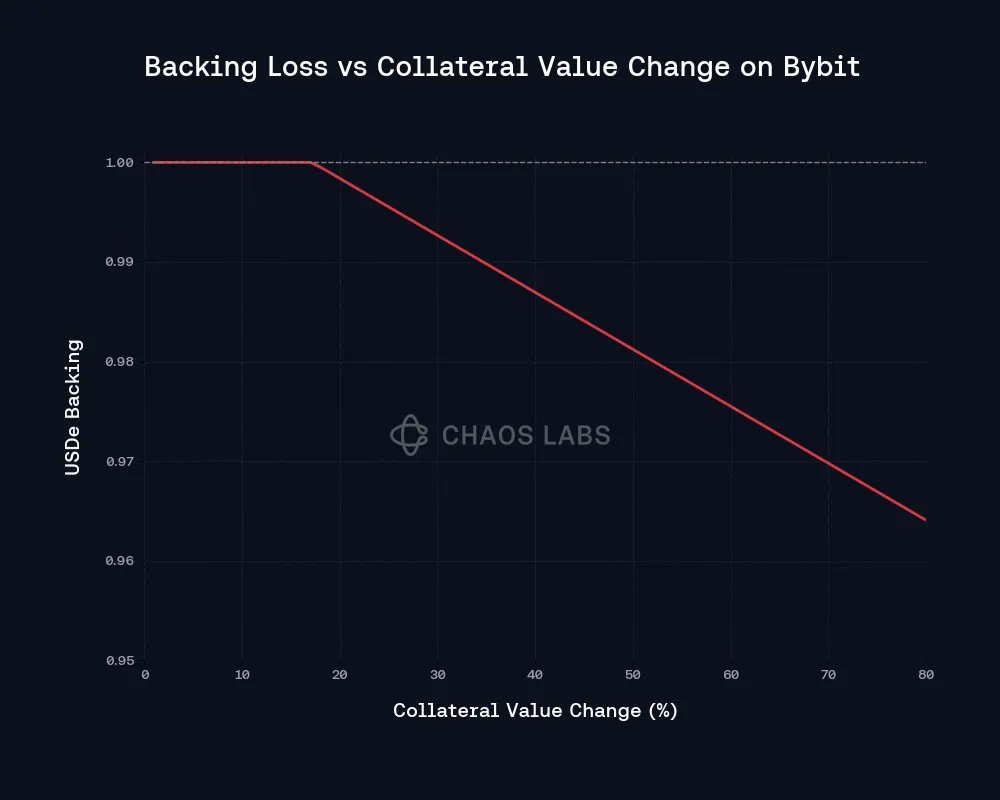
Assuming that the $400 million "book" notional ETH position cannot be liquidated and the ETH price drops 25% before Copper.co releases the funds, Ethena could face an unhedged loss of $100 million. However, considering the $60 million insurance fund, USDe's total backing loss is expected to be only 0.5%.
After the Bybit hack, how can DeFi effectively cope with market turmoil?

Based on the judgment that the risks are relatively controllable, Aave has prepared a risk response plan and continues to monitor developments.

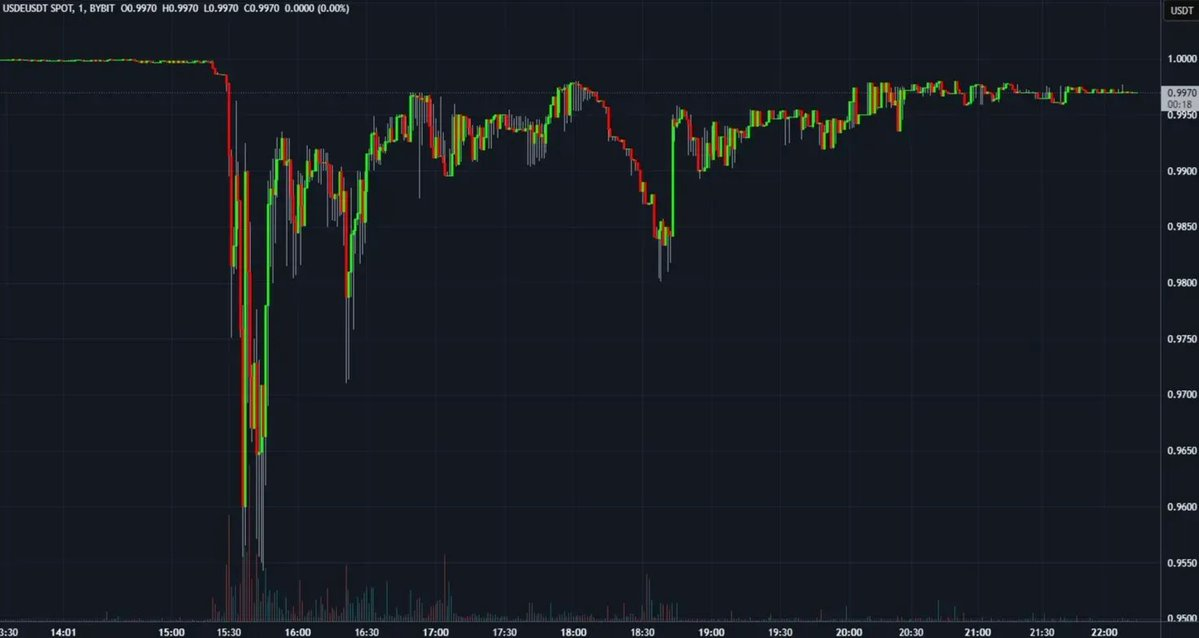
In terms of price, USDe showed obvious price deviations in different trading venues. On the Bybit platform, USDe/USDT once fell to $0.96 due to panic selling and lack of immediate arbitrage.
After the Bybit hack, how can DeFi effectively cope with market turmoil?

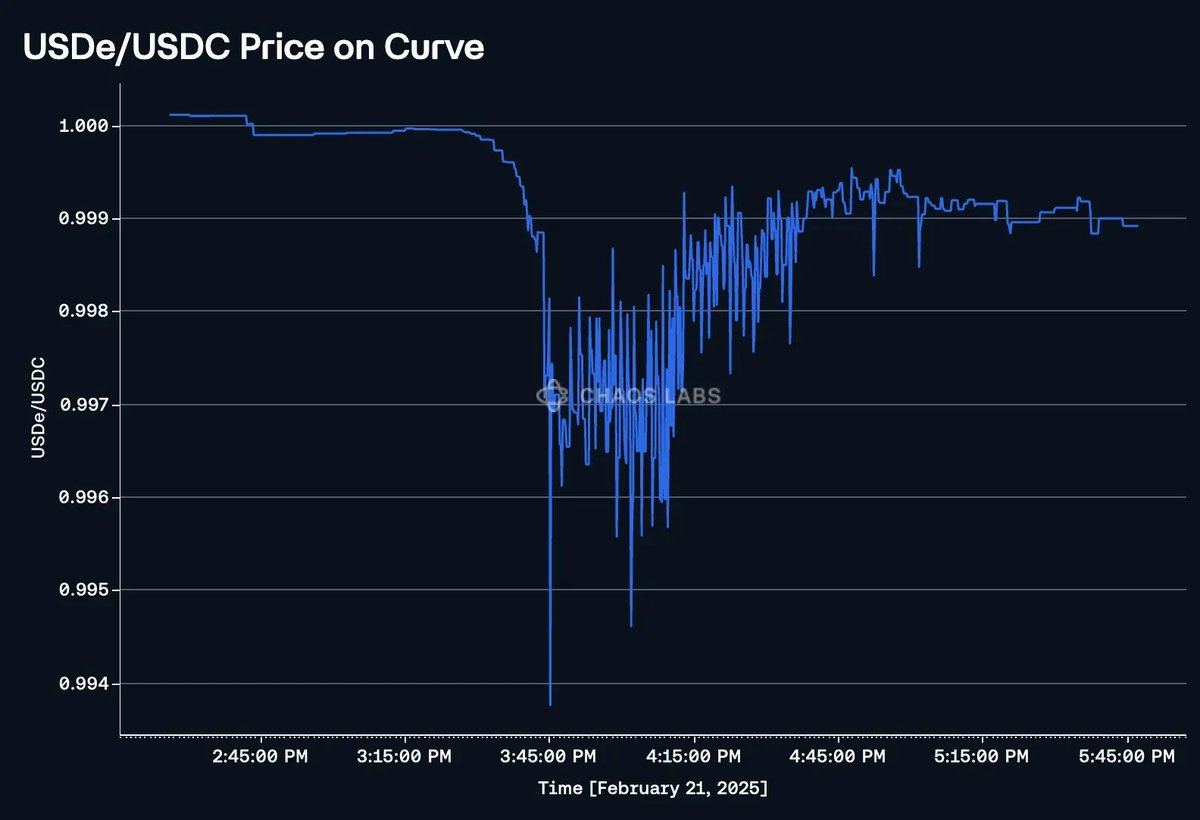
In contrast, on-chain pricing has been more stable, with only a brief decoupling to $0.994, which was quickly recovered through arbitrage. This difference is mainly due to the redemption mechanism and the role of the oracle.
After the Bybit hack, how can DeFi effectively cope with market turmoil?

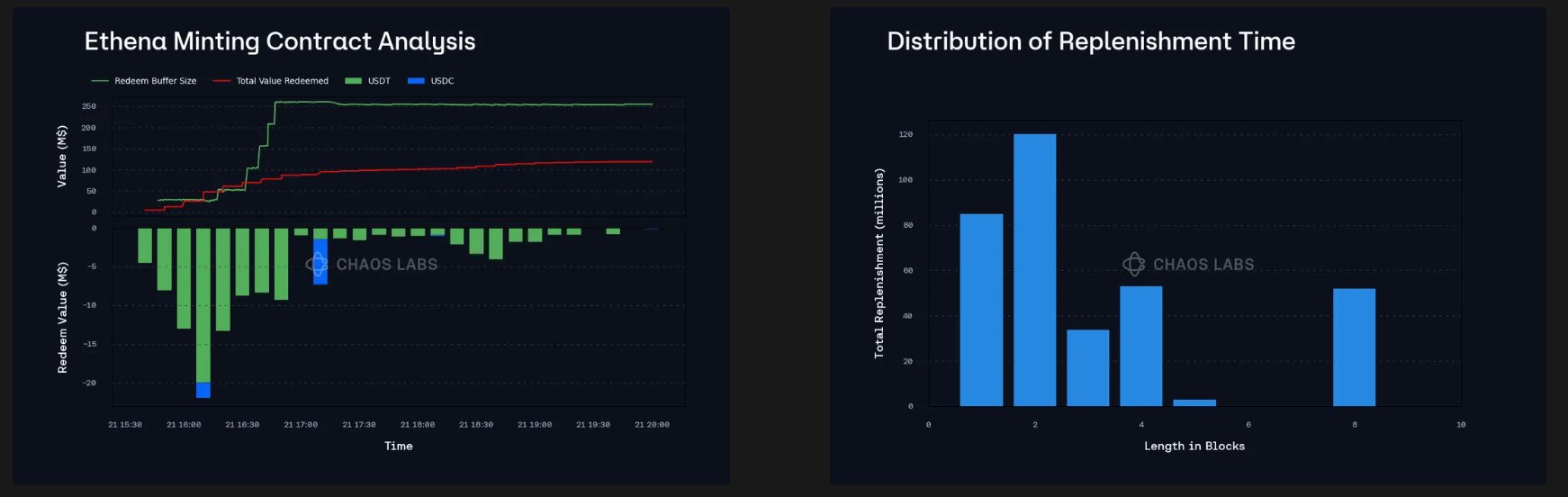
Unlike CeFi, USDe redemptions can be performed continuously and atomically on-chain through the Mint and Redeem contract. USDe's on-chain redemption mechanism worked smoothly, completing $117 million in redemptions in a few hours. Ethena Labs also increased the redemption buffer to $250 million and maintained price stability through continuous replenishment until USDe regained its peg. Due to the atomic nature of USDe redemptions, whitelisted redeemers quickly closed the price gap on Curve.
After the Bybit hack, how can DeFi effectively cope with market turmoil?

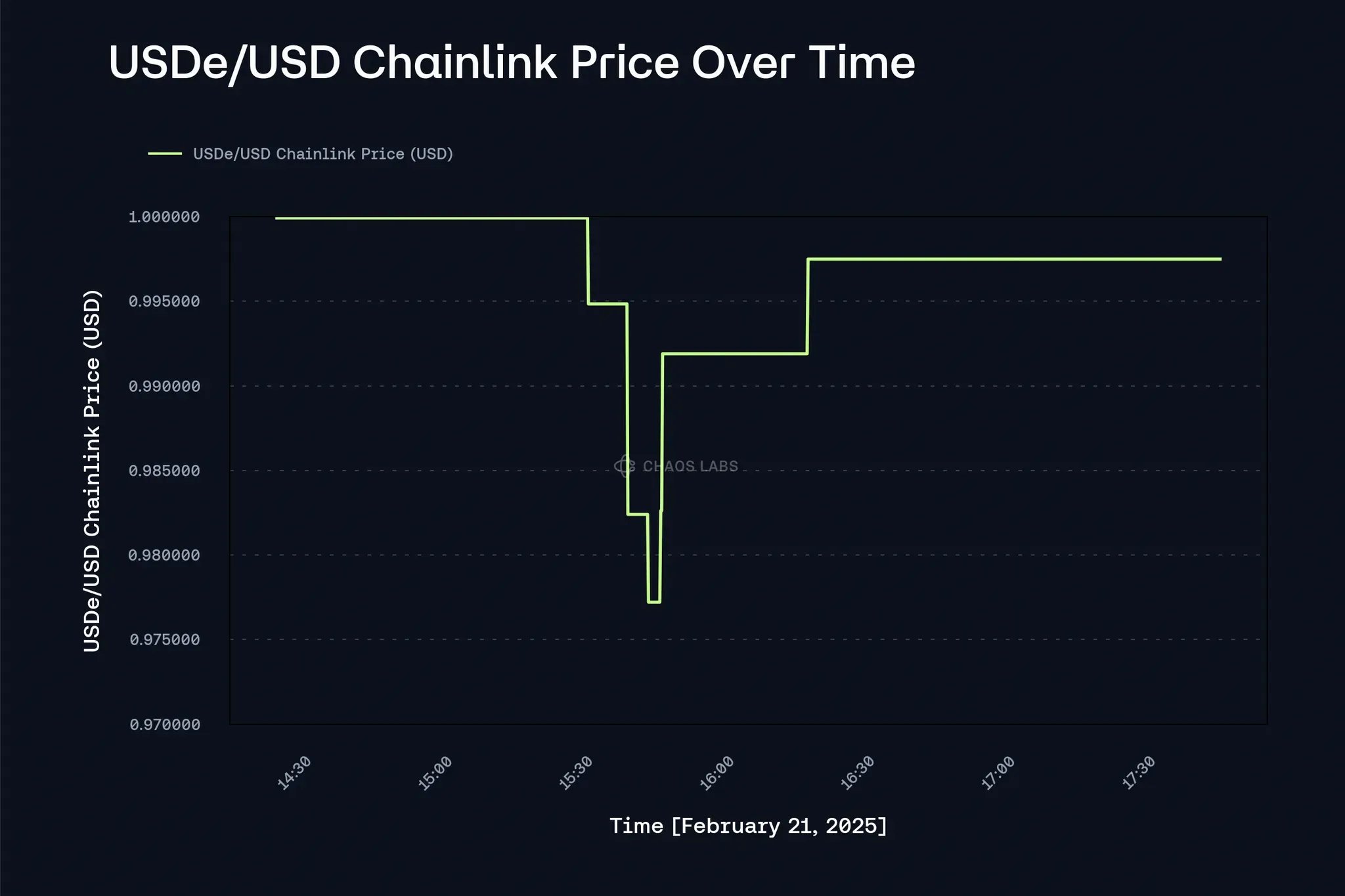
However, the anomaly of the oracle amplified the market risk. Chainlink’s USDe/USD price oracle deviated from the on-chain price and fell to $0.977, although the redemption mechanism was still operating normally.
After the Bybit hack, how can DeFi effectively cope with market turmoil?

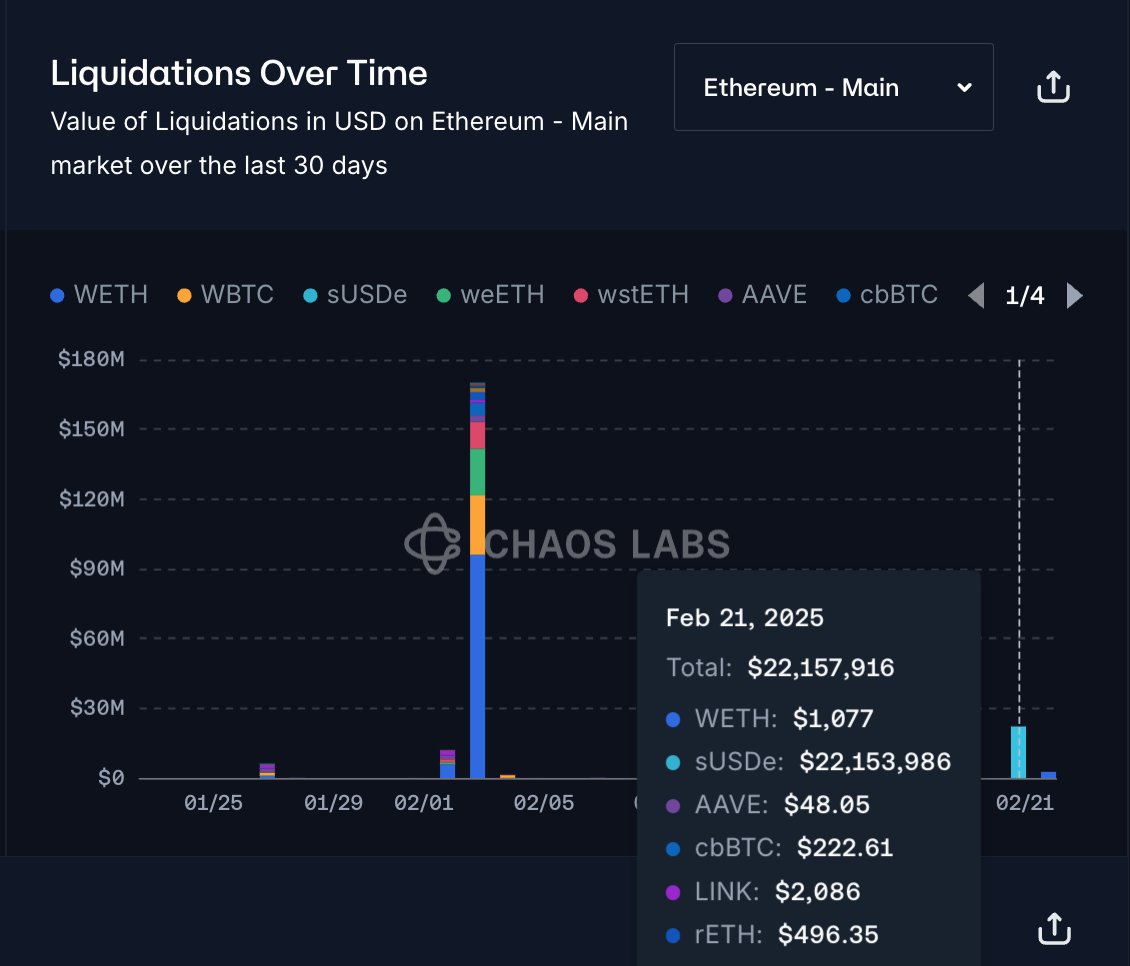
This deviation resulted in $22 million in liquidations on Aave, with traders being liquidated due to secondary market price fluctuations despite the fact that their USDe assets were well collateralized.
After the Bybit hack, how can DeFi effectively cope with market turmoil?

This highlights the room for improvement in the oracle mechanism. A smart data source that integrates proof of reserves may be able to provide a more accurate valuation of USDe and avoid unnecessary liquidations. Considering real-time redemption, rather than relying solely on the weighted average transaction price. Such a smart oracle can:

  • Prevent unnecessary liquidations;
  • Maintaining capital efficiency;
  • Reduce market pressure

What can be improved?

Risk, price, and proof-of-reserve data must work together, not in isolation, to ensure value and maintain the resilience of DeFi systems under stress. Price oracles should reflect true collateral backing, not just secondary market prices.

Overall, the DeFi ecosystem withstood this stress test. The Bybit team stabilized the market by maintaining transparent communication, the Ethena Labs team quickly eliminated risk exposure and ensured smooth redemption, and Aave effectively controlled risks without generating bad debts.

This incident shows that in order to build a more resilient system, the industry needs smarter oracles and risk-aware infrastructure to improve capital efficiency while ensuring security. It is only a matter of time before the next major stress test comes, and the industry needs to prepare for it.

Market Opportunity
Moonveil Logo
Moonveil Price(MORE)
$0,0007941
$0,0007941$0,0007941
-0,13%
USD
Moonveil (MORE) Live Price Chart
Disclaimer: The articles reposted on this site are sourced from public platforms and are provided for informational purposes only. They do not necessarily reflect the views of MEXC. All rights remain with the original authors. If you believe any content infringes on third-party rights, please contact [email protected] for removal. MEXC makes no guarantees regarding the accuracy, completeness, or timeliness of the content and is not responsible for any actions taken based on the information provided. The content does not constitute financial, legal, or other professional advice, nor should it be considered a recommendation or endorsement by MEXC.

You May Also Like

Best Crypto to Buy as Saylor & Crypto Execs Meet in US Treasury Council

Best Crypto to Buy as Saylor & Crypto Execs Meet in US Treasury Council

The post Best Crypto to Buy as Saylor & Crypto Execs Meet in US Treasury Council appeared on BitcoinEthereumNews.com. Michael Saylor and a group of crypto executives met in Washington, D.C. yesterday to push for the Strategic Bitcoin Reserve Bill (the BITCOIN Act), which would see the U.S. acquire up to 1M $BTC over five years. With Bitcoin being positioned yet again as a cornerstone of national monetary policy, many investors are turning their eyes to projects that lean into this narrative – altcoins, meme coins, and presales that could ride on the same wave. Read on for three of the best crypto projects that seem especially well‐suited to benefit from this macro shift:  Bitcoin Hyper, Best Wallet Token, and Remittix. These projects stand out for having a strong use case and high adoption potential, especially given the push for a U.S. Bitcoin reserve.   Why the Bitcoin Reserve Bill Matters for Crypto Markets The strategic Bitcoin Reserve Bill could mark a turning point for the U.S. approach to digital assets. The proposal would see America build a long-term Bitcoin reserve by acquiring up to one million $BTC over five years. To make this happen, lawmakers are exploring creative funding methods such as revaluing old gold certificates. The plan also leans on confiscated Bitcoin already held by the government, worth an estimated $15–20B. This isn’t just a headline for policy wonks. It signals that Bitcoin is moving from the margins into the core of financial strategy. Industry figures like Michael Saylor, Senator Cynthia Lummis, and Marathon Digital’s Fred Thiel are all backing the bill. They see Bitcoin not just as an investment, but as a hedge against systemic risks. For the wider crypto market, this opens the door for projects tied to Bitcoin and the infrastructure that supports it. 1. Bitcoin Hyper ($HYPER) – Turning Bitcoin Into More Than Just Digital Gold The U.S. may soon treat Bitcoin as…
Share
BitcoinEthereumNews2025/09/18 00:27
BlackRock boosts AI and US equity exposure in $185 billion models

BlackRock boosts AI and US equity exposure in $185 billion models

The post BlackRock boosts AI and US equity exposure in $185 billion models appeared on BitcoinEthereumNews.com. BlackRock is steering $185 billion worth of model portfolios deeper into US stocks and artificial intelligence. The decision came this week as the asset manager adjusted its entire model suite, increasing its equity allocation and dumping exposure to international developed markets. The firm now sits 2% overweight on stocks, after money moved between several of its biggest exchange-traded funds. This wasn’t a slow shuffle. Billions flowed across multiple ETFs on Tuesday as BlackRock executed the realignment. The iShares S&P 100 ETF (OEF) alone brought in $3.4 billion, the largest single-day haul in its history. The iShares Core S&P 500 ETF (IVV) collected $2.3 billion, while the iShares US Equity Factor Rotation Active ETF (DYNF) added nearly $2 billion. The rebalancing triggered swift inflows and outflows that realigned investor exposure on the back of performance data and macroeconomic outlooks. BlackRock raises equities on strong US earnings The model updates come as BlackRock backs the rally in American stocks, fueled by strong earnings and optimism around rate cuts. In an investment letter obtained by Bloomberg, the firm said US companies have delivered 11% earnings growth since the third quarter of 2024. Meanwhile, earnings across other developed markets barely touched 2%. That gap helped push the decision to drop international holdings in favor of American ones. Michael Gates, lead portfolio manager for BlackRock’s Target Allocation ETF model portfolio suite, said the US market is the only one showing consistency in sales growth, profit delivery, and revisions in analyst forecasts. “The US equity market continues to stand alone in terms of earnings delivery, sales growth and sustainable trends in analyst estimates and revisions,” Michael wrote. He added that non-US developed markets lagged far behind, especially when it came to sales. This week’s changes reflect that position. The move was made ahead of the Federal…
Share
BitcoinEthereumNews2025/09/18 01:44
Trump Denies Involvement in $500M Abu Dhabi WLFI Stake

Trump Denies Involvement in $500M Abu Dhabi WLFI Stake

The post Trump Denies Involvement in $500M Abu Dhabi WLFI Stake appeared on BitcoinEthereumNews.com. US President Donald Trump has denied knowledge of a reported
Share
BitcoinEthereumNews2026/02/03 23:26