

New trends in the development of the Bitcoin ecosystem: From institutional investment to consumer chain transformation, how does Core promote BTCFi?
Author: Weilin, PANews
In the current cycle, institutional adoption of Bitcoin has become a trend that has received much attention. A survey by Fidelity shows that there is a large amount of untapped demand for Bitcoin adoption. Under the influence of the approval of Bitcoin ETFs in the United States and the shift in regulatory policies, governments and large funds have begun to view Bitcoin as a strategic reserve asset. The United States is likely to establish a strategic reserve of Bitcoin, and more and more countries and institutions may follow suit, which may give rise to a new financial paradigm. Institutional adoption of Bitcoin is at a critical turning point.
Core introduced dual staking through the Fusion upgrade, superimposed its income-based ETP, CoreFi strategy, etc., to provide a solution for real Bitcoin returns. Messari recently announced Core's growth indicators for Q4 2024. It can be seen that in the Bitcoin ecosystem, as the user base expands, Bitcoin is transforming from an institutional investment chain to a consumer chain. As of February 4, Core's chain has staked more than 5,700 bitcoins, with a total locked value of more than $850 million.
The current state of institutional investment in Bitcoin: There is a large amount of untapped demand and it is at a critical turning point
A survey result released by Fidelity Digital Assets in June 2024 shows that institutional investors' interest in Bitcoin is gradually increasing. The survey was conducted in the previous year among more than 1,000 institutional investors around the world. In the survey, 60% of institutions said they knew something about digital assets, and 51% said they were currently investing in digital assets. In 2019, only 39% of institutions knew something about digital assets. Among American investors in 2019, only 22% were investing in digital assets.
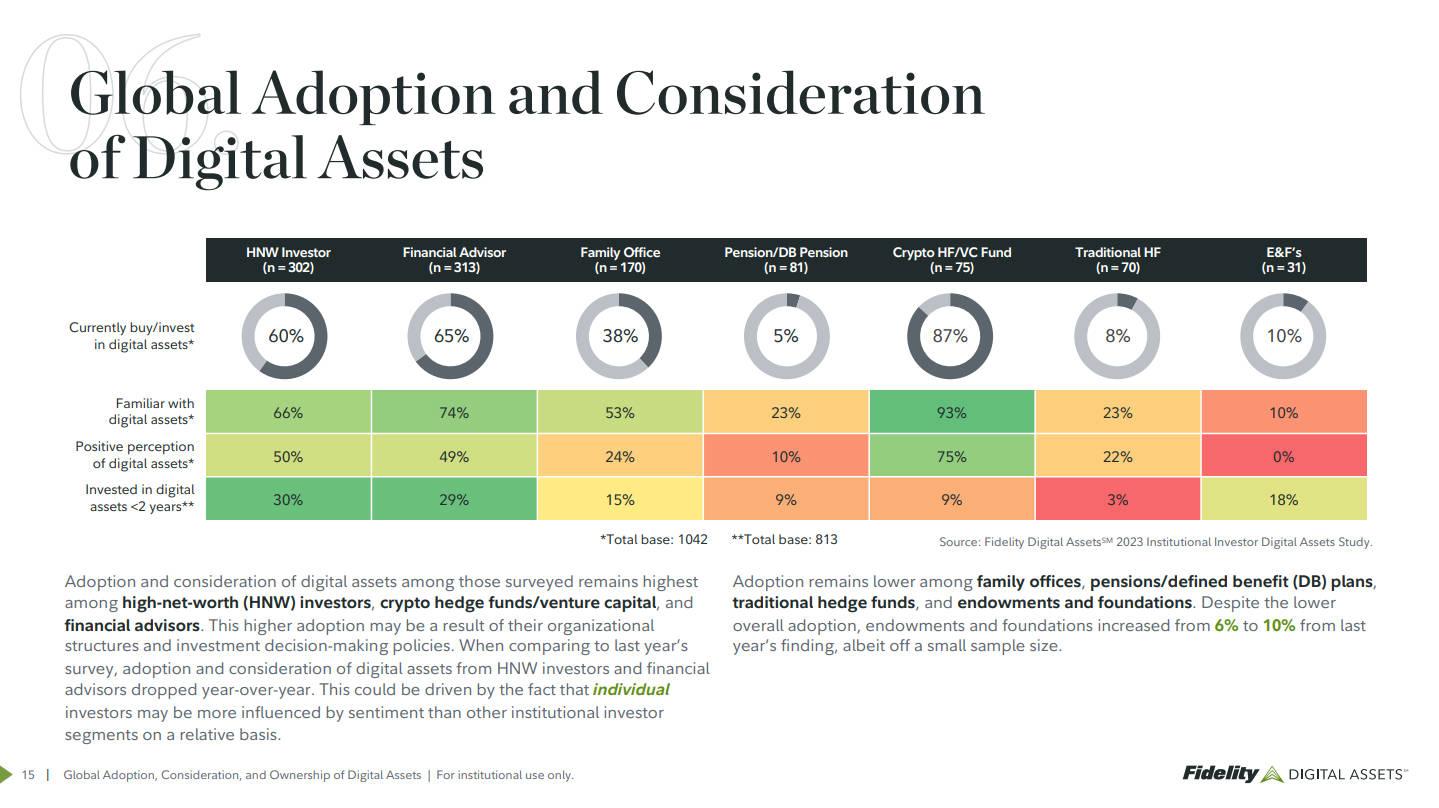
If we analyze these data in depth, we can find two types of investors. On the one hand, there are institutional investors driven by individuals, such as high net worth individuals, investment advisory companies, crypto hedge funds/VC, etc., 70 to 80% of which have invested in digital assets. On the other hand, there are large institutions, such as pension funds, traditional hedge funds, endowment funds, and foundations. Unfortunately, this proportion is still in the single digit percentage. The current market value of Bitcoin is about 2 trillion US dollars. The adoption of Bitcoin by institutional investors is at a critical turning point, and there is a lot of untapped demand.
In 2024, well-known institutions such as Strategy (formerly MicroStrategy), BlackRock, ARK Invest, and Fidelity have enhanced Bitcoin's market presence through strategic investments and innovative financial products such as Bitcoin ETFs. As of January 24, Strategy's holdings of Bitcoin have reached 471,107, with a total cost of approximately US$30.4 billion. In 2024, the company also purchased 258,320 Bitcoins.
With the approval of Bitcoin spot ETFs and the Trump administration's support for crypto assets, more and more large companies and institutions are beginning to adopt Bitcoin reserve plans. Companies such as Strategy, MARA Holdings, Riot Platforms, etc. have included Bitcoin in their financial reserves, and cryptocurrencies have gradually been integrated into mainstream conversations. Under the leadership of the new US government, plans for Bitcoin as an asset reserve are being explored at the state and federal levels, and it is expected that the new regulatory model will further promote the adoption of Bitcoin by institutions.
From the perspective of asset characteristics, Bitcoin provides high returns (9,800% in 8 years). Although it is accompanied by higher risks and volatility, it has a low correlation with traditional assets, making it an ideal portfolio diversification tool. Compared with traditional alternative assets such as real estate and art, Bitcoin has obvious advantages in liquidity, transparency and divisibility.
How Core Enhances Real Yield Solutions: Fusion Upgrade Introduces Dual Staking, Yield ETP and CoreFi Strategy
Institutions invest through direct purchases, Bitcoin futures, ETFs, custody services, BTCFi and Bitcoin-related stocks. Core provides institutions with the option of BTCFi staking, which allows them to obtain returns safely and stably.
In April 2024, the Core blockchain integrated non-custodial Bitcoin staking for the first time, allowing users to stake Bitcoin and earn returns while retaining full control of their assets. This native mechanism generates Bitcoin returns without the need to introduce additional trust assumptions.
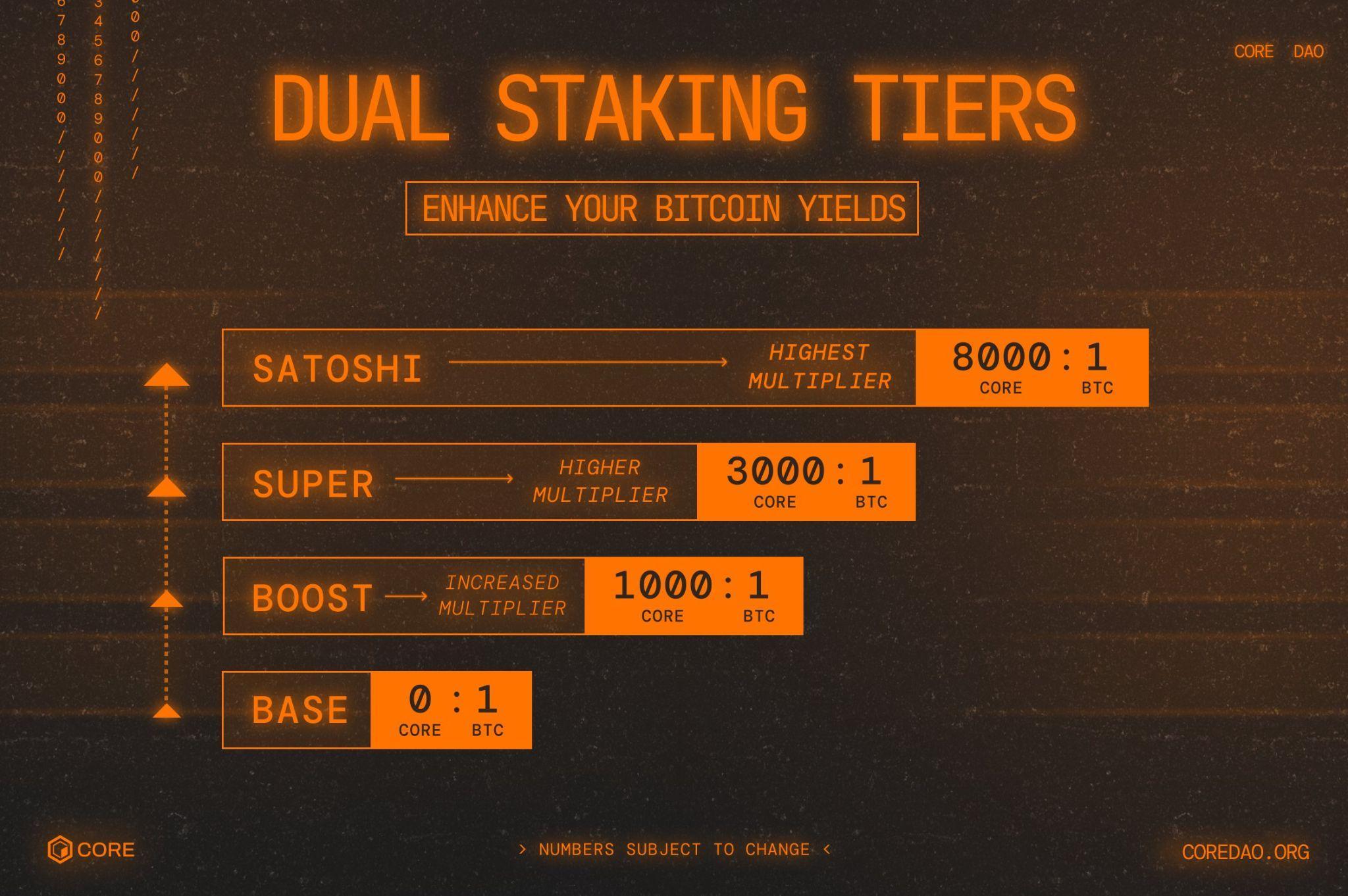
On November 19, 2024, Core launched the Fusion upgrade. PANews once introduced that Core has ushered in new market opportunities in the Bitcoin ecosystem based on this upgrade. The launch of the dual-staking product aims to solve the problem of balance in the distribution of community rewards that may be caused by Bitcoin pledgers locking their assets and receiving CORE token rewards through verification nodes during non-custodial staking. Especially in the case of a large number of Bitcoin pledged by institutions, the released CORE rewards will increase accordingly. Based on this background, in order to encourage Bitcoin pledgers to re-stake the received CORE rewards to the verification nodes, dual staking increases user participation willingness by providing a higher annualized rate of return (APY).
To further enhance the revenue generation of non-custodial Bitcoin staking, the dual staking mechanism unlocks higher revenue tiers by staking Bitcoin and CORE tokens simultaneously. Since the daily CORE emission is fixed, users who stake both Bitcoin and CORE will receive higher reward tiers. The increase in rewards is linked to the number of staked CORE tokens, encouraging Bitcoin stakers to participate more deeply in the Core ecosystem and maximize revenue returns for loyal users.
Recently, Core also launched its first yield-based Bitcoin exchange-traded product (ETP), providing investors with the opportunity to earn income through non-custodial Bitcoin staking. In cooperation with Valour, a subsidiary of DeFi Technologies, this ETP provides investors with a 5.65% yield, becoming an important way for institutional investors to enter the BTCFi ecosystem.
On February 4, DeFi Technologies has entered into a binding letter of intent with CoreFi Strategy and Orinswift Ventures to facilitate a reverse takeover, which will enable the common shares of the merged entity to be listed on the Cboe Canadian Stock Exchange. The Core Foundation will contribute $20 million worth of CORE tokens to enhance CoreFi's financial reserves. At the same time, CoreFi plans to raise $20 million through a simultaneous financing to accelerate its development in the field of BTCFi technology.
In addition, Core has also established cooperation with custodian services such as Fireblocks, Copper, Cactus and Hashnote to provide support for double staking. Inspired by the successful experience of Strategy and Metaplanet, the CoreFi strategy provides institutional investors with a regulated investment method to achieve leveraged Bitcoin and CORE returns.
On February 18, the Core Foundation, in partnership with Maple Finance, BitGo, Copper and Hex Trust, announced the launch of lstBTC. lstBTC will become a new type of liquid, yield-bearing Bitcoin token on the Core blockchain, designed for institutions to generate income for idle Bitcoin. By transforming Bitcoin into a productive asset, lstBTC provides holders with a way to convert billions of dollars into income while maintaining security, compliance and liquidity.
Institutions can mint lstBTC by depositing Bitcoin with a trusted custodian such as BitGo, Copper, or Hex Trust. lstBTC generates yield while maintaining full liquidity - institutions can trade, transfer, or use lstBTC as collateral. When redeemed, holders will receive their original Bitcoin plus a pro-rated share of the yield, deposited directly into their custodial account.
The unique features of lstBTC include:
Unlike other Bitcoin yield solutions, lstBTC is designed specifically for institutions without the need to transfer assets or take unnecessary risks.
No changes to custody arrangements are required – institutions can continue to store Bitcoin with existing custodians.
Real BTC Yield - Earn BTC-denominated returns through Core’s dual-staking mechanism without having to transfer Bitcoin out of custodianship.
Fully liquid and scalable — lstBTC can be traded, transferred, or used as collateral while the underlying Bitcoin is still generating yield.
Built for institutional use cases – seamlessly integrates into existing and new portfolio strategies to enhance returns.
New trends based on data: Core leads Bitcoin adoption, transitioning from institutional investment to consumer chains
As the hype and bluffing fade away, the blockchain field tends to focus more on practical applications and real user growth. Core is becoming the consumer chain of Bitcoin, promoting the practical application of Bitcoin and achieving continuous growth of users.
According to a third-party report from Messari, a well-known research institution, in the fourth quarter of 2024, Core's DeFi TVL (in US dollars) increased by 90% month-on-month to US$811.8 million. Avalon Labs topped the DeFi TVL rankings, followed by Colend and Pell Network. Pell Network launched the BTC restaking function in August, bringing new growth momentum to the Core ecosystem.
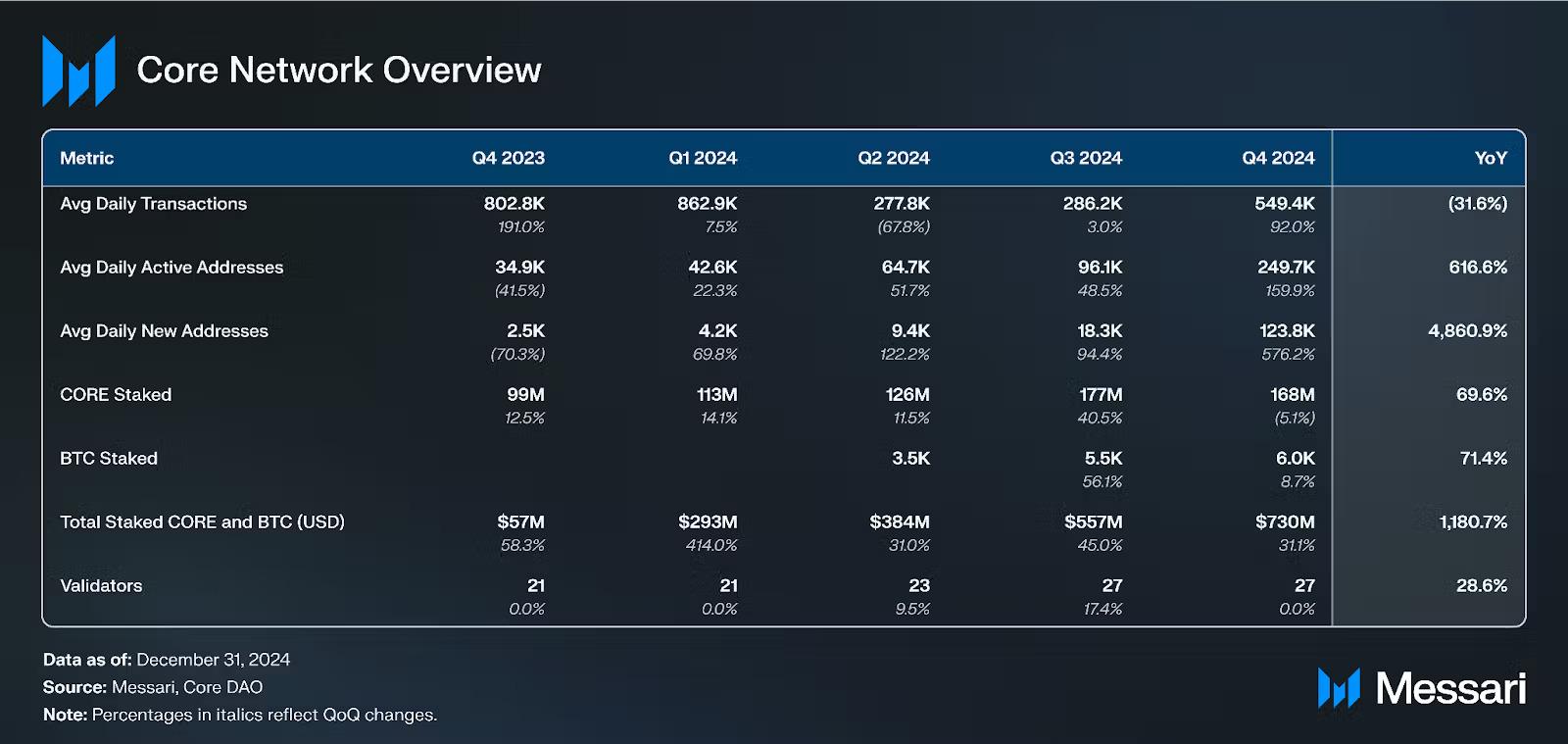
Core and BTC staking (USD) grew 31% month-over-month to $730.5 million. The growth was driven by 500 BTC staked through Core’s non-custodial Bitcoin staking product, which launched in April.
Core’s daily average active addresses grew 160% quarter-over-quarter to 249,700. Core’s cumulative total unique wallets stood at 34.8 million by the end of the fourth quarter. Fees grew 97% quarter-over-quarter to $235,000.
Core released the Fusion upgrade in Q4, which introduced dual staking and LstBTC. In Q4, a total of 1,298 Bitcoin and 16.5 million CORE were double-staked, accounting for 22% and 19% of all Bitcoin and all CORE staked on the Core network, respectively.
Judging from the data performance, Core has achieved real user growth and sustained block space demand, ahead of its competitors. Looking ahead, Core's Q1 focus will be to further develop relationships with custody/institutional partners.
As the Bitcoin ecosystem is trending towards a consumer chain, Core is leading this transformation and promoting the true application and popularization of the Bitcoin ecosystem. Through innovative staking mechanisms, yield-based financial products, and a strong partner network, Core not only provides institutional investors with a stable income channel, but also creates more opportunities for ordinary users to participate. In the future, as the regulatory environment becomes clearer and technology continues to advance, Core is expected to continue to play an important role in promoting the transformation of Bitcoin from an investment tool to a consumer chain.
You May Also Like

Best Crypto to Buy as Saylor & Crypto Execs Meet in US Treasury Council

BlackRock boosts AI and US equity exposure in $185 billion models
