This article was first published on The Bit Journal. Bitcoin bear market signals are reshaping crypto debate in a quieter way than past cycles. There is no panicThis article was first published on The Bit Journal. Bitcoin bear market signals are reshaping crypto debate in a quieter way than past cycles. There is no panic

Data Signals Bitcoin Has Traded in Bear Territory Since Late 2025

This article was first published on The Bit Journal.

Bitcoin bear market signals are reshaping crypto debate in a quieter way than past cycles. There is no panic or sudden collapse. Instead, long-term data is raising concerns that Bitcoin may already be in a corrective phase much earlier than many investors expected.

Several on-chain and technical indicators turned bearish late last year and have yet to recover. According to CryptoQuant’s head of research, Julio Moreno, multiple metrics shifted into bearish territory in early November, suggesting Bitcoin may already be about two months into a bear market despite relatively stable price action.

This view challenges the idea that Bitcoin remains firmly in a growth phase and highlights how modern market cycles are unfolding differently from earlier ones.

Long-Term Metrics Are Flashing Early Warnings

The clearest evidence for a Bitcoin bear market is coming from long-term indicators rather than short-term price moves. Analysts often look to the one-year moving average to filter out market noise. When Bitcoin trades below this level for extended periods, momentum has historically weakened instead of recovering.

CryptoQuant’s head of research, Julio Moreno, sees this sustained move below the one-year average as the final technical confirmation of a bear market. His view is supported by CryptoQuant’s Bull Score Index, which tracks market health through activity, investor behavior, demand, and liquidity. The index turned bearish in early November and has remained weak, pointing to a prolonged cooling phase rather than a temporary dip.

Another key signal is realized price, which reflects the average cost at which Bitcoin was acquired. In past downturns, price has often drifted back toward this level before forming a more stable base. Together, these indicators suggest the market is consolidating, not simply pulling back.

Bitcoin Price Action Adds Context

The latest price action continues to validate the bearish narrative on Bitcoin. Verified market data indicates that Bitcoin price started 2025 at around $93,000, passed above $126,000 in October and ended the year lower than it had begun. Such reversals more often than not mark the end of expansion waves in history.

As of early January, live market data shows the Bitcoin price trading near $88,000. Based on historical drawdowns and realized price models, analysts estimate a possible bottom between $56,000 and $60,000 within the following year.

If reached, this would represent a 55 percent decline from the all-time high, notably smaller than in past bear markets.
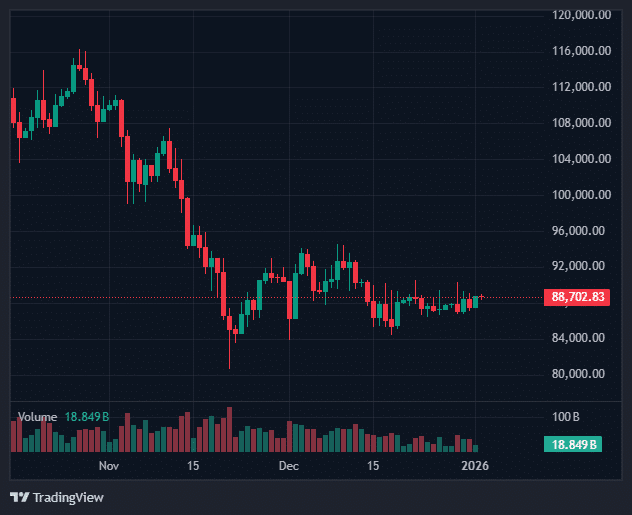
Bitcoin PriceSource: CoinMarketCap

Why This Bitcoin Bear Market Looks Different

This Bitcoin bear market lacks the chaos seen in earlier downturns. Major industry failures and forced liquidations amplified previous cycles. In contrast, the current phase shows no comparable systemic collapses.

One reason is the evolving demand structure. Institutional investors now hold a larger share of circulating supply and tend to accumulate periodically rather than react emotionally. This behavior has helped keep the Bitcoin price more stable despite weakening momentum.

What This Means For 2026 Expectations

Many forecasts still frame 2026 as a strong growth year. The Bitcoin bear market thesis complicates that view. Historically, recoveries begin only after prolonged consolidation near realized price levels.

For financial students, analysts, and developers, this phase offers a clear lesson in how market structure reshapes familiar cycles. Patience, not timing, may matter most.

Conclusion

The current Bitcoin bear market is unfolding quietly, guided by data rather than drama. Long-term indicators point to ongoing consolidation, while the Bitcoin price reflects growing restraint.

With stronger foundations and steadier demand, this cycle may be less destructive, but no less critical. Understanding it now can shape smarter decisions later.

Glossary of Key Terms

Bitcoin Bear Market: A sustained period of declining or stagnant Bitcoin prices.

Realized Price: The average acquisition price of all existing Bitcoin.

One-Year Moving Average: A long-term indicator used to identify trend direction.

Market Cycle: Repeating phases of growth, peak, decline, and recovery.

FAQs About Bitcoin Bear Market

Is Bitcoin currently in a bear market?

Several long-term indicators suggest conditions consistent with a Bitcoin bear market.

At what point can Bitcoin expect to find a base?

Analysts consensually predict a range between $56,000 and $60,000.

In what way is that the difference between this bear market and previous bear markets?

Institutional demand and fewer systemic failures help smooth out the wild gyrations.

Does this change the ultimate outlook for Bitcoin?

The answer is no. Over time, bear markets frequently clear the air, paving the way for future growth.

Sources

FinanceYahoo

CryptoQuant

CoinMarketCap

Read More: Data Signals Bitcoin Has Traded in Bear Territory Since Late 2025">Data Signals Bitcoin Has Traded in Bear Territory Since Late 2025

Market Opportunity
Bitdealer Logo
Bitdealer Price(BIT)
$0.002788
$0.002788$0.002788
-2.27%
USD
Bitdealer (BIT) Live Price Chart
Disclaimer: The articles reposted on this site are sourced from public platforms and are provided for informational purposes only. They do not necessarily reflect the views of MEXC. All rights remain with the original authors. If you believe any content infringes on third-party rights, please contact [email protected] for removal. MEXC makes no guarantees regarding the accuracy, completeness, or timeliness of the content and is not responsible for any actions taken based on the information provided. The content does not constitute financial, legal, or other professional advice, nor should it be considered a recommendation or endorsement by MEXC.

You May Also Like

The Channel Factories We’ve Been Waiting For

The Channel Factories We’ve Been Waiting For

The post The Channel Factories We’ve Been Waiting For appeared on BitcoinEthereumNews.com. Visions of future technology are often prescient about the broad strokes while flubbing the details. The tablets in “2001: A Space Odyssey” do indeed look like iPads, but you never see the astronauts paying for subscriptions or wasting hours on Candy Crush.  Channel factories are one vision that arose early in the history of the Lightning Network to address some challenges that Lightning has faced from the beginning. Despite having grown to become Bitcoin’s most successful layer-2 scaling solution, with instant and low-fee payments, Lightning’s scale is limited by its reliance on payment channels. Although Lightning shifts most transactions off-chain, each payment channel still requires an on-chain transaction to open and (usually) another to close. As adoption grows, pressure on the blockchain grows with it. The need for a more scalable approach to managing channels is clear. Channel factories were supposed to meet this need, but where are they? In 2025, subnetworks are emerging that revive the impetus of channel factories with some new details that vastly increase their potential. They are natively interoperable with Lightning and achieve greater scale by allowing a group of participants to open a shared multisig UTXO and create multiple bilateral channels, which reduces the number of on-chain transactions and improves capital efficiency. Achieving greater scale by reducing complexity, Ark and Spark perform the same function as traditional channel factories with new designs and additional capabilities based on shared UTXOs.  Channel Factories 101 Channel factories have been around since the inception of Lightning. A factory is a multiparty contract where multiple users (not just two, as in a Dryja-Poon channel) cooperatively lock funds in a single multisig UTXO. They can open, close and update channels off-chain without updating the blockchain for each operation. Only when participants leave or the factory dissolves is an on-chain transaction…
Share
BitcoinEthereumNews2025/09/18 00:09
Solana Prepares Major Consensus Upgrade with Alpenglow Protocol

Solana Prepares Major Consensus Upgrade with Alpenglow Protocol

TLDR: Alpenglow reduces Solana finality from 12.8 seconds to 100-150 milliseconds, a 100-fold improvement. Votor enables one or two-round block finalization through
Share
Blockonomi2026/01/03 02:29
Why The Green Bay Packers Must Take The Cleveland Browns Seriously — As Hard As That Might Be

Why The Green Bay Packers Must Take The Cleveland Browns Seriously — As Hard As That Might Be

The post Why The Green Bay Packers Must Take The Cleveland Browns Seriously — As Hard As That Might Be appeared on BitcoinEthereumNews.com. Jordan Love and the Green Bay Packers are off to a 2-0 start. Getty Images The Green Bay Packers are, once again, one of the NFL’s better teams. The Cleveland Browns are, once again, one of the league’s doormats. It’s why unbeaten Green Bay (2-0) is a 8-point favorite at winless Cleveland (0-2) Sunday according to betmgm.com. The money line is also Green Bay -500. Most expect this to be a Packers’ rout, and it very well could be. But Green Bay knows taking anyone in this league for granted can prove costly. “I think if you look at their roster, the paper, who they have on that team, what they can do, they got a lot of talent and things can turn around quickly for them,” Packers safety Xavier McKinney said. “We just got to kind of keep that in mind and know we not just walking into something and they just going to lay down. That’s not what they going to do.” The Browns certainly haven’t laid down on defense. Far from. Cleveland is allowing an NFL-best 191.5 yards per game. The Browns gave up 141 yards to Cincinnati in Week 1, including just seven in the second half, but still lost, 17-16. Cleveland has given up an NFL-best 45.5 rushing yards per game and just 2.1 rushing yards per attempt. “The biggest thing is our defensive line is much, much improved over last year and I think we’ve got back to our personality,” defensive coordinator Jim Schwartz said recently. “When we play our best, our D-line leads us there as our engine.” The Browns rank third in the league in passing defense, allowing just 146.0 yards per game. Cleveland has also gone 30 straight games without allowing a 300-yard passer, the longest active streak in the NFL.…
Share
BitcoinEthereumNews2025/09/18 00:41