With Bitcoin‘s waning price action extending and its value still below the $90,000 mark, many key metrics and indicators are starting to enter into negative territoryWith Bitcoin‘s waning price action extending and its value still below the $90,000 mark, many key metrics and indicators are starting to enter into negative territory

Bitcoin Sharpe Ratio Turns Negative, But History Says This Phase Could Be Significant

With Bitcoin‘s waning price action extending and its value still below the $90,000 mark, many key metrics and indicators are starting to enter into negative territory in this new year. One of the major metrics that has turned negative as the year begins is the BTC Sharpe Ratio, which measures the risk level of the flagship cryptocurrency asset.

 A Rare Bitcoin Risk-Low Opportunity Has Emerged

Ongoing volatility has hampered Bitcoin’s price action despite several attempts at an upward move, keeping the asset stuck below the $100,000 mark. Although the Bitcoin market appears vulnerable at first glance, a closer examination of risk-adjusted returns reveals a more complex picture.

Darkfost, a market expert and author at CryptoQuant, has delved into BTC’s risk performance via the Sharpe Ratio, revealing a major shift in the market. According to Darkfost, it is a tool for evaluating risk based on the volatility and returns of an asset. By comparing these two variables, analysts are able to determine periods when exposure is more or less risky.

Following his analysis of the Sharpe Ratio, the expert has disclosed that the metric has flipped into a negative territory after falling to -0.5, a move that typically unfolds during periods of market stress or transition. As seen in the chart shared by Darkfost, the metric is now approaching a historical low-risk zone.
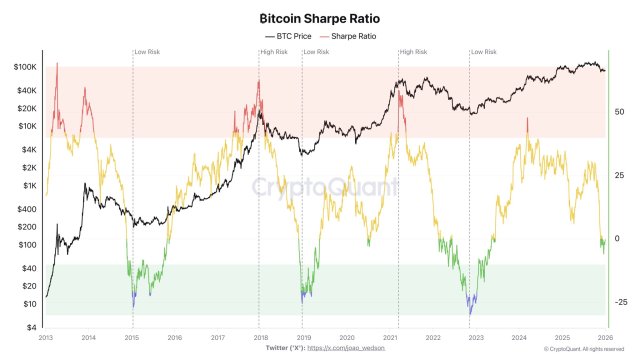
Bitcoin

Typically, when the Sharpe ratio falls to low levels, it is accompanied by high-risk periods. However, this implies that returns have been low for  Bitcoin, which is volatile by nature. In other words, investors have experienced a series of losses while volatility stays elevated.

This shift may be a sign of weakness in Bitcoin market dynamics. However, it brings Bitcoin closer to areas that have historically been associated with lower downside risk and longer-term opportunities. 

Darkfost highlighted that the best opportunities on Bitcoin typically appear after losses have already been realized and the correction has been intensified by volatility. The trend leads to significant drawdowns and negative returns. 

For this reason, a negative Sharpe ratio, such as the current drop to -0.5, may indicate a favorable Bitcoin opportunity. In the past, the best purchasing opportunities have appeared whenever this ratio has reached the extremely low-risk zone indicated on the chart.

Are Long-Term Holders Now Buying More BTC?

A report from Axel Adler Jr., a researcher and author, shows that Bitcoin long-term holders are demonstrating resilience despite current price fluctuations. Adler’s analysis focuses on the BTC LTH Distribution Pressure metric, which has undergone a key shift that could shape the market’s trajectory.

Data tells that the LTH Distribution Pressure Index has fallen to -1.628, which implies that the metric has transitioned into the Accumulation zone. The shift points to minimal selling pressure from BTC’s long-term holders, indicating renewed confidence among the cohort in the asset’s prospects.

Currently, the average daily LTH spending for Bitcoin is at 221 BTC, marking one of the lowest levels in months. Darkfost also indicated the Spent Output Profit Ratio (SOPR), which is positioned at 1.13, confirming that BTC holders remain in profit levels. With the key metrics positioned at these critical levels, the market structure seems favorable.

Bitcoin
Market Opportunity
Major Logo
Major Price(MAJOR)
$0.127
$0.127$0.127
+1.12%
USD
Major (MAJOR) Live Price Chart
Disclaimer: The articles reposted on this site are sourced from public platforms and are provided for informational purposes only. They do not necessarily reflect the views of MEXC. All rights remain with the original authors. If you believe any content infringes on third-party rights, please contact [email protected] for removal. MEXC makes no guarantees regarding the accuracy, completeness, or timeliness of the content and is not responsible for any actions taken based on the information provided. The content does not constitute financial, legal, or other professional advice, nor should it be considered a recommendation or endorsement by MEXC.

You May Also Like

The Channel Factories We’ve Been Waiting For

The Channel Factories We’ve Been Waiting For

The post The Channel Factories We’ve Been Waiting For appeared on BitcoinEthereumNews.com. Visions of future technology are often prescient about the broad strokes while flubbing the details. The tablets in “2001: A Space Odyssey” do indeed look like iPads, but you never see the astronauts paying for subscriptions or wasting hours on Candy Crush.  Channel factories are one vision that arose early in the history of the Lightning Network to address some challenges that Lightning has faced from the beginning. Despite having grown to become Bitcoin’s most successful layer-2 scaling solution, with instant and low-fee payments, Lightning’s scale is limited by its reliance on payment channels. Although Lightning shifts most transactions off-chain, each payment channel still requires an on-chain transaction to open and (usually) another to close. As adoption grows, pressure on the blockchain grows with it. The need for a more scalable approach to managing channels is clear. Channel factories were supposed to meet this need, but where are they? In 2025, subnetworks are emerging that revive the impetus of channel factories with some new details that vastly increase their potential. They are natively interoperable with Lightning and achieve greater scale by allowing a group of participants to open a shared multisig UTXO and create multiple bilateral channels, which reduces the number of on-chain transactions and improves capital efficiency. Achieving greater scale by reducing complexity, Ark and Spark perform the same function as traditional channel factories with new designs and additional capabilities based on shared UTXOs.  Channel Factories 101 Channel factories have been around since the inception of Lightning. A factory is a multiparty contract where multiple users (not just two, as in a Dryja-Poon channel) cooperatively lock funds in a single multisig UTXO. They can open, close and update channels off-chain without updating the blockchain for each operation. Only when participants leave or the factory dissolves is an on-chain transaction…
Share
BitcoinEthereumNews2025/09/18 00:09
WHAT NOT TO MISS AT CES 2026

WHAT NOT TO MISS AT CES 2026

Innovators Show Up for the World’s Most Powerful Tech Event Returning to Las Vegas January 6-9 ARLINGTON, Va., Jan. 2, 2026 /PRNewswire/ — CES® 2026, the world’
Share
AI Journal2026/01/03 02:31
Gold continues to hit new highs. How to invest in gold in the crypto market?

Gold continues to hit new highs. How to invest in gold in the crypto market?

As Bitcoin encounters a "value winter", real-world gold is recasting the iron curtain of value on the blockchain.
Share
PANews2025/04/14 17:12
