

Hyperliquid Founder Reasserts Hardline Ethos: ‘No Insiders Allowed’
Hyperliquid’s founder is doubling down on what he says is the project’s non-negotiable premise: credibility comes from refusing the usual backroom economics. In a Jan. 1 post on X, Jeff Yan framed “integrity” and “credible neutrality” as design constraints, not marketing language.
Hyperliquid Reaffirms ‘No Insiders’ Ethos
“Integrity has always been one of Hyperliquid’s core values. The house of all finance must be credibly neutral. This means no private investors, no market maker deals, and no protocol fees to any company,” he wrote, drawing a straight line between governance legitimacy and the absence of paid counterparties.
That posture also extends to the origin story. “The initial state of any blockchain is a crucial part of its story that can never be erased. The original ethos of Bitcoin was a permissionless network accessible to all. Hyperliquid’s genesis distribution followed this spirit, going entirely to early users with core contributors excluded,” the post continued, adding that “the full distribution is verifiable onchain without obfuscation.”
The founder acknowledged that this approach is not always convenient for would-be partners or ecosystem builders accustomed to preferential terms. “This principle of fairness frustrates a few users and builders who are used to special treatment,” he said, arguing it forces the community to “do things the hard way”, including “zero tolerance” for “integrity yellow flags” among team members.
It is not the first time he has put the stance in blunt terms. In a January 2024 post, he summarized the policy as: “No investors. No paid market makers. No fees to the dev team… No insiders @HyperliquidX.”
Lighter Debut Sparks Controversy
The timing matters because the on-chain perpetuals category is now fighting not just over latency and liquidity, but over distribution optics, and Hyperliquid’s most visible new rival has become a live case study.
Lighter, an Ethereum-based perpetual futures exchange that also operates as an Ethereum layer-2, launched earlier this week and has climbed quickly in the rankings. On Dec. 30, it airdropped 250 million LIT tokens, 25% of its 1 billion total supply, to early users, with another 25% set aside for future growth programs.
The controversy is the other half. Lighter allocated 50% of supply to employees and investors, subject to a one-year lockup and three-year vesting, a structure that has triggered debate across DeFi about whether “community-first” narratives still hold when insiders retain an equal share of the cap table.
In other words, Lighter’s launch has intensified the same ideological fault line Hyperliquid is trying to own: whether the cleanest on-chain market structure is primarily about product performance or about refusing the incentives that come with investors, paid liquidity, and insider allocations.
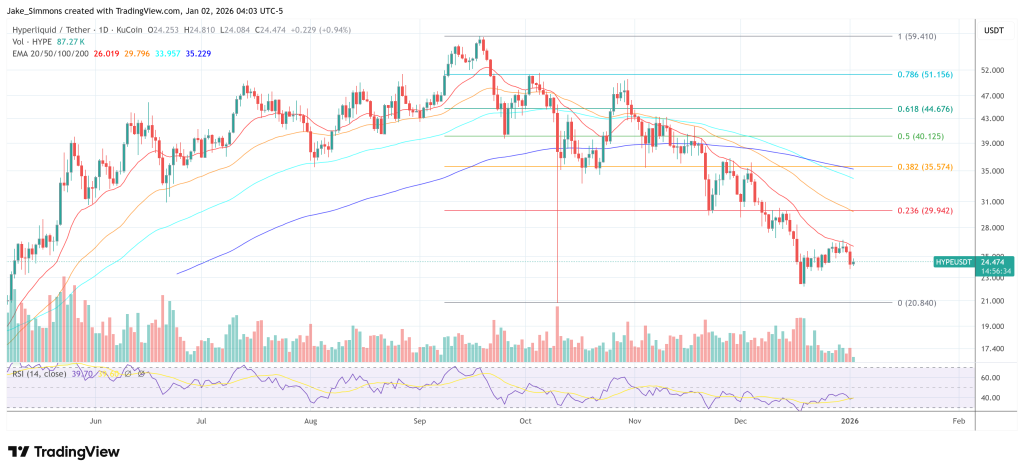
At press time, HYPE traded at $24,51.
You May Also Like

OKX Updates Proof of Reserves

Ready for 2026: SB19 announces Trilogy Concert Finale in Manila
