This article will analyze in depth three profit models that do not rely on market trends from the technical and strategic levels. This article will analyze in depth three profit models that do not rely on market trends from the technical and strategic levels.

Bear Market Survival Guide: Three Cryptocurrency Profit Strategies That Don’t Rely on Market Conditions

2025/02/16 14:01
3 min read

Original article: The DeFi Investor

Compiled by: Yuliya, PANews

Bear Market Survival Guide: Three Cryptocurrency Profit Strategies That Don’t Rely on Market Conditions

Despite the recent sluggish performance of the cryptocurrency market, there are still profit opportunities in the market that do not rely on the rise in token prices. In fact, in addition to traditional traders and investors, there are many participants who have made considerable profits in this field through other means. This article will deeply analyze three profit models that do not rely on market trends from the technical and strategic levels.

1. Airdrops and Yield Farms

In the current DeFi ecosystem, the liquidity mining and airdrop mechanism centered on top assets such as BTC, ETH, and SOL is becoming more and more perfect. Taking the Pendle protocol as an example, its smart contract supports the locking of stablecoin assets to obtain a fixed annualized rate of return (APY) of 19%, and a fixed annualized return of 12% for BTC assets. By optimizing the strategy combination and capital utilization efficiency, professional operators can achieve an annualized return of 50-80% on stablecoins.

Bear Market Survival Guide: Three Cryptocurrency Profit Strategies That Don’t Rely on Market Conditions

2. Short-selling arbitrage of high FDV new coins
Bear Market Survival Guide: Three Cryptocurrency Profit Strategies That Don’t Rely on Market Conditions

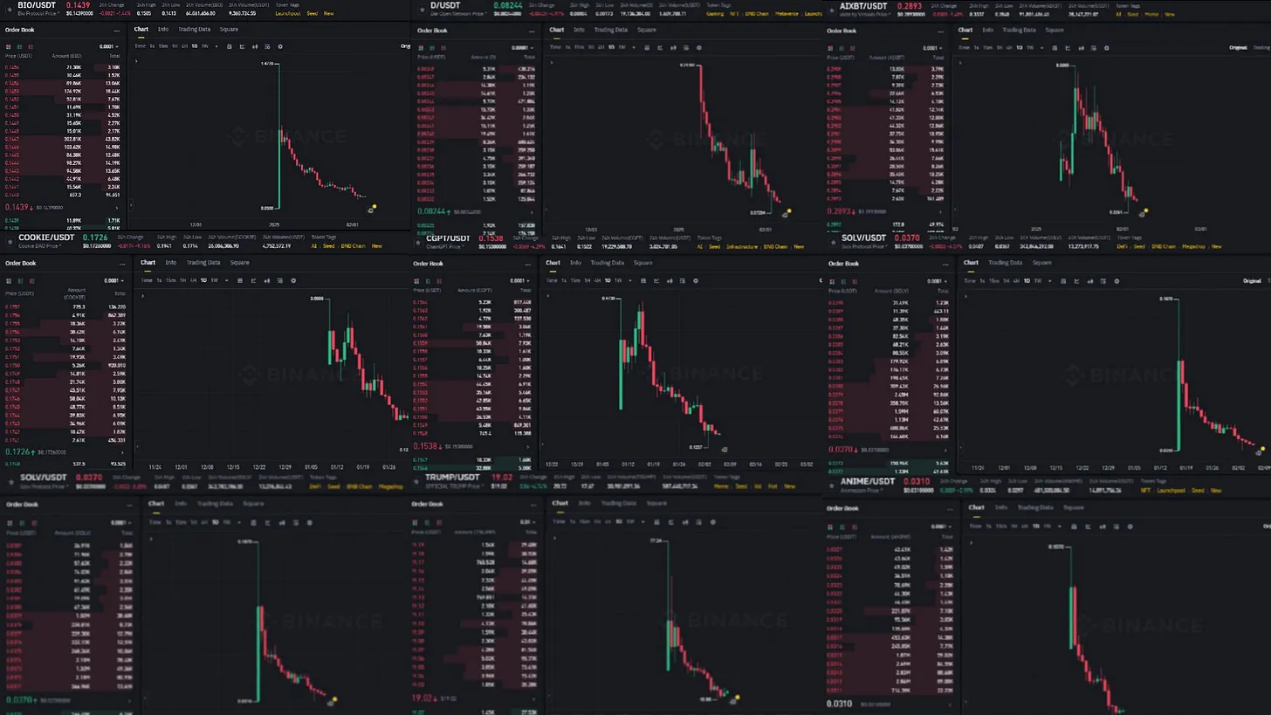
 New Tokens Recently Listed on Binance

Technical analysis of newly listed tokens on Binance shows that most tokens show a clear downward trend after TGE . This market phenomenon is mainly due to two core factors:

  • Tokens are severely decentralized : On-chain data shows that tens of thousands of tokens are issued every day
  • Imbalanced valuation system : Project owners tend to cash out early investors through high valuation models

As the saying goes: "In chaos there is opportunity". This market inefficiency provides professional traders with significant short-selling opportunities. Derivatives trading platforms represented by Hyperliquid provide an effective trading channel for short-selling strategies by quickly launching new coin perpetual contracts. However, it should be noted that considering the high volatility of newly issued tokens, it is recommended to adopt a low-leverage strategy to optimize the risk-return ratio and accumulate strategy experience through small-scale experiments.

3. Funding rate arbitrage (Delta neutral strategy)

In the pricing mechanism of the perpetual contract market, the funding rate, as a periodic settlement mechanism for long and short parties, provides arbitrageurs with significant profit margins.

  • When the funding rate is positive, the long side needs to pay fees to the short side;
  • When the funding rate is negative, shorts pay longs.

Professional traders can capture funding rate differences by building a Delta neutral portfolio. In terms of specific operations, when a significant positive funding rate is observed, a $1,000 BTC spot long position and a $1,000 contract short position can be established at the same time (funding rates can be monitored through the Coinglass platform) to obtain stable returns through market neutral strategies.

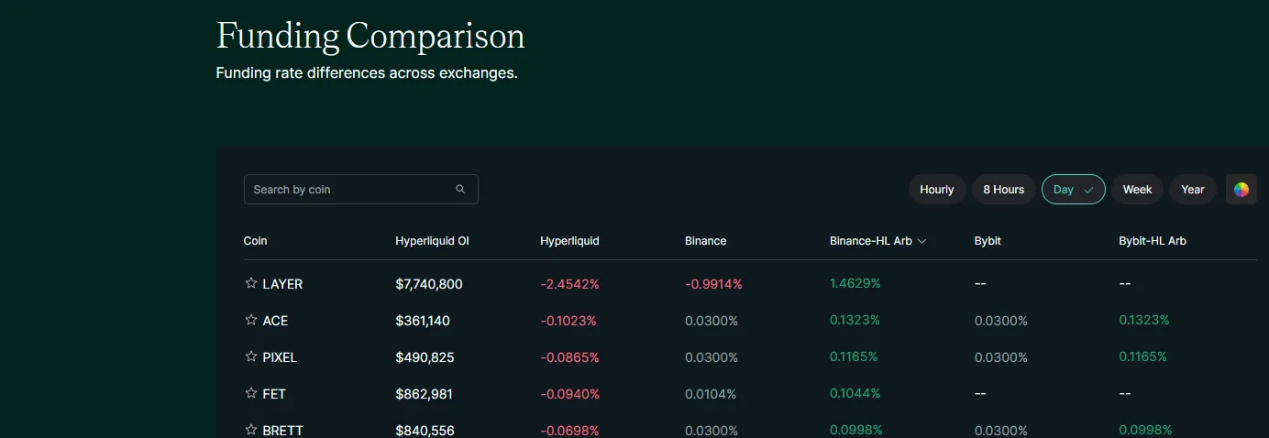
Currently, protocols such as Ethena and Resolv have developed automated funding rate arbitrage systems to provide users with passive income. However, manually operating multi-product arbitrage strategies, although more time-consuming, may still yield higher returns. Investors can use the "Funding Comparison" function section of the Hyperliquid platform to find arbitrage opportunities.
Bear Market Survival Guide: Three Cryptocurrency Profit Strategies That Don’t Rely on Market Conditions

Summarize

Even during a market downturn, there are still many opportunities in the cryptocurrency space. Contrary to popular belief, there are still many inefficiencies in the crypto market, which provides arbitrageurs with abundant profit opportunities. It is recommended that each participant should find a specific area in which they are good at and can make a profit, and continue to improve and strive to become an expert in this field.

Market Opportunity
Threshold Logo
Threshold Price(T)
$0.00796
$0.00796$0.00796
-2.13%
USD
Threshold (T) Live Price Chart
Disclaimer: The articles reposted on this site are sourced from public platforms and are provided for informational purposes only. They do not necessarily reflect the views of MEXC. All rights remain with the original authors. If you believe any content infringes on third-party rights, please contact [email protected] for removal. MEXC makes no guarantees regarding the accuracy, completeness, or timeliness of the content and is not responsible for any actions taken based on the information provided. The content does not constitute financial, legal, or other professional advice, nor should it be considered a recommendation or endorsement by MEXC.

You May Also Like

Cashing In On University Patents Means Giving Up On Our Innovation Future

Cashing In On University Patents Means Giving Up On Our Innovation Future

The post Cashing In On University Patents Means Giving Up On Our Innovation Future appeared on BitcoinEthereumNews.com. “It’s a raid on American innovation that would deliver pennies to the Treasury while kneecapping the very engine of our economic and medical progress,” writes Pipes. Getty Images Washington is addicted to taxing success. Now, Commerce Secretary Howard Lutnick is floating a plan to skim half the patent earnings from inventions developed at universities with federal funding. It’s being sold as a way to shore up programs like Social Security. In reality, it’s a raid on American innovation that would deliver pennies to the Treasury while kneecapping the very engine of our economic and medical progress. Yes, taxpayer dollars support early-stage research. But the real payoff comes later—in the jobs created, cures discovered, and industries launched when universities and private industry turn those discoveries into real products. By comparison, the sums at stake in patent licensing are trivial. Universities collectively earn only about $3.6 billion annually in patent income—less than the federal government spends on Social Security in a single day. Even confiscating half would barely register against a $6 trillion federal budget. And yet the damage from such a policy would be anything but trivial. The true return on taxpayer investment isn’t in licensing checks sent to Washington, but in the downstream economic activity that federally supported research unleashes. Thanks to the bipartisan Bayh-Dole Act of 1980, universities and private industry have powerful incentives to translate early-stage discoveries into real-world products. Before Bayh-Dole, the government hoarded patents from federally funded research, and fewer than 5% were ever licensed. Once universities could own and license their own inventions, innovation exploded. The result has been one of the best returns on investment in government history. Since 1996, university research has added nearly $2 trillion to U.S. industrial output, supported 6.5 million jobs, and launched more than 19,000 startups. Those companies pay…
Share
BitcoinEthereumNews2025/09/18 03:26
Trump foe devises plan to starve him of what he 'craves' most

Trump foe devises plan to starve him of what he 'craves' most

A longtime adversary of President Donald Trump has a plan for a key group to take away what Trump craves the most — attention. EX-CNN journalist Jim Acosta, who
Share
Rawstory2026/02/04 01:19
Why Bitcoin Is Struggling: 8 Factors Impacting Crypto Markets

Why Bitcoin Is Struggling: 8 Factors Impacting Crypto Markets

Failed blockchain adoption narratives and weak fee capture have undercut confidence in major crypto projects.
Share
CryptoPotato2026/02/04 01:05