The National Collegiate Athletic Association has asked the US Commodity Futures Trading Commission to immediately suspend college sports prediction markets, warningThe National Collegiate Athletic Association has asked the US Commodity Futures Trading Commission to immediately suspend college sports prediction markets, warning

NCAA Demands CFTC Halt $320M College Sports Betting Markets—Citing Student Safety

3 min read

The National Collegiate Athletic Association has asked the US Commodity Futures Trading Commission to immediately suspend college sports prediction markets, warning that the fast-growing sector is exposing student-athletes to heightened risks and undermining the integrity of college competition.

The request targets an estimated $320 million in active college sports markets, a figure that reflects how quickly prediction platforms have expanded into territory long dominated by regulated sportsbooks.

As Prediction Markets Grow, NCAA Pushes for Safeguards

In a letter dated January 14, 2026, NCAA President Charlie Baker urged CFTC Chairman Michael Selig to halt collegiate sports prediction trading until stronger safeguards are put in place.
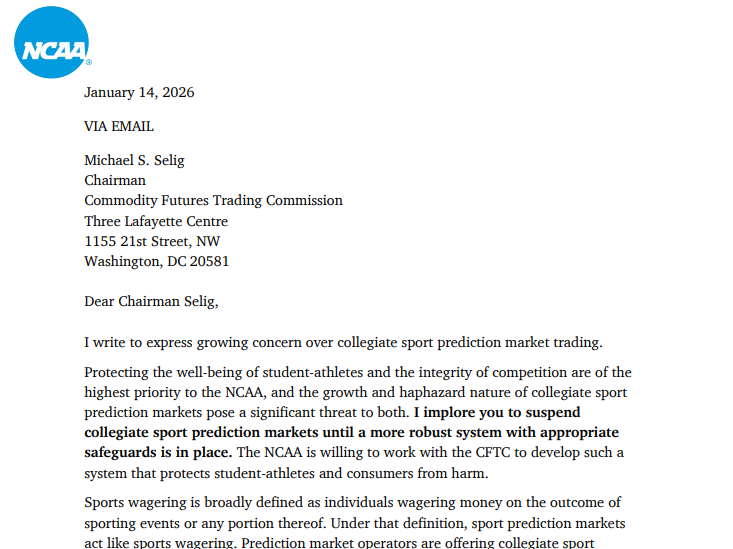
Source: NCAA

Baker argued that although prediction markets are often framed as financial products, many now function in practice like sports wagering.

NCAA noted that platforms are offering moneyline, spread, and total markets on college games that closely mirror traditional betting, while operating under a lighter regulatory framework.

The timing of the letter comes as prediction markets experience explosive growth. Total daily trading volume across major platforms reached a record $701.7 million on January 12, with sports accounting for a growing share of activity.

Source: Dune analysis

Platforms such as Kalshi and Polymarket together processed tens of billions of dollars in trades during 2025, and sports markets now represent roughly three-quarters of Kalshi’s weekly volume and nearly 40% of Polymarket’s.

That scale has drawn institutional interest, but it has also raised alarms among regulators and sports bodies.

At the center of the NCAA’s concern is student safety. Baker warned that college prediction markets often allow participants as young as 18, compared with the 21-and-over requirement in most states for sports betting.

NCAA surveys show that 58 percent of individuals aged 18 to 22 have participated in sports betting, with a significant portion reporting academic, financial, and mental health consequences.

The letter also highlighted gaps in advertising rules. While sportsbooks face restrictions on marketing to college campuses, similar limits do not consistently apply to prediction markets.

The NCAA said some students may mistakenly view prediction trading as a form of investing rather than gambling, despite the inherent unpredictability of sports outcomes.

NCAA Cites Harassment and Integrity Gaps in College Prediction Platforms

That framing, Baker argued, increases the risk of excessive participation and financial harm.

Integrity monitoring was another key issue, as the NCAA monitors more than 23,000 contests annually for suspicious activity and relies on detailed data, including bettor geolocation, to investigate irregularities.

Baker said many prediction platforms lack this level of oversight and are not required to share integrity alerts with other operators or governing bodies.

He pointed to recent efforts by prediction platforms to seek approval for markets tied to the college transfer portal as an example of activity that could create severe risks for athletes if left unchecked.

The NCAA also raised concerns about harassment, as Baker said student-athletes frequently report abuse from bettors, including online harassment tied to game outcomes.

He argued that prediction markets should be required to enforce anti-harassment measures across platforms, including banning participants who target athletes.

Harm reduction resources were also cited as missing, with the NCAA noting that many states direct sportsbook revenue toward gambling education and treatment programs on campuses, a mechanism that prediction markets do not consistently provide.

The request places the CFTC in a difficult position, as prediction markets fall under federal commodities law rather than state gambling statutes, and the agency has previously approved certain sports-related contracts.

However, the rapid growth of college-focused markets and the entry of major sports betting and fantasy operators into the space have intensified scrutiny.

Disclaimer: The articles reposted on this site are sourced from public platforms and are provided for informational purposes only. They do not necessarily reflect the views of MEXC. All rights remain with the original authors. If you believe any content infringes on third-party rights, please contact [email protected] for removal. MEXC makes no guarantees regarding the accuracy, completeness, or timeliness of the content and is not responsible for any actions taken based on the information provided. The content does not constitute financial, legal, or other professional advice, nor should it be considered a recommendation or endorsement by MEXC.

You May Also Like

Regulatory Clarity Could Drive 40% of Americans to Adopt DeFi Protocols, Survey Shows

Regulatory Clarity Could Drive 40% of Americans to Adopt DeFi Protocols, Survey Shows

Over 40% of Americans express willingness to use decentralized finance (DeFi) protocols once regulatory clarity on crypto privacy emerges, according to a recent survey from crypto advocacy organization the DeFi Education Fund (DEF). The survey, released on September 18, revealed that many Americans feel frustrated with traditional financial institutions and seek greater control over their financial assets and data. Respondents believe DeFi innovations can deliver this change by providing affordability, equity, and consumer protection. The survey was conducted with Ipsos on KnowledgePanel and included supplementary in-depth interviews in the Bronx and Queens between August 18 and 21, polling 1,321 US adults. Survey Results Show Americans Ready to Adopt DeFi Protocols The findings demonstrate that many Americans are curious about DeFi despite its early stage. 42% of Americans indicated they would likely try DeFi if proposed legislation becomes law (9% extremely/very likely and 33% somewhat likely). 84% said they would use it to “make purchases online,” while 78% would use it to “pay bills.” According to the survey, 77% would use DeFi protocols to “save money,” and 12% of Americans are “extremely” and “very” interested in learning about DeFi. Moreover, nearly 4 in 10 Americans believe that DeFi can address high transaction and service fees found in traditional finance (39%). Consistent with other probability-based sample surveys, the Ipsos x DEF research shows that almost 1 in 5 Americans (18%) have owned or used crypto at some point in their lifetime. Nearly a quarter of Americans (22%) said they’re interested in learning more about nontraditional forms of finance, such as blockchain, crypto, or decentralized finance.Source: DEF The research shows that more than half (56%) of Americans want to reclaim control of their finances. Americans are interested in having control over their money at all times, and many seek ways to send or receive money without intermediaries. One Bronx, NY resident shared his experience of needing to transfer money between accounts, but the bank required him to certify the transfer and visit in person because he couldn’t move the amount he needed remotely. He expressed frustration about the situation because “it was my money… I didn’t understand why I was given a hard time.“ More than half of surveyed Americans agree there should be a way to digitally send money to people without third-party involvement, and this number rises notably for foreign-born Americans (66%). The researchers concluded that Americans are interested in DeFi and believe DeFi can reduce friction points in today’s financial system. Regulatory Developments on DeFi Adoption in the U.S Last month, DeFi Education Fund called on the US Senate Banking Committee to rethink how it plans to regulate the decentralized finance industry after reviewing its recently published discussion draft on a key crypto market-structure bill. The response, signed on behalf of DeFi Education Fund (DEF) members including a16z Crypto, Uniswap Labs, and Paradigm, argued the Responsible Financial Innovation Act of 2025 (RFA) bill should be crafted in a more tech-neutral manner. The group also emphasized that crypto developers should be protected from “inappropriate regulation meant for intermediaries,” and that self-custody rights for all Americans are “essential.” The banking committee is now working on the discussion draft to help ensure it builds on the Digital Asset Market Clarity Act of 2025. The goal is to promote innovation in the $162 billion DeFi industry without compromising consumer protections or financial stability. On September 5, US Federal Reserve Governor Christopher Waller said there was “nothing to be afraid of” about crypto payments operating outside the traditional banking system. This statement has raised hopes among many that DeFi would soon become the new financial infrastructure for Americans and the world
Share
CryptoNews2025/09/18 21:29
Michael Burry’s Bitcoin Warning: Crypto Crash Could Drag Down Gold and Silver Markets

Michael Burry’s Bitcoin Warning: Crypto Crash Could Drag Down Gold and Silver Markets

TLDR Michael Burry warned that bitcoin’s drop below $73,000 may have forced institutions to sell up to $1 billion in gold and silver to cover crypto losses Burry
Share
Coincentral2026/02/04 15:28
Michelin-starred dimsum chain Tim Ho Wan doubles HK footprint with 10th store

Michelin-starred dimsum chain Tim Ho Wan doubles HK footprint with 10th store

For Tim Ho Wan’s chief executive officer Young Sheng Lee, the brand’s aggressive expansion in its home turf helped create a proven growth model that can be replicated
Share
Rappler2026/02/04 15:27
