BlackRock reported $14.1 billion in digital asset net inflows for the second quarter of 2025, pushing the firm’s total assets under management (AUM) in this segment to $79.6 billion. Although digital assets still represent just 1% of BlackRock’s $12.5 trillion in total AUM, the category is emerging as one of its fastest-growing product lines. Digital assets contributed hugely to BlackRock’s broader ETF performance. Within the firm’s $85 billion in total ETF inflows during Q2, digital products alone accounted for $14 billion. Year-to-date, digital asset net inflows have reached $17 billion, showing persistent institutional interest despite a complex macroeconomic backdrop. Revenue Contribution Remains Modest—For Now Digital assets generated $40 million in base fees and securities lending revenue in Q2 2025, also accounting for 1% of BlackRock’s total revenue from investment advisory and administration services. While modest compared to traditional asset classes, the figure reflects a growing stream of yield-generating exposure from crypto-related products . CEO Larry Fink attributed some of the firm’s performance momentum to digital assets, along with custom strategies and technology-led platforms like Aperio. BlackRock Shows Long-Term Commitment to Digital Finance In a statement accompanying the results, CEO Larry Fink emphasized the growing role of digital assets in attracting a new generation of investors. “We’re attracting a new and increasingly global generation of investors through things like our digital assets offerings,” he said. Digital assets are currently reported under the ETF category, alongside core equity and fixed income. However, with digital assets contributing nearly 31% of alternative product flows in Q2, they are becoming a key pillar of the firm’s alternative investment strategy. While digital assets remain a small slice of the overall portfolio, BlackRock’s growing involvement in tokenized finance, ETFs, and related infrastructure suggests a long-term commitment to institutional crypto adoption. “These are just the early days in our next phase of even stronger growth,” Fink added. BlackRock Shares Tumble BlackRock shares fell more than 6% after a major institutional client based in Asia withdrew $52 billion from its index funds during the second quarter, the Wall Street Journal reported. The withdrawal illustrates the volatility that even the world’s largest asset manager can face from a small number of large clients, particularly in passive investment vehicles. Still, BlackRock’s overall performance remained strong, with total assets under management climbing to a record $12.53 trillion. According to the WSJ , net income rose 6.5% year-over-year to $1.59 billion, indicating operational resilience in the face of short-term outflows. The firm also reported increased revenue driven by higher base fees and strong flows into active strategies and ETFs, suggesting that BlackRock continues to diversify its growth drivers beyond traditional index products.BlackRock reported $14.1 billion in digital asset net inflows for the second quarter of 2025, pushing the firm’s total assets under management (AUM) in this segment to $79.6 billion. Although digital assets still represent just 1% of BlackRock’s $12.5 trillion in total AUM, the category is emerging as one of its fastest-growing product lines. Digital assets contributed hugely to BlackRock’s broader ETF performance. Within the firm’s $85 billion in total ETF inflows during Q2, digital products alone accounted for $14 billion. Year-to-date, digital asset net inflows have reached $17 billion, showing persistent institutional interest despite a complex macroeconomic backdrop. Revenue Contribution Remains Modest—For Now Digital assets generated $40 million in base fees and securities lending revenue in Q2 2025, also accounting for 1% of BlackRock’s total revenue from investment advisory and administration services. While modest compared to traditional asset classes, the figure reflects a growing stream of yield-generating exposure from crypto-related products . CEO Larry Fink attributed some of the firm’s performance momentum to digital assets, along with custom strategies and technology-led platforms like Aperio. BlackRock Shows Long-Term Commitment to Digital Finance In a statement accompanying the results, CEO Larry Fink emphasized the growing role of digital assets in attracting a new generation of investors. “We’re attracting a new and increasingly global generation of investors through things like our digital assets offerings,” he said. Digital assets are currently reported under the ETF category, alongside core equity and fixed income. However, with digital assets contributing nearly 31% of alternative product flows in Q2, they are becoming a key pillar of the firm’s alternative investment strategy. While digital assets remain a small slice of the overall portfolio, BlackRock’s growing involvement in tokenized finance, ETFs, and related infrastructure suggests a long-term commitment to institutional crypto adoption. “These are just the early days in our next phase of even stronger growth,” Fink added. BlackRock Shares Tumble BlackRock shares fell more than 6% after a major institutional client based in Asia withdrew $52 billion from its index funds during the second quarter, the Wall Street Journal reported. The withdrawal illustrates the volatility that even the world’s largest asset manager can face from a small number of large clients, particularly in passive investment vehicles. Still, BlackRock’s overall performance remained strong, with total assets under management climbing to a record $12.53 trillion. According to the WSJ , net income rose 6.5% year-over-year to $1.59 billion, indicating operational resilience in the face of short-term outflows. The firm also reported increased revenue driven by higher base fees and strong flows into active strategies and ETFs, suggesting that BlackRock continues to diversify its growth drivers beyond traditional index products.

BlackRock’s Q2 Digital Asset Inflows Reach $14B, Total AUM Hits $79.6B

3 min read

BlackRock reported $14.1 billion in digital asset net inflows for the second quarter of 2025, pushing the firm’s total assets under management (AUM) in this segment to $79.6 billion.

Although digital assets still represent just 1% of BlackRock’s $12.5 trillion in total AUM, the category is emerging as one of its fastest-growing product lines.
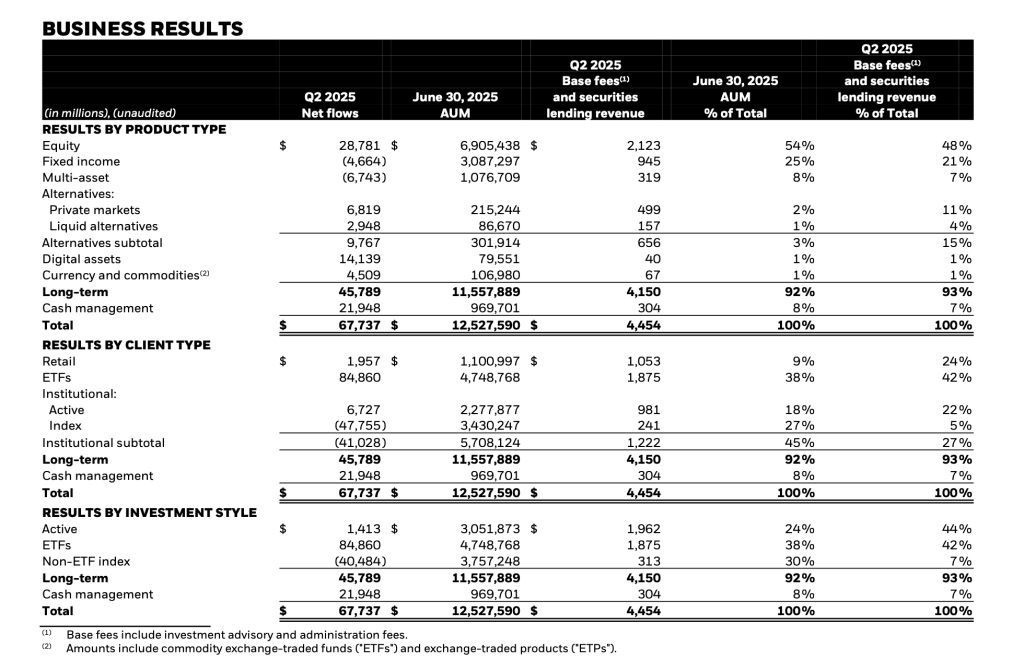
Digital assets contributed hugely to BlackRock’s broader ETF performance. Within the firm’s $85 billion in total ETF inflows during Q2, digital products alone accounted for $14 billion.

Year-to-date, digital asset net inflows have reached $17 billion, showing persistent institutional interest despite a complex macroeconomic backdrop.

Revenue Contribution Remains Modest—For Now

Digital assets generated $40 million in base fees and securities lending revenue in Q2 2025, also accounting for 1% of BlackRock’s total revenue from investment advisory and administration services.

While modest compared to traditional asset classes, the figure reflects a growing stream of yield-generating exposure from crypto-related products.

CEO Larry Fink attributed some of the firm’s performance momentum to digital assets, along with custom strategies and technology-led platforms like Aperio.

BlackRock Shows Long-Term Commitment to Digital Finance

In a statement accompanying the results, CEO Larry Fink emphasized the growing role of digital assets in attracting a new generation of investors.

“We’re attracting a new and increasingly global generation of investors through things like our digital assets offerings,” he said.

Digital assets are currently reported under the ETF category, alongside core equity and fixed income. However, with digital assets contributing nearly 31% of alternative product flows in Q2, they are becoming a key pillar of the firm’s alternative investment strategy.

While digital assets remain a small slice of the overall portfolio, BlackRock’s growing involvement in tokenized finance, ETFs, and related infrastructure suggests a long-term commitment to institutional crypto adoption.

“These are just the early days in our next phase of even stronger growth,” Fink added.

BlackRock Shares Tumble

BlackRock shares fell more than 6% after a major institutional client based in Asia withdrew $52 billion from its index funds during the second quarter, the Wall Street Journal reported.

The withdrawal illustrates the volatility that even the world’s largest asset manager can face from a small number of large clients, particularly in passive investment vehicles.

Still, BlackRock’s overall performance remained strong, with total assets under management climbing to a record $12.53 trillion.

According to the WSJ, net income rose 6.5% year-over-year to $1.59 billion, indicating operational resilience in the face of short-term outflows.

The firm also reported increased revenue driven by higher base fees and strong flows into active strategies and ETFs, suggesting that BlackRock continues to diversify its growth drivers beyond traditional index products.

Market Opportunity
Streamflow Logo
Streamflow Price(STREAM)
$0.01504
$0.01504$0.01504
+0.26%
USD
Streamflow (STREAM) Live Price Chart
Disclaimer: The articles reposted on this site are sourced from public platforms and are provided for informational purposes only. They do not necessarily reflect the views of MEXC. All rights remain with the original authors. If you believe any content infringes on third-party rights, please contact [email protected] for removal. MEXC makes no guarantees regarding the accuracy, completeness, or timeliness of the content and is not responsible for any actions taken based on the information provided. The content does not constitute financial, legal, or other professional advice, nor should it be considered a recommendation or endorsement by MEXC.

You May Also Like

Regulatory Clarity Could Drive 40% of Americans to Adopt DeFi Protocols, Survey Shows

Regulatory Clarity Could Drive 40% of Americans to Adopt DeFi Protocols, Survey Shows

Over 40% of Americans express willingness to use decentralized finance (DeFi) protocols once regulatory clarity on crypto privacy emerges, according to a recent survey from crypto advocacy organization the DeFi Education Fund (DEF). The survey, released on September 18, revealed that many Americans feel frustrated with traditional financial institutions and seek greater control over their financial assets and data. Respondents believe DeFi innovations can deliver this change by providing affordability, equity, and consumer protection. The survey was conducted with Ipsos on KnowledgePanel and included supplementary in-depth interviews in the Bronx and Queens between August 18 and 21, polling 1,321 US adults. Survey Results Show Americans Ready to Adopt DeFi Protocols The findings demonstrate that many Americans are curious about DeFi despite its early stage. 42% of Americans indicated they would likely try DeFi if proposed legislation becomes law (9% extremely/very likely and 33% somewhat likely). 84% said they would use it to “make purchases online,” while 78% would use it to “pay bills.” According to the survey, 77% would use DeFi protocols to “save money,” and 12% of Americans are “extremely” and “very” interested in learning about DeFi. Moreover, nearly 4 in 10 Americans believe that DeFi can address high transaction and service fees found in traditional finance (39%). Consistent with other probability-based sample surveys, the Ipsos x DEF research shows that almost 1 in 5 Americans (18%) have owned or used crypto at some point in their lifetime. Nearly a quarter of Americans (22%) said they’re interested in learning more about nontraditional forms of finance, such as blockchain, crypto, or decentralized finance.Source: DEF The research shows that more than half (56%) of Americans want to reclaim control of their finances. Americans are interested in having control over their money at all times, and many seek ways to send or receive money without intermediaries. One Bronx, NY resident shared his experience of needing to transfer money between accounts, but the bank required him to certify the transfer and visit in person because he couldn’t move the amount he needed remotely. He expressed frustration about the situation because “it was my money… I didn’t understand why I was given a hard time.“ More than half of surveyed Americans agree there should be a way to digitally send money to people without third-party involvement, and this number rises notably for foreign-born Americans (66%). The researchers concluded that Americans are interested in DeFi and believe DeFi can reduce friction points in today’s financial system. Regulatory Developments on DeFi Adoption in the U.S Last month, DeFi Education Fund called on the US Senate Banking Committee to rethink how it plans to regulate the decentralized finance industry after reviewing its recently published discussion draft on a key crypto market-structure bill. The response, signed on behalf of DeFi Education Fund (DEF) members including a16z Crypto, Uniswap Labs, and Paradigm, argued the Responsible Financial Innovation Act of 2025 (RFA) bill should be crafted in a more tech-neutral manner. The group also emphasized that crypto developers should be protected from “inappropriate regulation meant for intermediaries,” and that self-custody rights for all Americans are “essential.” The banking committee is now working on the discussion draft to help ensure it builds on the Digital Asset Market Clarity Act of 2025. The goal is to promote innovation in the $162 billion DeFi industry without compromising consumer protections or financial stability. On September 5, US Federal Reserve Governor Christopher Waller said there was “nothing to be afraid of” about crypto payments operating outside the traditional banking system. This statement has raised hopes among many that DeFi would soon become the new financial infrastructure for Americans and the world
Share
CryptoNews2025/09/18 21:29
Michael Burry’s Bitcoin Warning: Crypto Crash Could Drag Down Gold and Silver Markets

Michael Burry’s Bitcoin Warning: Crypto Crash Could Drag Down Gold and Silver Markets

TLDR Michael Burry warned that bitcoin’s drop below $73,000 may have forced institutions to sell up to $1 billion in gold and silver to cover crypto losses Burry
Share
Coincentral2026/02/04 15:28
Michelin-starred dimsum chain Tim Ho Wan doubles HK footprint with 10th store

Michelin-starred dimsum chain Tim Ho Wan doubles HK footprint with 10th store

For Tim Ho Wan’s chief executive officer Young Sheng Lee, the brand’s aggressive expansion in its home turf helped create a proven growth model that can be replicated
Share
Rappler2026/02/04 15:27
