

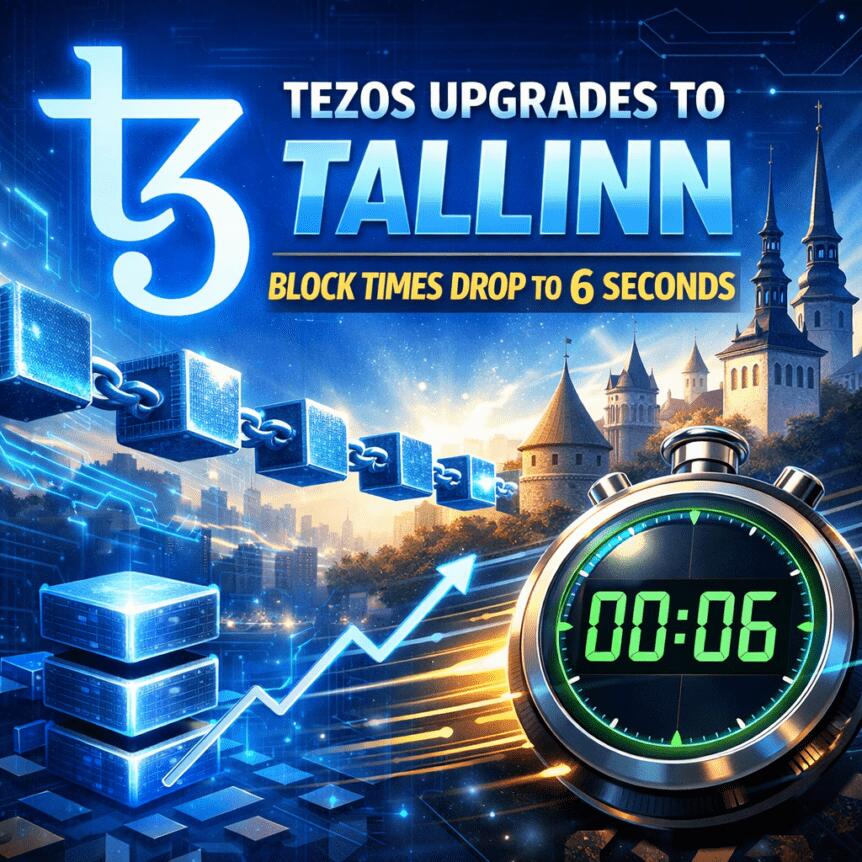
Tezos Upgrades to Tallinn; Block Times Drop to 6 Seconds
Introduction
Tezos (XTZ) has unveiled Tallinn, its latest protocol upgrade, marking a significant step in the network’s ongoing effort to boost throughput and reduce cost. The update, Tezos’ 20th protocol revision, lowers base-layer block times to about 6 seconds and introduces an optimization that could shorten settlement times for on-chain transactions. Central to Tallinn is a shift in how blocks are attested: all network validators, known as bakers, can attest to every block, a change enabled by aggregate BLS cryptographic signatures. The development aims to reduce latency and storage overhead, potentially enabling broader use cases on the Tezos ecosystem.
Key Takeaways
– Tallinn is Tezos’ 20th protocol upgrade and targets faster finality by enabling all bakers to attest to each block, rather than a subset.
– The upgrade uses BLS signatures to aggregate attestations, significantly lightening node workloads and potentially enabling further reductions in block time.
– An address indexing mechanism introduced with Tallinn claims to cut redundant address data, boosting storage efficiency by up to 100x for applications built on Tezos.
– The upgrade aligns Tezos with a broader industry push toward higher-throughput blockchains capable of supporting more complex use cases and faster settlement.
– The changes come amid a wider discussion of layer-2 scaling and modular designs across major networks, as users and developers seek faster, cheaper transactions.
Tickers mentioned: $BTC, $ETH, $XTZ, $SOL
Sentiment: Neutral
Price impact: Positive. The Tallinn upgrade could improve network efficiency and application performance, though it does not constitute financial advice.
Trading idea (Not Financial Advice): Hold. The upgrade signals ongoing maturation of Tezos but does not alone drive investment decisions.
Market context: The trajectory toward faster, more scalable blockchain networks continues to shape the sector, with networks experimenting with tiered architectures, L2 infrastructures, and modular designs to balance security, throughput, and data availability.
Why it matters
Tezos’ Tallinn upgrade underscores the platform’s commitment to closing the gap with higher-throughput networks while preserving on-chain governance and security properties. By enabling every baker to attest to each block through aggregated signatures, Tallinn reduces the computational burden previously placed on individual validators. This design aims to maintain decentralized finality guarantees while enabling faster block production, a combination that could expand Tezos’ appeal for on-chain applications requiring lower latency.
The storage efficiency gain, driven by the new address indexing mechanism, is another notable development. Tezos executives described the improvement as removing redundant address data, claiming storage costs for certain applications can be dramatically reduced—reported as a 100x improvement in storage efficiency. In practical terms, developers and wallets operating on Tezos could see lower infrastructure costs and faster onboarding of users whose interactions generate large address datasets. If the headline efficiency persists in production, it could influence the cost structure of building and running Tezos-based services, potentially supporting broader adoption.
This upgrade also sits within a broader industry context where blockchains are increasingly measured by throughput and finality latency as much as security guarantees. The industry has long recognized the need for scale beyond single-layer base protocols. Some networks pursue layer-2 solutions, including payment channels and rollups, to shoulder transaction execution off-chain while preserving a secure settlement on the base layer. For Bitcoin (CRYPTO: BTC), the system’s typical 10-minute block times have driven development of off-chain networks like the Lightning Network to facilitate payments at higher speeds. The Bitcoin network’s base-layer speed limitations have catalyzed diverse layer-2 approaches, a trend that Tezos appears to be addressing from a different architectural angle.
In the broader ecosystem, Ethereum (CRYPTO: ETH) has pursued a modular approach to scaling, with multiple layers handling execution, consensus, and data availability. By contrast, some monolithic networks, such as Solana (CRYPTO: SOL), aim to consolidate functions into a single layer, a design philosophy that has its own trade-offs. Tallinn’s emphasis on reducing block time and storage overhead illustrates Tezos’ preference for practical throughput gains within a formally governed, proof-of-stake framework.
This progression comes as the sector continues to weigh the balance between on-chain scalability and the user experience, with industry observers highlighting the ongoing importance of improved finality times, lower transaction fees, and better on-chain data efficiency as core levers for broader usage.
What to watch next
– Monitor Tezos baker activity and block finality metrics post-Tallinn to gauge the practical impact of full-block attestations.
– Track the adoption rate of the new address indexing feature and any downstream effects on on-chain storage costs for dApps.
– Review network performance data for changes in latency, throughput, and finality times over the next several network epochs.
– Look for developer feedback and ecosystem tooling updates that integrate with Tallinn’s changes, including wallet and node software support.
– Watch for any subsequent protocol proposals or governance votes that refine or extend Tallinn’s capabilities or address any edge cases encountered in production.
Sources & verification
– Tezos official communications and governance documents detailing Tallinn’s features and objectives.
– Public statements from Tezos project spokespeople regarding BLS-based aggregation and per-block attestations.
– Technical analyses and on-chain data dashboards tracking finality times, attestations, and storage usage post-upgrade.
– Related readings on scaling approaches across major blockchains, including references to Lightning Network and modular vs monolithic architectures.
– Supplementary material on Ethereum’s scaling philosophy and monolithic designs, including industry write-ups and editorial coverage where applicable.
Rewritten article body
Tezos Tallinn upgrade accelerates block finality and storage efficiency
Tezos (XTZ) has rolled out Tallinn, its 20th protocol upgrade, a development that targets faster finality and lower operating costs for applications running atop the network. The upgrade delivers a base-layer block time around six seconds, a meaningful improvement for dApps and users seeking quicker settlement. In a notable architectural shift, Tallinn enables all bakers—Tezos’ validators—to attest to every block. This universal attestation replaces the prior model in which a subset of validators verified blocks, a move designed to reduce attestation latency and distribution overhead.
Spokespeople for Tezos explained that the shift is enabled by a BLS (Boneh–Lynn–Shacham) cryptographic scheme, which aggregates hundreds of signatures into a single one per block. The practical effect is a lighter load on validator nodes and the potential for further reductions in block time as the network grows. “This is achieved through the use of BLS cryptographic signatures, which aggregate hundreds of signatures into just one per block. By lightening the load on nodes, it also opens the door to further block time reductions,” Tezos representatives stated.
Alongside this consensus optimization, Tallinn introduces an address indexing mechanism that trims redundant address data. According to Tezos, the storage efficiency for on-chain data is improved by a factor of 100, a development that could meaningfully lower the cost of running applications and services on the Tezos ecosystem. The approach aligns with a broader industry emphasis on reducing data bloat and improving on-chain storage economics, particularly as developers build more complex and data-intensive dApps on L1 networks.
As the industry continues to pursue faster and higher-throughput blockchain networks, Tallinn’s design choices reflect a pragmatic balance of security, decentralization and performance. The upgrade underscores Tezos’ ongoing evolution within a crowded field that includes discussions around scalable Layer 2s, modular designs and alternative architectures that aim to deliver lower latency without compromising governance or security.
Block times and throughput have seen dramatic shifts since the early days of distributed ledgers. The first generation of blockchains, such as Bitcoin (CRYPTO: BTC) and Ethereum (CRYPTO: ETH), operated at roughly seven and 15–30 transactions per second (TPS), respectively. The Bitcoin protocol targets blocks every ~10 minutes, a cadence that has long limited the feasibility of everyday payments on the base chain. This reality has spurred a spectrum of scaling solutions, with Bitcoin relying on off-chain channels and networks designed to settle the net result later on the base layer. The Lightning Network, for instance, creates off-chain payment channels that can be settled in a single on-chain transaction after a channel closes.
The Ethereum ecosystem has pursued a modular scaling approach, separating execution, consensus and data availability layers and fostering an ecosystem of Layer 2 (L2) networks that handle most transaction execution. In contrast, monolithic blockchain networks like Solana (CRYPTO: SOL) consolidate these functions within a single layer, a design that influences performance, data availability and resilience trade-offs. Tallinn’s emphasis on reducing block time and storage footprint parallels ongoing industry conversations about the best paths to scalability while maintaining robust security and governance — a balance Tezos continues to navigate as it expands its operational footprint.
In parallel, the industry continues to explore how scaling innovations translate into real-world usage. For Tezos, Tallinn could unlock new use cases that demand rapid finality, such as micro-payments, real-time settlement for decentralized applications, and more responsive governance processes that rely on timely on-chain voting and updates. The upgrade, while technical in nature, is a signal of Tezos’ intent to remain competitive by delivering tangible improvements in efficiency and reliability for developers and users alike.
As the ecosystem weighs the implications of these changes, observers will watch for how Tallinn affects dApp performance, wallet operations and the cost structure of on-chain storage. The upgrade is one piece of a wider mosaic in which networks strive to strike a balance between throughput, decentralization and user experience, a balance that ultimately determines long-term viability and adoption.
This article was originally published as Tezos Upgrades to Tallinn; Block Times Drop to 6 Seconds on Crypto Breaking News – your trusted source for crypto news, Bitcoin news, and blockchain updates.
You May Also Like

Cashing In On University Patents Means Giving Up On Our Innovation Future

VectorUSA Achieves Fortinet’s Engage Preferred Services Partner Designation
