Today, Russia’s Prosecutor General has officially added Ukrainian crypto exchange WhiteBit, its parent W Group, and all affiliates to the list of “undesirable organizationsToday, Russia’s Prosecutor General has officially added Ukrainian crypto exchange WhiteBit, its parent W Group, and all affiliates to the list of “undesirable organizations

Russia Escalates Crypto Enforcement, Adds WhiteBit to Undesirable List

3 min read

Today, Russia’s Prosecutor General has officially added Ukrainian crypto exchange WhiteBit, its parent W Group, and all affiliates to the list of “undesirable organizations.”

The move effectively prohibits operations or collaborations with these organizations within Russia and exposes local individuals or companies to potential legal penalties under Russian law.

Authorities allege WhiteBit facilitated the transfer of funds from Russia to Ukraine, including contributions supporting the country’s armed forces.

Officials claim the exchange’s infrastructure enabled complex transactions beyond typical crypto trading and provided technical support to Ukraine’s state-backed fundraising platform, United24.

While these allegations have not been independently verified, they reflect Moscow’s increasingly strict approach to foreign crypto activity.

Also Read: XRP Holds $1.90 as Spot ETF Inflows Signal Renewed Demand

Russian investigators estimate that WhiteBit management moved roughly $11 million from Russia to Ukraine since 2022. Authorities claim nearly $900,000 of that sum was used to purchase drones for Ukraine’s armed forces.

Investigators also highlight cooperation with Ukraine’s Ministry of Foreign Affairs, portraying WhiteBit as a facilitator of cross-border financial support for military operations.

The Prosecutor General frames the case as part of a broader national security project to close down financial channels that are considered adversarial.

This position may have the effect of discouraging foreign exchanges from doing business with Russian clients and will inform how international digital asset exchanges approach compliance on a global basis.

Broader Crypto Crackdown in Russia

The WhiteBit case takes place while Russia continues to move forward with its plans to reform its local digital asset laws. Currently, there is no cryptocurrency exchange operating in Russia that is fully registered locally.

The Bank of Russia plans to make intermediaries more accountable, with plans to introduce regulations by July 1, 2027, that will hold them responsible for engaging in illegal activities related to cryptocurrencies.

According to experts, the WhiteBit case provides insight into how Russian authorities are likely to enforce such regulations. It appears that foreign cryptocurrency exchanges may be under the spotlight, and users in Russia may find it more difficult to access foreign cryptocurrency services.

Why This Matters

Geopolitical enforcement is emerging as a trend as Russia increases its use of formal legal designations to target foreign cryptocurrency platforms. This is an indication of increased risk for entities involved with the Russian market.

The WhiteBit case is a clear example of how cross-border cryptocurrency services can face restrictions, which can affect traders, exchanges, and users in Russia.

Also Read: ApeCoin Downtrend Exhaustion Builds Case For $0.55

Disclaimer: The articles reposted on this site are sourced from public platforms and are provided for informational purposes only. They do not necessarily reflect the views of MEXC. All rights remain with the original authors. If you believe any content infringes on third-party rights, please contact [email protected] for removal. MEXC makes no guarantees regarding the accuracy, completeness, or timeliness of the content and is not responsible for any actions taken based on the information provided. The content does not constitute financial, legal, or other professional advice, nor should it be considered a recommendation or endorsement by MEXC.

You May Also Like

Once Upon a Farm Announces Pricing of Initial Public Offering

Once Upon a Farm Announces Pricing of Initial Public Offering

BERKELEY, Calif.–(BUSINESS WIRE)–Once Upon a Farm today announced the pricing of its initial public offering of 10,997,209 shares of its common stock, 7,631,537
Share
AI Journal2026/02/06 08:15
Forward Industries Bets Big on Solana With $4B Capital Plan
Forward Industries Bets Big on Solana With $4B Capital Plan

The firm has filed with the U.S. Securities and Exchange Commission to launch a $4 billion at-the-market (ATM) equity program, […] The post Forward Industries Bets Big on Solana With $4B Capital Plan appeared first on Coindoo.
Share
Coindoo2025/09/18 04:15
332M accounts and $28B TVL,

332M accounts and $28B TVL,

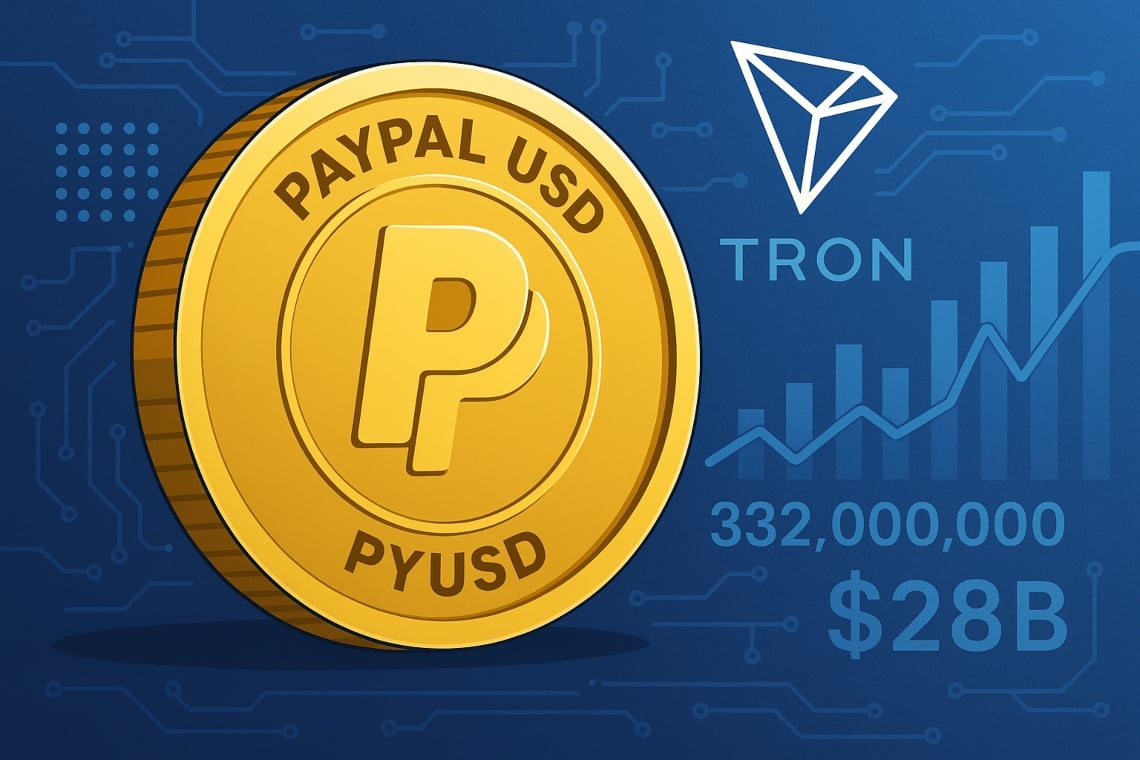
The post 332M accounts and $28B TVL, appeared on BitcoinEthereumNews.com. PayPal USD debuts on TRON as a permissionless token PYUSD0, enabled by LayerZero’s OFT standard and the Stargate Hydra extension. The announcement on September 18, 2025 (Geneva) introduces native interoperability between chains and transfers without manual steps for users; the news echoes elements already communicated by PayPal at the launch of PYUSD PayPal Newsroom. The move concerns an ecosystem that includes 332 million accounts and over $28 billion in TVL. In this context, the fungibility of a stablecoin regulated across multiple networks and the use of TRON as a settlement layer for payments and remittances is at stake. According to the data collected by TRONSCAN updated as of September 18, 2025, the network metrics confirm the cited volumes and highlighted traffic patterns. Our editorial team has verified the transaction logs and monitored the public chain metrics to corroborate the reported figures; the observations on daily flows and TVL are consistent with the network dashboards. Industry analysts observe that the entry of a regulated issuer like PayPal tends to increase institutional interest, provided there is transparency on reserves and compliance checks. What is PYUSD0 on TRON and why is it relevant PYUSD0 is the representation of PayPal USD on TRON. It is pegged one-to-one to PYUSD through the OFT standard: the two tokens remain a single stablecoin, fungible and reconciled across chains. The integration is made possible by Stargate Hydra, now operational through LayerZero. According to the founder of TRON, Justin Sun, the extension on TRON expands access and trust for users and institutions. For Bryan Pellegrino (CEO of LayerZero Labs), stablecoins represent a pillar of global payments and remittances, as the native compatibility between chains enables their operational scalability. It must be said that the alignment between issuer, cross-chain infrastructure, and settlement network is a key element. Key Numbers: TRON…
Share
BitcoinEthereumNews2025/09/19 08:18