TLDR Solana traders are increasing long positions in derivatives markets, suggesting expectations of price gains SOL is trading near $127.35 with a market cap ofTLDR Solana traders are increasing long positions in derivatives markets, suggesting expectations of price gains SOL is trading near $127.35 with a market cap of

Solana (SOL) Price: Traders Bet on Recovery as Long Positions Jump

3 min read

TLDR

  • Solana traders are increasing long positions in derivatives markets, suggesting expectations of price gains
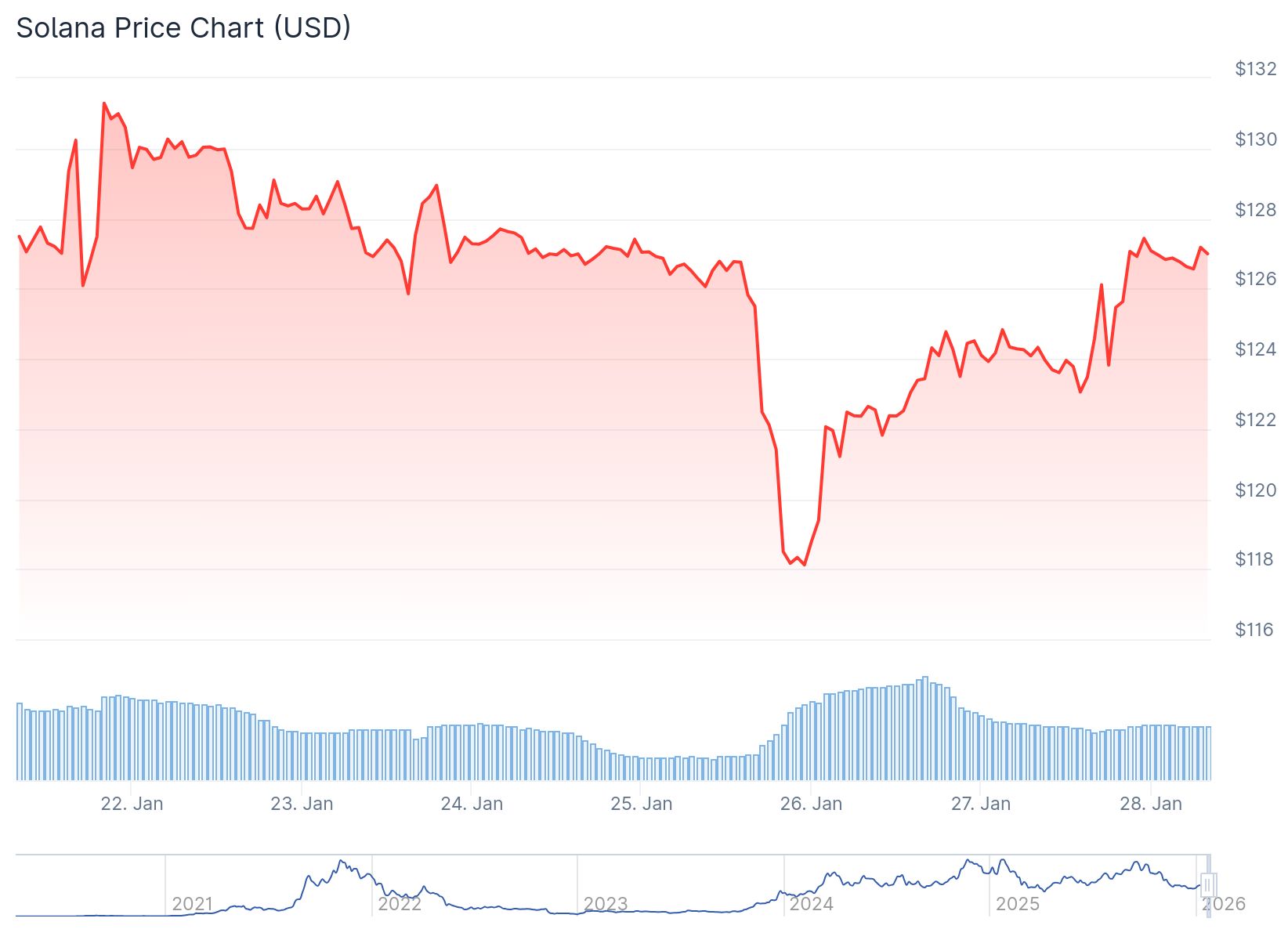
  • SOL is trading near $127.35 with a market cap of $72.08 billion after weeks of pressure
  • The shift comes after a recent slump tied to market worries and legal concerns
  • Solana’s fast transaction speeds and low costs continue attracting new projects and traders
  • Long-heavy positioning can reverse quickly through liquidations if prices drop

Solana traders are placing more long bets in derivatives markets after weeks of hesitation. Data shows more traders are opening positions that profit from price increases rather than declines.
Solana (SOL) PriceSolana (SOL) Price

SOL is currently trading near $127.35 with a market cap of $72.08 billion. The token has been holding near recent resistance levels as buying interest slowly returns.

Going long means betting that prices will rise. Traders use derivatives contracts linked to SOL’s price instead of buying the actual token.

Right now, long positions outnumber short positions. Short positions make money when prices fall, so this imbalance shows traders expect higher prices ahead.

The increase in bullish positioning follows a difficult period for SOL. The token spent weeks under pressure from broader market concerns and legal issues.

During that time, many traders stepped back. Trading activity slowed and confidence weakened across the market.

Return of Confidence

The return of long bets suggests some traders believe the worst news is already priced in. That belief alone can bring buyers back into the market.

Staking activity on Solana has remained steady during the downturn. When people lock up tokens to earn rewards, it often shows long-term trust in the network.

Solana stays popular with traders because of its speed and low costs. Transactions settle in seconds and cost very little compared to other networks.

The network continues attracting new projects ranging from finance apps to tokenized assets. More activity on Solana usually means more demand for SOL to pay transaction fees.

Network History Remains a Factor

Past network outages and recent security concerns have not been forgotten. These issues make some traders quick to exit when markets turn unstable.

Rallies driven by derivatives positioning can reverse quickly. When too many traders hold long positions, even small price drops can trigger forced selling.

These liquidations can wipe out gains in minutes. Beginners often feel the impact most because they tend to enter positions late.

Trader positioning often changes before prices move. When confidence appears early, price movements sometimes follow later.

Solana has been hovering near resistance levels while the wider crypto market searches for the next altcoin to gain attention. Bitcoin has cooled off recently, shifting focus to alternative tokens.

Solana’s market cap of $72.08 billion reflects a 2.08% gain in the last 24 hours. The increase in long positions comes as buying pressure gradually returns to the market.

The post Solana (SOL) Price: Traders Bet on Recovery as Long Positions Jump appeared first on CoinCentral.

Disclaimer: The articles reposted on this site are sourced from public platforms and are provided for informational purposes only. They do not necessarily reflect the views of MEXC. All rights remain with the original authors. If you believe any content infringes on third-party rights, please contact [email protected] for removal. MEXC makes no guarantees regarding the accuracy, completeness, or timeliness of the content and is not responsible for any actions taken based on the information provided. The content does not constitute financial, legal, or other professional advice, nor should it be considered a recommendation or endorsement by MEXC.

You May Also Like

Cashing In On University Patents Means Giving Up On Our Innovation Future

Cashing In On University Patents Means Giving Up On Our Innovation Future

The post Cashing In On University Patents Means Giving Up On Our Innovation Future appeared on BitcoinEthereumNews.com. “It’s a raid on American innovation that would deliver pennies to the Treasury while kneecapping the very engine of our economic and medical progress,” writes Pipes. Getty Images Washington is addicted to taxing success. Now, Commerce Secretary Howard Lutnick is floating a plan to skim half the patent earnings from inventions developed at universities with federal funding. It’s being sold as a way to shore up programs like Social Security. In reality, it’s a raid on American innovation that would deliver pennies to the Treasury while kneecapping the very engine of our economic and medical progress. Yes, taxpayer dollars support early-stage research. But the real payoff comes later—in the jobs created, cures discovered, and industries launched when universities and private industry turn those discoveries into real products. By comparison, the sums at stake in patent licensing are trivial. Universities collectively earn only about $3.6 billion annually in patent income—less than the federal government spends on Social Security in a single day. Even confiscating half would barely register against a $6 trillion federal budget. And yet the damage from such a policy would be anything but trivial. The true return on taxpayer investment isn’t in licensing checks sent to Washington, but in the downstream economic activity that federally supported research unleashes. Thanks to the bipartisan Bayh-Dole Act of 1980, universities and private industry have powerful incentives to translate early-stage discoveries into real-world products. Before Bayh-Dole, the government hoarded patents from federally funded research, and fewer than 5% were ever licensed. Once universities could own and license their own inventions, innovation exploded. The result has been one of the best returns on investment in government history. Since 1996, university research has added nearly $2 trillion to U.S. industrial output, supported 6.5 million jobs, and launched more than 19,000 startups. Those companies pay…
Share
BitcoinEthereumNews2025/09/18 03:26
VectorUSA Achieves Fortinet’s Engage Preferred Services Partner Designation

VectorUSA Achieves Fortinet’s Engage Preferred Services Partner Designation

TORRANCE, Calif., Feb. 3, 2026 /PRNewswire/ — VectorUSA, a trusted technology solutions provider, specializes in delivering integrated IT, security, and infrastructure
Share
AI Journal2026/02/05 00:02
Top Solana Treasury Firm Forward Industries Unveils $4 Billion Capital Raise To Buy More SOL ⋆ ZyCrypto

Top Solana Treasury Firm Forward Industries Unveils $4 Billion Capital Raise To Buy More SOL ⋆ ZyCrypto

The post Top Solana Treasury Firm Forward Industries Unveils $4 Billion Capital Raise To Buy More SOL ⋆ ZyCrypto appeared on BitcoinEthereumNews.com. Advertisement &nbsp &nbsp Forward Industries, the largest publicly traded Solana treasury company, has filed a $4 billion at-the-market (ATM) equity offering program with the U.S. SEC  to raise more capital for additional SOL accumulation. Forward Strategies Doubles Down On Solana Strategy In a Wednesday press release, Forward Industries revealed that the 4 billion ATM equity offering program will allow the company to issue and sell common stock via Cantor Fitzgerald under a sales agreement dated Sept. 16, 2025. Forward said proceeds will go toward “general corporate purposes,” including the pursuit of its Solana balance sheet and purchases of income-generating assets. The sales of the shares are covered by an automatic shelf registration statement filed with the US Securities and Exchange Commission that is already effective – meaning the shares will be tradable once they’re sold. An automatic shelf registration allows certain publicly listed companies to raise capital with flexibility swiftly.  Kyle Samani, Forward’s chairman, astutely described the ATM offering as “a flexible and efficient mechanism” to raise and deploy capital for the company’s Solana strategy and bolster its balance sheet.  Advertisement &nbsp Though the maximum amount is listed as $4 billion, the firm indicated that sales may or may not occur depending on existing market conditions. “The ATM Program enhances our ability to continue scaling that position, strengthen our balance sheet, and pursue growth initiatives in alignment with our long-term vision,” Samani said. Forward Industries kicked off its Solana treasury strategy on Sept. 8. The Wednesday S-3 form follows Forward’s $1.65 billion private investment in public equity that closed last week, led by crypto heavyweights like Galaxy Digital, Jump Crypto, and Multicoin Capital. The company started deploying that capital this week, announcing it snatched up 6.8 million SOL for approximately $1.58 billion at an average price of $232…
Share
BitcoinEthereumNews2025/09/18 03:42