

Dollar Crash Playing Into Crypto Playbook?

A seesaw in the forex markets is bringing some relief to the crypto markets, with Bitcoin once again testing the $90,000 mark.
However, how the dollar plays out from mixed messages on what the US administration wants for the greenback will drive crypto traders more.
Treasury Secretary Scott Bessent hinted at a robust dollar strategy, giving some support to the dollar's crash after US President Donald Trump's comments caused a freefall and prompted further gains for gold.
On Tuesday, Trump expressed confidence despite dollar weakness, contributing to the greenback crashing over 1% to its lowest value since early 2022.
But Bessent's pro-dollar statement boosted the dollar to a broad recovery.
More importantly, the other side of the exchange rate, the yen, fell to its steepest intra-day decline in over a month. After murmurs surfaced of a US-Japan coordinated foreign exchange intervention, Bessent denied such plans and sent the yen reeling.
But for cryptos, it is the dollar that is driving direction at the moment. At least on the positive side, for now.
Bitcoin regained some composure after the dollar's significant decline, even as Wednesday's recovery did not hurt the top token, which gained about 2% to above $89,600 on the broader narrative of a declining dollar trend.
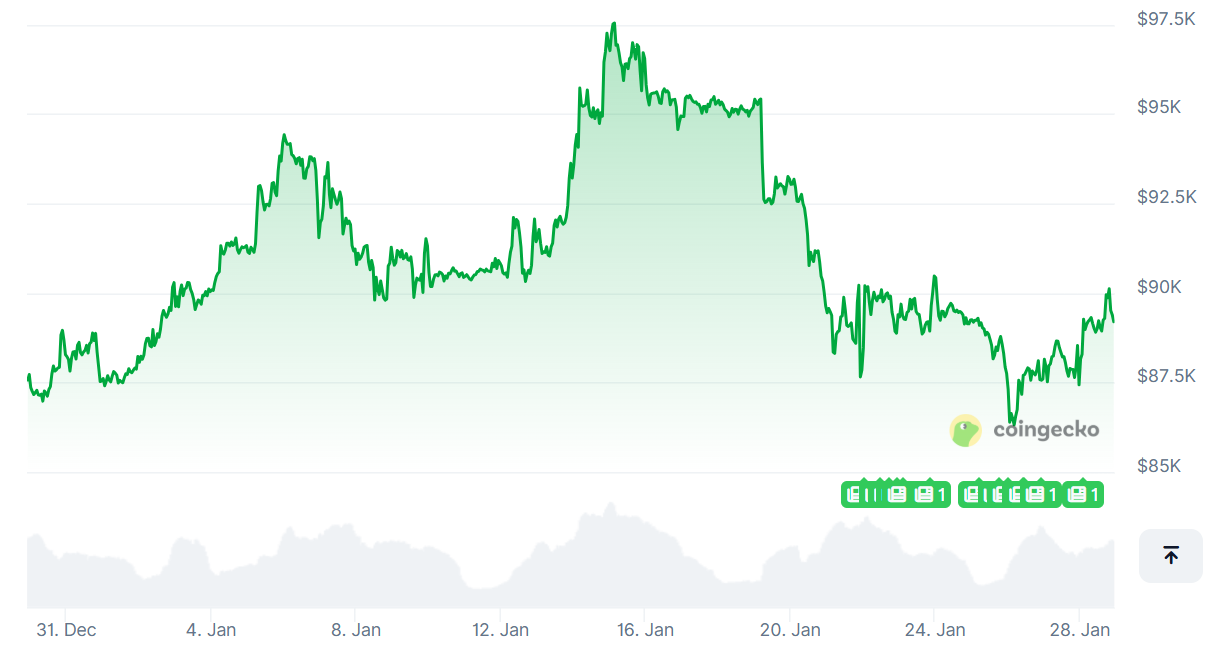 Source: CoinGecko
Looking at the past, the current dollar index level is close to the trigger of a Bitcoin bull run in 2017 and 2021.
The dollar index, a gauge of the greenback versus major currencies, is now trading around 96, a level of critical importance. The index (DXY) has gone below its long-term trendline that has run for 16 years.
Bitcoin has experienced a substantial increase whenever DXY has fallen below 96 and stayed there. In June 2017, the DXY fell beneath the 96 mark. Bitcoin experienced a remarkable increase of nearly eight times over the subsequent five to six months.
During the pandemic period of 2020, following a significant influx of liquidity into the markets, the DXY once again fell to 96. Bitcoin once again experienced an impressive run of about sevenfold over the subsequent 7 to 8 months. Ethereum and various alternative cryptocurrencies also experienced remarkable growth, achieving returns of 10x, 20x, and beyond.
While the current trading pattern suggests there are more risks to that narrative, it does suggest some momentum is finally building.
How Does the Dollar Impact Cryptos?
Since Tuesday, as reports emerged regarding the decline of the US dollar in the market, the prices of Ethereum and Bitcoin experienced a notable increase.
Recent statistics indicating that the US dollar has dropped to its lowest level in four years have raised concerns about the stability of the world's leading reserve currency.
Market participants are redirecting their focus from the dollar to precious metals and digital currencies, particularly BTC, which is regarded as a possible safeguard against currency devaluation.
The dollar's value has been steadily declining over the past few weeks, and it has dropped even lower after Trump's comments about the currency's performance.
Trump said the dollar is "doing great," despite its fall over the past year or so.
Sellers were prompted to increase their activity following the president's subdued reaction to the drop in the dollar's value.
Currently, the dollar index stands at 95.92, down from a previous level near 100. The current level hasn't been seen since 2022.
In addition, Bloomberg's Dollar Spot Index saw its worst four-day decline since Trump announced fresh tariffs in April 2025.
Given the potential effects of US policy risks on the world's principal reserve currency, participants in the $9.5 trillion per day currency markets are growing increasingly pessimistic about the dollar's future performance.
Digital currencies like Bitcoin and Ethereum are currently seeing strong gains as a result of the dollar's decline. Ethereum has climbed more than 3% and now trades at more than $3,000, while the price of Bitcoin has gained beyond $89,000 in the previous 24 hours.
The simultaneous rise of cryptocurrency prices and the fall of the US dollar may signal a movement of funds towards riskier investments.
Although this relationship does not definitively signal an upcoming surge in cryptocurrency, experts indicate that a weakening dollar may bolster a more extensive recovery in the crypto market.
As the dollar declines, we have already seen an influx of capital into valuable assets such as gold and silver. Analysts say this capital will eventually flow into BTC, possibly driving a price recovery.
However, other experts cautioned that this action provides temporary relief instead of a lasting solution, as the cryptocurrency markets prepare for a challenging array of macroeconomic and policy uncertainties in the US.
Although Bitcoin's recent recovery has put short-term liquidation worries to rest, it has done nothing to change the fundamental considerations that still strongly favor downside protection.
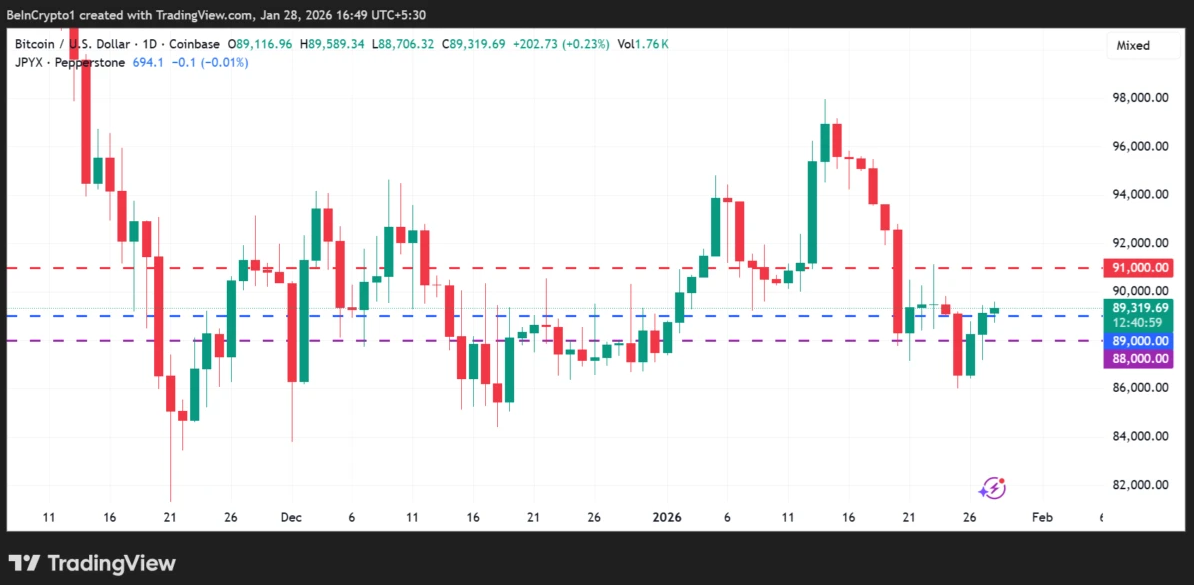
The return of Bitcoin to the $88,000–$89,000 range is still crucial from a technical standpoint. Experts say $88,000 is a critical threshold, widely known as a "trap door" mark.
The recent developments indicate that sudden breaks have caused quick, liquidation-driven gaps, while rapid recoveries have brought the price back within the established range.
Consistent stability above that threshold is far more significant than fleeting intraday movements, particularly with major economic factors aligning in the near future.
Meanwhile, the currency markets continue to exhibit volatility, as recent USD/JPY rate-check signals have underscored the rapid unwinding of crowded positions.
The options markets illustrate this uneven risk landscape.
The current market shows a stable level of fluctuation, with the term structure indicating a gradual upward trend, pointing towards a period of consolidation instead of a significant downturn.
Nonetheless, there is demand on the left side.
The presence of negative skew and the abundance of near-dated downside options suggest a preference for protecting against potential gaps in the market, rather than anticipating a gradual increase in volatility.
For now, a rally in risk assets is supporting the crypto narrative amidst a dollar sell-off.
The S&P 500 hit a new all-time high, breaching the 7,000 points mark, before the rally lost some steam after Bessent's comments on the dollar.
Also, positioning data shows a growing willingness to be cautious, with signs of giving in starting to show.
In addition to significant withdrawals from Bitcoin and Ethereum ETFs, the options markets are projecting only a 30% chance that Bitcoin will reclaim its all-time high by year's end.
Given Bitcoin's recent rise past $89,000, there might be a reduced sense of worry.
Rather than experiencing a straightforward breakout, the markets are expected to encounter fluctuations driven by looming economic challenges and an ongoing inclination for protective measures against potential declines.
Be at the heart of TradFi–DeFi collaboration at Money20/20 Asia 2026.

Are you looking to forge partnerships with banks and fintechs? To expand into new markets across Asia, or to secure funding from top-tier investors? This April, the world of digital assets, blockchain, and Web3 converges with the biggest players in APAC’s financial ecosystem at Money20/20 Asia 2026 and its brand new ‘Intersection’ zone, complete with a dedicated content stage, TradFi-Defi innovator showcase, and curated networking spaces. From traditional banking giants to decentralised innovators, private equity leaders, and cutting-edge fintech disruptors, this is where they meet to forge partnerships, spark dialogue, and shape the future of finance. Passes available at early bird rates until January 30.
You May Also Like

Cashing In On University Patents Means Giving Up On Our Innovation Future

VectorUSA Achieves Fortinet’s Engage Preferred Services Partner Designation
