

FinancePolice aims to simplify the choices. You will get clear distinctions between core and satellite holdings, a checklist for risk controls, example allocations for different tolerances, and operational tips for rebalancing and exits.
What the 80/20 rule in crypto means: Pareto idea and common uses
The 80/20 concept has two linked meanings in crypto: a general Pareto-style observation and a specific portfolio framing that divides assets into a large-cap core and a smaller, speculative satellite sleeve. The Pareto principle describes how a minority of causes often explain a majority of outcomes, and that idea explains why people use the shorthand 80/20 when talking about allocation or attention in finance Investopedia article on the Pareto Principle.
As a simple rule of thumb, the 80/20 label helps people separate stable, widely adopted tokens from riskier bets. Use this as a heuristic, not a guarantee, because outcomes depend on time horizon, custody, taxes, and other factors.
Advertise with FinancePolice
Read on for concrete examples and step-by-step checks you can use to decide if an 80/20 setup fits your situation.
See advertising options
In conversations about portfolios the phrase often moves quickly from idea to practice: some investors speak of an 80% ‘‘core’’ sleeve made of large-cap tokens and a 20% ‘‘satellite’’ sleeve for smaller or experimental positions. That move from observation to allocation is common in investing education and practice.
Keep in mind that 80/20 is a framework, not a rule written in stone. For many readers, it is a starting point for creating rules about sizing, rebalancing, and exits that match personal goals.

Why investors talk about an 80/20 crypto split today
Market data show a continued concentration of value in a small group of large tokens, which helps explain why a core sleeve focused on big-cap assets is a common starting point for many investors CoinGecko Research on market concentration and in our Finance Police crypto coverage.
At the same time, fund-flow reports and manager notes through 2024 and 2025 document demand for satellite exposure that targets higher returns or thematic bets, although managers differ in how actively they trade or use leverage inside those allocations CoinShares research on fund flows and manager strategies.
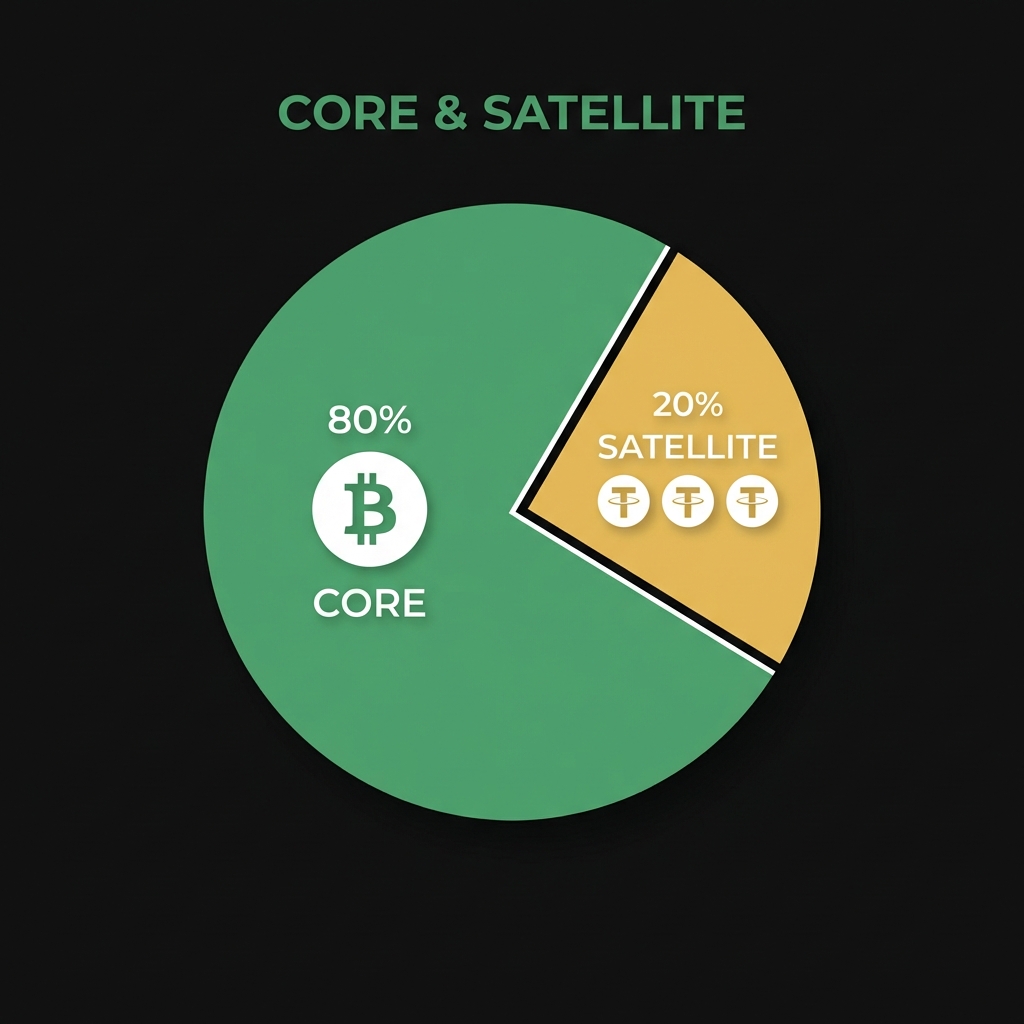
The practical link is simple: if a few tokens make up a large share of market capitalization then a core sleeve that leans on those tokens can reduce some sources of portfolio concentration risk, while the satellite sleeve captures targeted upside opportunities.
Core and satellite explained: building an 80/20 crypto portfolio
What belongs in the core sleeve, hedge fund crypto
A core sleeve is usually the least volatile part of the crypto allocation. It tends to include large-cap tokens with broad liquidity and infrastructure support, and it is intended to provide a stable foundation for the rest of the portfolio. Industry materials describe this structure as an extension of long-established core-satellite approaches to portfolio management CFA Institute paper on core-satellite strategy and a practical guide is available from Saxo Core-satellite approach: A smarter way to diversify your investments.
Core assets typically have higher market cap, more active trading, and stronger developer and user adoption. The point is to limit position-level risk inside the majority sleeve while keeping the portfolio exposed to the market’s main trends.
The 80 20 rule in crypto is a heuristic that either describes concentration (Pareto idea) or a practical portfolio split where about 80% is in large-cap core tokens and 20% in speculative satellite bets. For beginners, use it as a template: define which tokens are core, limit the size of satellite positions, set rebalancing and exit rules, and consider fees, custody, and taxes before implementing.
The satellite sleeve is the smaller, intentionally riskier portion of the allocation. It includes small-cap altcoins, experimental protocols, or targeted strategies that may have higher upside and also higher failure rates. Strict position sizing and diversification inside this sleeve are important to limit the chance that one loss overwhelms the core.
Choosing assets for the core sleeve
Choose core assets using clear criteria: large market capitalization, deep liquidity, visible network activity, and protocol maturity. These criteria help distinguish tokens that are more likely to remain tradeable during stress from those that can become illiquid or fail.
When selecting core tokens, many practitioners look for assets with broad exchange support and mature custody options, because custody and counterparty choices can change risk exposure significantly CoinGecko Research on market structure.
Custody matters. Holding core assets in secure custody with clear recovery and insurance options can reduce counterparty and custody risk, which is particularly relevant for a large sleeve that you plan to hold for a long time.
The satellite sleeve is where you place higher-risk, higher-reward ideas: small-cap tokens, experimental protocols, thematic trades, or yield and liquidity strategies that aim for outsized returns but carry elevated failure risk.
Inside the satellite sleeve, risk controls are essential. Limit position size, diversify across multiple themes, and set explicit loss limits before entering trades to avoid emotional doubling-down that can magnify losses Journal of Asset Management review on cryptoassets.
Funds and managers vary widely in how they implement satellite strategies. Some use active trading, derivatives, or leverage to amplify returns, while others restrict the sleeve to spot holdings and careful position sizing. That variation is a reason to document your approach in advance.
Risk controls: sizing, rebalancing, custody and exit rules
Common controls for an 80/20 crypto plan include position sizing limits, dollar-cost averaging into positions, scheduled or threshold rebalancing, and pre-defined exit rules that guide when to cut losses or take profits. These techniques are repeatedly recommended in portfolio literature as practical risk management steps Journal of Risk and Financial Management review and in a Finance Police piece on strategies to reduce risk strategies to reduce risk.
Position sizing can be simple: set a maximum percent of the satellite sleeve for any one token and stick to it. Dollar-cost averaging can help smooth entry price risk for core holdings, especially in volatile markets.
Rebalancing rules matter. A calendar rebalancing plan is straightforward. A threshold or band approach reacts to market moves. Each has tax and fee implications that should be considered when you pick a cadence.
Implementation trade-offs: fees, taxes, custody and regulation
Fees and taxes can materially change net results for an 80/20 strategy. Rebalancing frequently can increase trading costs and trigger taxable events, which reduces the benefit of tight rebalancing for many retail investors CoinShares research on manager strategies and fund flows.
Custody and counterparty risk vary across services and product types. Holding spot tokens in a self-custody wallet has different operational risks than using a custodial service that offers insurance. Consider how custody choices interact with your time horizon and security needs.
basic allocation and rebalancing checklist
Use as a starting point only
Regulation is an evolving factor that can change the suitability of fixed splits. Policy and tax changes alter trading costs, reporting requirements, and custody choices, so verify current rules before implementing a plan.
Example allocations and timelines: sample 80/20 scenarios
Here are qualitative scenarios to show how the core and satellite balance shifts with risk tolerance. A conservative variant keeps a very stable core and a low-risk satellite focused on liquid, larger altcoins.
One balanced example uses an 80% core of established tokens and 20% satellite split across several themes. An aggressive example keeps the 80/20 nominal split but increases the volatility inside the satellite by concentrating on small-cap and experimental protocols. Use these as templates to adapt to your risk tolerance and time horizon.
Longer time horizons may allow more room for speculative satellites because they give more time for recovery from drawdowns. Short horizons usually call for smaller satellite exposure or a different allocation entirely.
Typical mistakes and pitfalls with an 80/20 crypto plan
Common errors include overconcentration in a few satellite bets, failing to diversify inside the satellite sleeve, chasing recent winners, and ignoring rebalancing costs. These behaviors increase downside risk and can undo the intended protection of a core sleeve.
Behavioral mistakes also matter. Doubling down on a losing position or moving money out of the core during market stress are predictable errors that a pre-defined plan helps prevent. Documenting rules in advance reduces the chance of emotion-driven decisions.
Another pitfall is neglecting custody protections and tax reporting. Not all platforms offer similar insurance or clear reporting tools, and overlooking these operational details can create unexpected losses or compliance work.
When an 80/20 split might not be right for you
Use this short checklist to decide if an 80/20 split fits your situation: long time horizon, willingness to tolerate moderate drawdowns, clear custody plan, and comfort with tax reporting and fees. If you answer no to several items, a different allocation may be preferable.
Investor types for whom 80/20 can be less suitable include those with short time horizons, low risk tolerance, or limited appetite for handling custody and tax complexity. In those cases, smaller crypto allocations or fully passive strategies may be better options.
If you are unsure, consider alternatives such as a more conservative split, a passive-only approach, or seeking a professional manager, keeping in mind fees and transparency trade-offs. For coverage of related topics like stablecoins and issuer models see how do stablecoin issuers generate revenue.
Operational steps: how to rebalance and set exit rules
Two common rebalancing approaches are calendar rebalancing and threshold rebalancing. Calendar rebalancing happens on a fixed schedule. Threshold rebalancing triggers when allocation bands are crossed. Each method has trade-offs in simplicity, tax impact, and responsiveness.
Exit rules should be explicit. Examples include setting stop-loss percentages for satellite positions or having profit-taking bands that move gains back into core assets. Document these rules and test them mentally before committing capital.
When choosing rebalancing methods account for fees and taxes. Frequent trades can erode returns through costs, and taxable events can change the after-tax benefit of tight rebalancing.
Measuring results: what to track and how to evaluate performance
Useful metrics include sleeve performance, volatility, maximum drawdown, fees paid, and tax drag. Track these separately for core and satellite so you can see which sleeve drives outcomes and how costs affect net returns Journal of Asset Management review on evaluating crypto in portfolios.
Compare performance to your stated goals and risk tolerance rather than to short-term market moves. Allow time to see if the allocation behaves as expected, and be ready to adapt if underlying assumptions change.
Review results on a schedule that matches your rebalancing cadence and time horizon, and keep a simple log of trades, fees, and tax events to simplify annual review.
Other approaches and alternatives to an 80/20 split
Alternatives include different numeric splits such as 90/10 or 70/30, fully passive allocations that track market-cap weightings, or active fund management that aims to select winners within the space. Each choice trades off control, cost, and transparency.
Professional management may suit investors who prefer delegation, but it brings fees and requires trust in the manager’s strategy and reporting. Verify fee structures, strategy transparency, and custody arrangements before committing to a fund.
Conclusion: can an 80/20 rule help your crypto plan?
Three short takeaways: first, 80/20 is a heuristic rooted in the Pareto idea and adapted as a core-satellite portfolio approach; second, managing an 80/20 split requires explicit risk controls like sizing and rebalancing; third, practical trade-offs such as fees, tax treatment, and custody can change whether the split fits your goals Investopedia article on the Pareto Principle and Investopedia 80-20 rule.
Before implementing, verify custody options, check fee and tax implications, and align the plan with your time horizon and risk tolerance. Use FinancePolice as an educational reference while you confirm details with primary sources and advisors.
Keep the approach simple. Document allocation percentages, rebalancing rules, and exit triggers so you can follow the plan when markets get noisy.
It is a heuristic that either describes a Pareto-style concentration or a practical core-satellite allocation where roughly 80% is in large-cap tokens and 20% in speculative positions.
Use strict position limits inside the satellite sleeve, diversify across themes, and set pre-defined loss limits to avoid letting one position dominate losses.
No. The split can help structure exposure, but risks remain from volatility, custody, taxes, fees, and regulatory change.
Use this guide as a starting point for learning and then confirm details with primary sources or a qualified advisor if you need tax or legal advice.
References
- https://www.investopedia.com/terms/p/paretoprinciple.asp
- https://8020.in/cryptocurrency
- https://www.coingecko.com/en/research
- https://coinshares.com/research
- https://www.cfainstitute.org/en/research/foundation/2012/core-satellite-approach-to-portfolio-management
- https://www.home.saxo/learn/guides/diversification/core-satellite-approach-a-smarter-way-to-diversify-your-investments
- https://www.palgrave.com/gp/journal/41260
- https://financepolice.com/advertise/
- https://www.mdpi.com/journal/jrfm
- https://www.investopedia.com/terms/1/80-20-rule.asp
- https://financepolice.com/category/crypto/
- https://financepolice.com/strategies-to-reduce-risk-in-cryptocurrency-investments-through-diversification-in-2025/
- https://financepolice.com/how-do-stablecoin-issuers-generate-revenue-in-2025/
You May Also Like

Cashing In On University Patents Means Giving Up On Our Innovation Future

VectorUSA Achieves Fortinet’s Engage Preferred Services Partner Designation
