Bitcoin’s unusually subdued options pricing and weak month-to-date activity are setting up what ProCap CIO and Bitwise adviser Jeff Park calls a dangerous asymmetryBitcoin’s unusually subdued options pricing and weak month-to-date activity are setting up what ProCap CIO and Bitwise adviser Jeff Park calls a dangerous asymmetry

‘Paper’ Bitcoin Isn’t Suppressing Price – Silver Shows Why, Jeff Park Says

2026/01/29 12:00
3 min read

Bitcoin’s unusually subdued options pricing and weak month-to-date activity are setting up what ProCap CIO and Bitwise adviser Jeff Park calls a dangerous asymmetry: upside momentum is unlikely without volatility, and the longer BTC stays “quiet,” the more violent the eventual move could be.

In a post via X on Jan.27, Park described the current tape as “still a trader’s market,” arguing that low implied volatility and thin participation are a poor foundation for a clean grind higher. “It is very unlikely for Bitcoin to find momentum to the upside without experiencing significantly higher volatility,” he wrote.

“The fact that we are at ~38 IV combined with horrible volume MTD gives me pause (lower than ANY month of 2025, and especially bad for January in general) when you can see what the metals complex is doing. You literally can’t imagine a worse set up for disappointment.”

What Happened In Silver And Why It Could Repeat For Bitcoin

Park’s reference point is a silver market that has gone from strong to disorderly. Silver prices have surged above $117 per ounce on Monday, with reports pointing to a speculative bid layered on top of tight physical conditions and heavy retail participation via bars, coins, and physically backed ETFs.

The move also featured a sharp single-day jump. On Jan. 26, the most-active silver futures contract rose 14%, the largest one-day gain since 1985. That price action coincided with a staggering surge in trading and options activity across silver vehicles.

Bloomberg ETF analyst Eric Balchunas highlighted the scale: “WHOA: The volume in the SLV is $32b.. that 15x its avg and by far the most volume of any security on the planet. For context, SPY is $24b, NVDA and TSLA $16b. Can’t remember the last time something so relatively small took over like this. Game Stop maybe.”

He later added that SLV “ended up trading $40b worth of shares [on Monday],” adding: “To put that into perspective, that’s more than it traded in all of Q1 last year. Jan + Feb +Mar = $35b. Options volume also in stratosphere. It’s already done $1.5b in pre-market, which is 3x more than any other ETF, 5x more than Tesla, Nvidia. Again, reminds me of Game Stop in its how is this even possible-ness.”

“Paper” Exposure As An Accelerant

A common crypto refrain is that “synthetic” or “paper” bitcoin suppresses spot price. Park argued the opposite dynamic is often underappreciated and he used silver to illustrate how leverage and market structure can turn into the catalyst.

“People often blame incorrectly that ‘synthetic/paper’ bitcoin is the cause of price suppression,” Park wrote. “I have long argued it is quite the opposite, which you can see how it manifests in silver below- Silver didn’t have a 6-sigma event because the spot market was so vibrant.”

In his telling, silver’s melt-up wasn’t driven by orderly spot demand; it was driven by the “shenanigans” inside financialized exposure. “Silver’s record-setting meltup comes from all the shenanigans behind ‘paper silver’ where margin rules, leveraged instruments and vehicles, and liquidity and maturity transformation mismatches create tremendous pressure on breaking points where no physical supply can be introduced fast enough to counter the velocity of paper supply,” he said.

“For Park, the takeaway is directional but not calendar-specific. “To root for Bitcoin is to root for its volatility,” he wrote. “Anyone who tells you otherwise does not understand the fundamentals of the commodities market … It may not be today or yet tomorrow, but eventually Bitcoin is going to rip many faces off. Volatility or bust.”

At press time, BTC traded at $89,430.
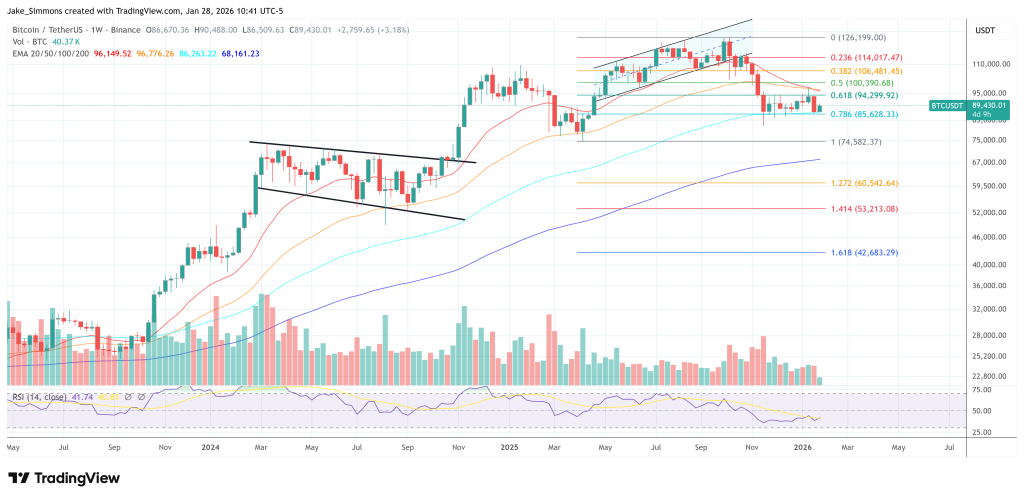
Bitcoin price chart
Disclaimer: The articles reposted on this site are sourced from public platforms and are provided for informational purposes only. They do not necessarily reflect the views of MEXC. All rights remain with the original authors. If you believe any content infringes on third-party rights, please contact [email protected] for removal. MEXC makes no guarantees regarding the accuracy, completeness, or timeliness of the content and is not responsible for any actions taken based on the information provided. The content does not constitute financial, legal, or other professional advice, nor should it be considered a recommendation or endorsement by MEXC.

You May Also Like

Cashing In On University Patents Means Giving Up On Our Innovation Future

Cashing In On University Patents Means Giving Up On Our Innovation Future

The post Cashing In On University Patents Means Giving Up On Our Innovation Future appeared on BitcoinEthereumNews.com. “It’s a raid on American innovation that would deliver pennies to the Treasury while kneecapping the very engine of our economic and medical progress,” writes Pipes. Getty Images Washington is addicted to taxing success. Now, Commerce Secretary Howard Lutnick is floating a plan to skim half the patent earnings from inventions developed at universities with federal funding. It’s being sold as a way to shore up programs like Social Security. In reality, it’s a raid on American innovation that would deliver pennies to the Treasury while kneecapping the very engine of our economic and medical progress. Yes, taxpayer dollars support early-stage research. But the real payoff comes later—in the jobs created, cures discovered, and industries launched when universities and private industry turn those discoveries into real products. By comparison, the sums at stake in patent licensing are trivial. Universities collectively earn only about $3.6 billion annually in patent income—less than the federal government spends on Social Security in a single day. Even confiscating half would barely register against a $6 trillion federal budget. And yet the damage from such a policy would be anything but trivial. The true return on taxpayer investment isn’t in licensing checks sent to Washington, but in the downstream economic activity that federally supported research unleashes. Thanks to the bipartisan Bayh-Dole Act of 1980, universities and private industry have powerful incentives to translate early-stage discoveries into real-world products. Before Bayh-Dole, the government hoarded patents from federally funded research, and fewer than 5% were ever licensed. Once universities could own and license their own inventions, innovation exploded. The result has been one of the best returns on investment in government history. Since 1996, university research has added nearly $2 trillion to U.S. industrial output, supported 6.5 million jobs, and launched more than 19,000 startups. Those companies pay…
Share
BitcoinEthereumNews2025/09/18 03:26
VectorUSA Achieves Fortinet’s Engage Preferred Services Partner Designation

VectorUSA Achieves Fortinet’s Engage Preferred Services Partner Designation

TORRANCE, Calif., Feb. 3, 2026 /PRNewswire/ — VectorUSA, a trusted technology solutions provider, specializes in delivering integrated IT, security, and infrastructure
Share
AI Journal2026/02/05 00:02
Top Solana Treasury Firm Forward Industries Unveils $4 Billion Capital Raise To Buy More SOL ⋆ ZyCrypto

Top Solana Treasury Firm Forward Industries Unveils $4 Billion Capital Raise To Buy More SOL ⋆ ZyCrypto

The post Top Solana Treasury Firm Forward Industries Unveils $4 Billion Capital Raise To Buy More SOL ⋆ ZyCrypto appeared on BitcoinEthereumNews.com. Advertisement &nbsp &nbsp Forward Industries, the largest publicly traded Solana treasury company, has filed a $4 billion at-the-market (ATM) equity offering program with the U.S. SEC  to raise more capital for additional SOL accumulation. Forward Strategies Doubles Down On Solana Strategy In a Wednesday press release, Forward Industries revealed that the 4 billion ATM equity offering program will allow the company to issue and sell common stock via Cantor Fitzgerald under a sales agreement dated Sept. 16, 2025. Forward said proceeds will go toward “general corporate purposes,” including the pursuit of its Solana balance sheet and purchases of income-generating assets. The sales of the shares are covered by an automatic shelf registration statement filed with the US Securities and Exchange Commission that is already effective – meaning the shares will be tradable once they’re sold. An automatic shelf registration allows certain publicly listed companies to raise capital with flexibility swiftly.  Kyle Samani, Forward’s chairman, astutely described the ATM offering as “a flexible and efficient mechanism” to raise and deploy capital for the company’s Solana strategy and bolster its balance sheet.  Advertisement &nbsp Though the maximum amount is listed as $4 billion, the firm indicated that sales may or may not occur depending on existing market conditions. “The ATM Program enhances our ability to continue scaling that position, strengthen our balance sheet, and pursue growth initiatives in alignment with our long-term vision,” Samani said. Forward Industries kicked off its Solana treasury strategy on Sept. 8. The Wednesday S-3 form follows Forward’s $1.65 billion private investment in public equity that closed last week, led by crypto heavyweights like Galaxy Digital, Jump Crypto, and Multicoin Capital. The company started deploying that capital this week, announcing it snatched up 6.8 million SOL for approximately $1.58 billion at an average price of $232…
Share
BitcoinEthereumNews2025/09/18 03:42