Solana has taken a breather after a sharp 20% sell-off, with the price now stabilizing at a technically significant zone. As volatility cools and consolidation Solana has taken a breather after a sharp 20% sell-off, with the price now stabilizing at a technically significant zone. As volatility cools and consolidation

Solana Pauses After 20% Drop — This Key Level Could Decide What’s Next

2026/01/29 20:30
3 min read

Solana has taken a breather after a sharp 20% sell-off, with the price now stabilizing at a technically significant zone. As volatility cools and consolidation sets in, the market is watching closely to see whether this level acts as a launchpad for a recovery or opens the door to further downside. The next move from here could define SOL’s short-term direction.

VAH Rejection Sends SOL Back Into Range

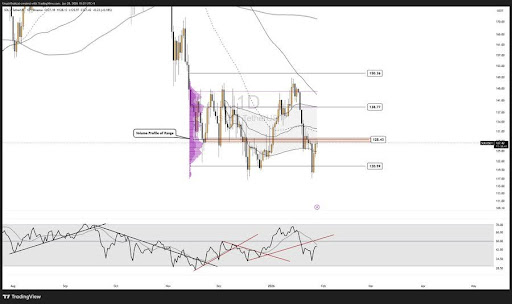
Market expert Umair Crypto explained that Solana’s rejection at the Value Area High (VAH) near $141 set the tone for the recent move. After briefly extending to $148, SOL once again failed to flip the psychological $150 level into support, and ultimately triggered a sharp downside reaction, resulting in a nearly 20% decline toward the $117 area.

Following the sell-off, price rotated back into the same two-month consolidation range, suggesting that the move lower was more of a range continuation than the start of a new trend. SOL is now retesting the Value Area Low flip zone around $128, a level that has repeatedly acted as a short-term pivot between buyers and sellers.
Solana

If $128 holds and buyers manage to defend this zone, the analyst sees room for a bounce toward $132. Further acceptance above that level could open a path toward the range Point of Control near $138. However, even a move into that region would still reflect range-bound conditions rather than a confirmed bullish breakout.

Umair Crypto stressed that SOL remains stuck inside a broad $30 range, offering little directional edge in the middle. An acceptance below $120 would shift the bias firmly bearish. On the other hand, a strong reclaim above $150 would flip the market structure bullish. Until either scenario plays out, the higher-probability outcome continues to lean toward lower prices within the range.

SOL Enters A Compression Phase Above Key Support

According to a recent market update from BitGuru, Solana has experienced a significant pullback and is now entering a phase of consolidation just above a critical support zone. This type of price compression is a classic technical indicator that the market is preparing for a sharp reaction move.

As volatility narrows and the trading range tightens, the build-up of market energy typically precedes a breakout. The path forward remains binary based on Solana’s interaction with its immediate boundaries. 

A clean reclaim of the nearby resistance level would signal a return of buyer confidence and a potential shift in momentum. Conversely, a failure to defend this established base would keep significant downside risk active, potentially leading to a deeper correction if the support zone is breached.

Solana
Disclaimer: The articles reposted on this site are sourced from public platforms and are provided for informational purposes only. They do not necessarily reflect the views of MEXC. All rights remain with the original authors. If you believe any content infringes on third-party rights, please contact [email protected] for removal. MEXC makes no guarantees regarding the accuracy, completeness, or timeliness of the content and is not responsible for any actions taken based on the information provided. The content does not constitute financial, legal, or other professional advice, nor should it be considered a recommendation or endorsement by MEXC.

You May Also Like

Cashing In On University Patents Means Giving Up On Our Innovation Future

Cashing In On University Patents Means Giving Up On Our Innovation Future

The post Cashing In On University Patents Means Giving Up On Our Innovation Future appeared on BitcoinEthereumNews.com. “It’s a raid on American innovation that would deliver pennies to the Treasury while kneecapping the very engine of our economic and medical progress,” writes Pipes. Getty Images Washington is addicted to taxing success. Now, Commerce Secretary Howard Lutnick is floating a plan to skim half the patent earnings from inventions developed at universities with federal funding. It’s being sold as a way to shore up programs like Social Security. In reality, it’s a raid on American innovation that would deliver pennies to the Treasury while kneecapping the very engine of our economic and medical progress. Yes, taxpayer dollars support early-stage research. But the real payoff comes later—in the jobs created, cures discovered, and industries launched when universities and private industry turn those discoveries into real products. By comparison, the sums at stake in patent licensing are trivial. Universities collectively earn only about $3.6 billion annually in patent income—less than the federal government spends on Social Security in a single day. Even confiscating half would barely register against a $6 trillion federal budget. And yet the damage from such a policy would be anything but trivial. The true return on taxpayer investment isn’t in licensing checks sent to Washington, but in the downstream economic activity that federally supported research unleashes. Thanks to the bipartisan Bayh-Dole Act of 1980, universities and private industry have powerful incentives to translate early-stage discoveries into real-world products. Before Bayh-Dole, the government hoarded patents from federally funded research, and fewer than 5% were ever licensed. Once universities could own and license their own inventions, innovation exploded. The result has been one of the best returns on investment in government history. Since 1996, university research has added nearly $2 trillion to U.S. industrial output, supported 6.5 million jobs, and launched more than 19,000 startups. Those companies pay…
Share
BitcoinEthereumNews2025/09/18 03:26
Trump foe devises plan to starve him of what he 'craves' most

Trump foe devises plan to starve him of what he 'craves' most

A longtime adversary of President Donald Trump has a plan for a key group to take away what Trump craves the most — attention. EX-CNN journalist Jim Acosta, who
Share
Rawstory2026/02/04 01:19
Why Bitcoin Is Struggling: 8 Factors Impacting Crypto Markets

Why Bitcoin Is Struggling: 8 Factors Impacting Crypto Markets

Failed blockchain adoption narratives and weak fee capture have undercut confidence in major crypto projects.
Share
CryptoPotato2026/02/04 01:05