The cross-chain bridge CrossCurve, formerly known as EYWA, confirmed it was actively under attack after a security exploit drained roughly $3 million in user assetsThe cross-chain bridge CrossCurve, formerly known as EYWA, confirmed it was actively under attack after a security exploit drained roughly $3 million in user assets

CrossCurve Bridge Hit by $3M Exploit as Message Spoofing Strikes Again

2026/02/02 10:47
3 min read

The cross-chain bridge CrossCurve, formerly known as EYWA, confirmed it was actively under attack after a security exploit drained roughly $3 million in user assets.

The incident quickly drew comparisons to earlier bridge failures, underscoring how long-standing vulnerabilities in cross-chain messaging continue to resurface across the ecosystem.

The exploit unfolded over January 31 and February 1, triggering immediate concern among users and security researchers as funds were siphoned from the protocol’s core contracts across multiple connected networks.

How the Exploit Worked

According to early technical breakdowns, the attack relied on a message spoofing flaw similar in structure to the 2022 Nomad bridge incident.

At the center of the issue was a missing validation check in CrossCurve’s smart contracts, which left a critical execution path insufficiently protected.

Attackers were able to invoke the expressExecute function using spoofed cross-chain messages. By doing so, they effectively bypassed the protocol’s intended gateway verification logic and triggered unauthorized executions directly within the PortalV2 contract. This flaw allowed token unlocks to occur without legitimate cross-chain authorization, giving attackers direct access to protocol-held assets.

The mechanism did not require sophisticated key compromises or oracle manipulation. Instead, it exploited a logic gap in message verification, a category of vulnerability that has repeatedly plagued cross-chain infrastructure.

Impact Across the Protocol

On-chain data from Arkham Intelligence showed the PortalV2 contract balance falling from approximately $3 million to near zero during the attack window. The rapid depletion suggested a largely unimpeded exploit path once the vulnerability was discovered.

The impact was not confined to a single chain. Because CrossCurve connects multiple networks, the exploit appeared to affect assets spanning several ecosystems, amplifying the overall damage and complicating containment efforts.

CrossCurve is backed by Michael Egorov, founder of Curve Finance, and had previously raised $7 million to develop its consensus-based bridging mechanism. The incident therefore carries broader reputational implications beyond the immediate financial loss.

Which Crypto Exchanges Dominated Spot Trading in 2025?

Security Community Reaction

The exploit prompted renewed frustration among security researchers. Taylor Monahan highlighted that message spoofing vulnerabilities remain a recurring failure mode in cross-chain systems, despite years of high-profile lessons from earlier bridge hacks.

The underlying issue, as experts note, is structural. Cross-chain protocols rely heavily on correct message validation across heterogeneous environments, making even small logic oversights potentially catastrophic. The CrossCurve incident reinforces how unforgiving this design space remains.

Takeaway

The CrossCurve exploit is less about a novel attack vector and more about a familiar one reappearing under a new name. Missing validation checks and spoofed messages continue to represent systemic risks for cross-chain bridges, regardless of funding, backing, or architectural ambition. Until message verification is treated as a zero-tolerance surface, similar incidents are likely to remain a recurring feature of cross-chain infrastructure rather than a solved problem.

The post CrossCurve Bridge Hit by $3M Exploit as Message Spoofing Strikes Again appeared first on ETHNews.

Disclaimer: The articles reposted on this site are sourced from public platforms and are provided for informational purposes only. They do not necessarily reflect the views of MEXC. All rights remain with the original authors. If you believe any content infringes on third-party rights, please contact [email protected] for removal. MEXC makes no guarantees regarding the accuracy, completeness, or timeliness of the content and is not responsible for any actions taken based on the information provided. The content does not constitute financial, legal, or other professional advice, nor should it be considered a recommendation or endorsement by MEXC.

You May Also Like

Fed Decides On Interest Rates Today—Here’s What To Watch For

Fed Decides On Interest Rates Today—Here’s What To Watch For

The post Fed Decides On Interest Rates Today—Here’s What To Watch For appeared on BitcoinEthereumNews.com. Topline The Federal Reserve on Wednesday will conclude a two-day policymaking meeting and release a decision on whether to lower interest rates—following months of pressure and criticism from President Donald Trump—and potentially signal whether additional cuts are on the way. President Donald Trump has urged the central bank to “CUT INTEREST RATES, NOW, AND BIGGER” than they might plan to. Getty Images Key Facts The central bank is poised to cut interest rates by at least a quarter-point, down from the 4.25% to 4.5% range where they have been held since December to between 4% and 4.25%, as Wall Street has placed 100% odds of a rate cut, according to CME’s FedWatch, with higher odds (94%) on a quarter-point cut than a half-point (6%) reduction. Fed governors Christopher Waller and Michelle Bowman, both Trump appointees, voted in July for a quarter-point reduction to rates, and they may dissent again in favor of a large cut alongside Stephen Miran, Trump’s Council of Economic Advisers’ chair, who was sworn in at the meeting’s start on Tuesday. It’s unclear whether other policymakers, including Kansas City Fed President Jeffrey Schmid and St. Louis Fed President Alberto Musalem, will favor larger cuts or opt for no reduction. Fed Chair Jerome Powell said in his Jackson Hole, Wyoming, address last month the central bank would likely consider a looser monetary policy, noting the “shifting balance of risks” on the U.S. economy “may warrant adjusting our policy stance.” David Mericle, an economist for Goldman Sachs, wrote in a note the “key question” for the Fed’s meeting is whether policymakers signal “this is likely the first in a series of consecutive cuts” as the central bank is anticipated to “acknowledge the softening in the labor market,” though they may not “nod to an October cut.” Mericle said he…
Share
BitcoinEthereumNews2025/09/18 00:23
While Shiba Inu and Turbo Chase Price, 63% APY Staking Puts APEMARS at the Forefront of the Best Meme Coin Presale 2026 – Stage 6 Ends in 3 Days!
While Shiba Inu and Turbo Chase Price, 63% APY Staking Puts APEMARS at the Forefront of the Best Meme Coin Presale 2026 – Stage 6 Ends in 3 Days!

What if your meme coin investment could generate passive income without selling a single token? Shiba Inu climbed 4.97% as 207 billion tokens left exchanges. Turbo
Share
Coinstats2026/02/04 03:15
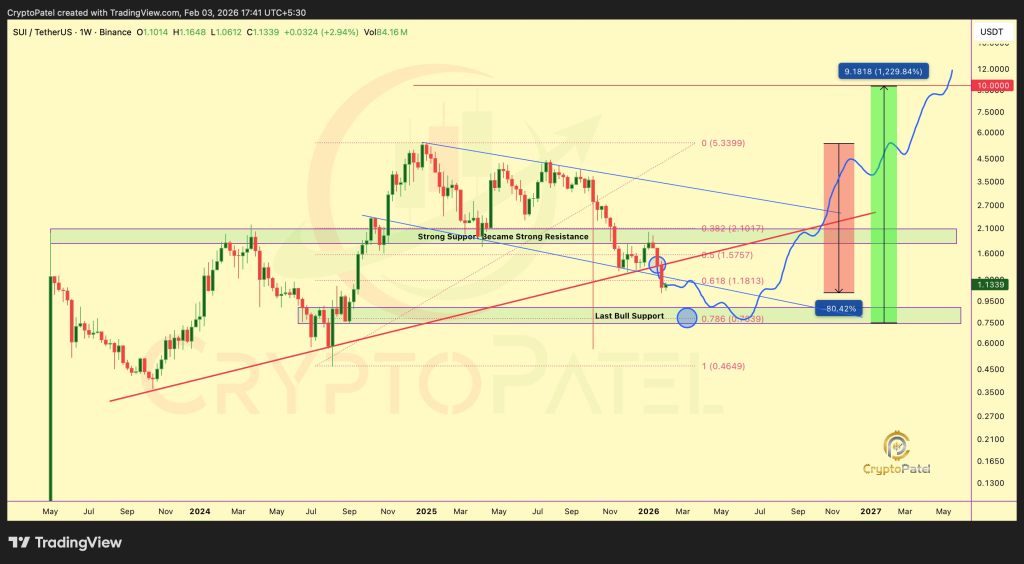
SUI Price Is Down 80%: Price Nears Level Bulls Cannot Afford to Lose

SUI Price Is Down 80%: Price Nears Level Bulls Cannot Afford to Lose

SUI price has quietly slipped into a zone that usually decides everything. Charts show an 80% drop from the peak, yet the market is no longer moving fast. This
Share
Captainaltcoin2026/02/04 03:00