Cardano founder Charles Hoskinson said he plans to sell a Blackhawk helicopter and multiple Lamborghinis and “mothball” his jet, framing the decision as a personalCardano founder Charles Hoskinson said he plans to sell a Blackhawk helicopter and multiple Lamborghinis and “mothball” his jet, framing the decision as a personal

Cardano Founder Says He’ll Sell A Blackhawk And Lambos, Mothball His Jet

3 min read

Cardano founder Charles Hoskinson said he plans to sell a Blackhawk helicopter and multiple Lamborghinis and “mothball” his jet, framing the decision as a personal reset and a critique of how crypto’s culture changed after the 2021 boom.

Speaking in a Jan. 31 video recorded from Fukuoka, Hoskinson opened with a market-watcher’s morning ritual and a broader question about what’s still under an industry participant’s control when prices turn against them. “I sat down,” he said, “and I said, ‘Gosh, you know, how did we get here?’” He described the mood as one of reflection after seeing “the markets and the red lights” on his phone.

Why The Cardano Founder Is Selling His Wealth

He tied that reflection to a multi-stop community tour across Japan, saying his team had recently presented in Hokkaido and Osaka before arriving in Fukuoka, and urged viewers to watch the latest Japanese community livestream. The trip, he suggested, pulled him back to the early days when Cardano was “just an idea,” and the scene felt more insurgent than institutional.

Hoskinson leaned into that contrast, calling crypto “the punk rock of finance” and arguing that a kind of mainstream acceptance drained energy from the sector. In his telling, 2021 marked a turning point: “We all got rich and we all got accepted. And you know, we all just basically became part of the system.” Once inside, he said, the system “take[s] the life out of it,” “strip[s] you of all the things that make you special,” and repackages work into something more consumerized.

Hoskinson then turned the critique inward, describing his own lifestyle as part of the problem. “I look at myself and I say, you know, I’ve gotten a little fat and happy, literally fat, and also an opulent lifestyle,” he said, arguing that repeating the same approach — “be part of that club, hedge a little bit” — isn’t compatible with doing “great things.”

“So, you know what I’m going to do is get back to that punk rock group,” he said. “Downsize a little bit. So, I’m going to sell my Blackhawk, mothball the jet, sell my Lamborghinis, just go all in. Why not?” He positioned the move as a return to an earlier, leaner period: “I started from nothing. Many of you older fans, you remember when I was sitting in my apartment and I had the stuffed giraffes back on the dresser and those were the days I love more than any other.”

A key part of Hoskinson’s “back to first principles” framing was day-to-day building. He said he has been coding every day and credited modern AI tooling for accelerating creativity, mentioning “a little bit of help from our friend Claude” and “a little bit of help from our friend Codex.”

He also pointed to a heavier technical workload, saying he wrote “over 400 pages of technical documents for Midnight over Christmas,” including an “executable specification oracle with a TLA spec” and a protocol specification. The thread running through the examples was urgency and immersion, doing the work “in the pits,” surrounded by builders, rather than managing crypto as a portfolio or status marker.

At press time, Cardano traded at $0.2853.
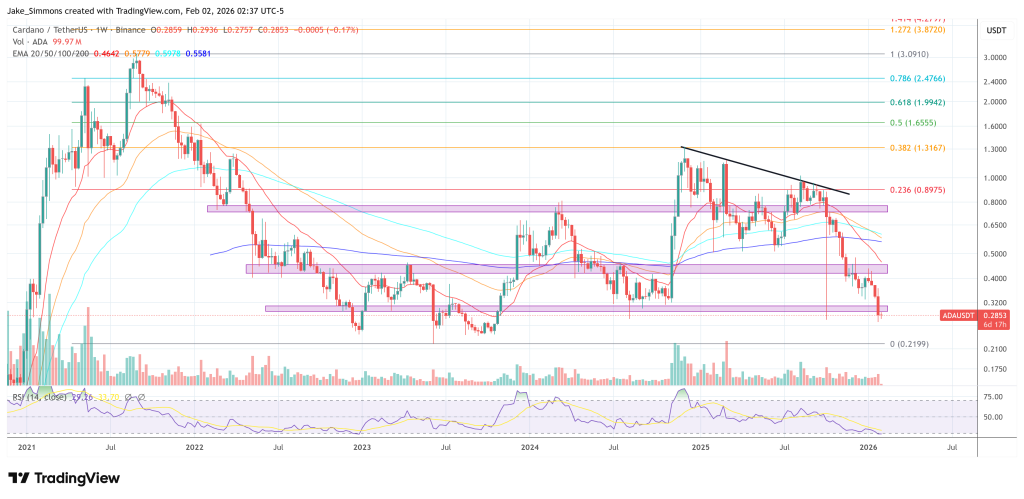
Cardano price
Disclaimer: The articles reposted on this site are sourced from public platforms and are provided for informational purposes only. They do not necessarily reflect the views of MEXC. All rights remain with the original authors. If you believe any content infringes on third-party rights, please contact [email protected] for removal. MEXC makes no guarantees regarding the accuracy, completeness, or timeliness of the content and is not responsible for any actions taken based on the information provided. The content does not constitute financial, legal, or other professional advice, nor should it be considered a recommendation or endorsement by MEXC.

You May Also Like

Cashing In On University Patents Means Giving Up On Our Innovation Future

Cashing In On University Patents Means Giving Up On Our Innovation Future

The post Cashing In On University Patents Means Giving Up On Our Innovation Future appeared on BitcoinEthereumNews.com. “It’s a raid on American innovation that would deliver pennies to the Treasury while kneecapping the very engine of our economic and medical progress,” writes Pipes. Getty Images Washington is addicted to taxing success. Now, Commerce Secretary Howard Lutnick is floating a plan to skim half the patent earnings from inventions developed at universities with federal funding. It’s being sold as a way to shore up programs like Social Security. In reality, it’s a raid on American innovation that would deliver pennies to the Treasury while kneecapping the very engine of our economic and medical progress. Yes, taxpayer dollars support early-stage research. But the real payoff comes later—in the jobs created, cures discovered, and industries launched when universities and private industry turn those discoveries into real products. By comparison, the sums at stake in patent licensing are trivial. Universities collectively earn only about $3.6 billion annually in patent income—less than the federal government spends on Social Security in a single day. Even confiscating half would barely register against a $6 trillion federal budget. And yet the damage from such a policy would be anything but trivial. The true return on taxpayer investment isn’t in licensing checks sent to Washington, but in the downstream economic activity that federally supported research unleashes. Thanks to the bipartisan Bayh-Dole Act of 1980, universities and private industry have powerful incentives to translate early-stage discoveries into real-world products. Before Bayh-Dole, the government hoarded patents from federally funded research, and fewer than 5% were ever licensed. Once universities could own and license their own inventions, innovation exploded. The result has been one of the best returns on investment in government history. Since 1996, university research has added nearly $2 trillion to U.S. industrial output, supported 6.5 million jobs, and launched more than 19,000 startups. Those companies pay…
Share
BitcoinEthereumNews2025/09/18 03:26
Trump foe devises plan to starve him of what he 'craves' most

Trump foe devises plan to starve him of what he 'craves' most

A longtime adversary of President Donald Trump has a plan for a key group to take away what Trump craves the most — attention. EX-CNN journalist Jim Acosta, who
Share
Rawstory2026/02/04 01:19
Why Bitcoin Is Struggling: 8 Factors Impacting Crypto Markets

Why Bitcoin Is Struggling: 8 Factors Impacting Crypto Markets

Failed blockchain adoption narratives and weak fee capture have undercut confidence in major crypto projects.
Share
CryptoPotato2026/02/04 01:05