Bitcoin’s latest drawdown is being framed less as a technical breakdown and more as a liquidity problem, with Ki Young Ju arguing that the key inputs that sustainedBitcoin’s latest drawdown is being framed less as a technical breakdown and more as a liquidity problem, with Ki Young Ju arguing that the key inputs that sustained

70% Bitcoin Crash Incoming? CryptoQuant CEO Says It Depends On This

2026/02/03 12:00
3 min read

Bitcoin’s latest drawdown is being framed less as a technical breakdown and more as a liquidity problem, with Ki Young Ju arguing that the key inputs that sustained the rally fresh capital inflows have stalled. In that setup, he says, calls for a full-cycle, -70% style capitulation hinge on a single variable: whether Strategy turns from buyer to meaningful seller.

Will Bitcoin Experience Another -70% Bear Market?

In a Feb. 1 post, Ki said “Bitcoin is dropping as selling pressure persists, with no fresh capital coming in.” He pointed to a flatlining Realized Cap as evidence that incremental money is no longer entering the market, and tied that directly to market structure. “Realized Cap” has flatlined, meaning no fresh capital. When market cap falls in that environment, it’s not a bull market.”
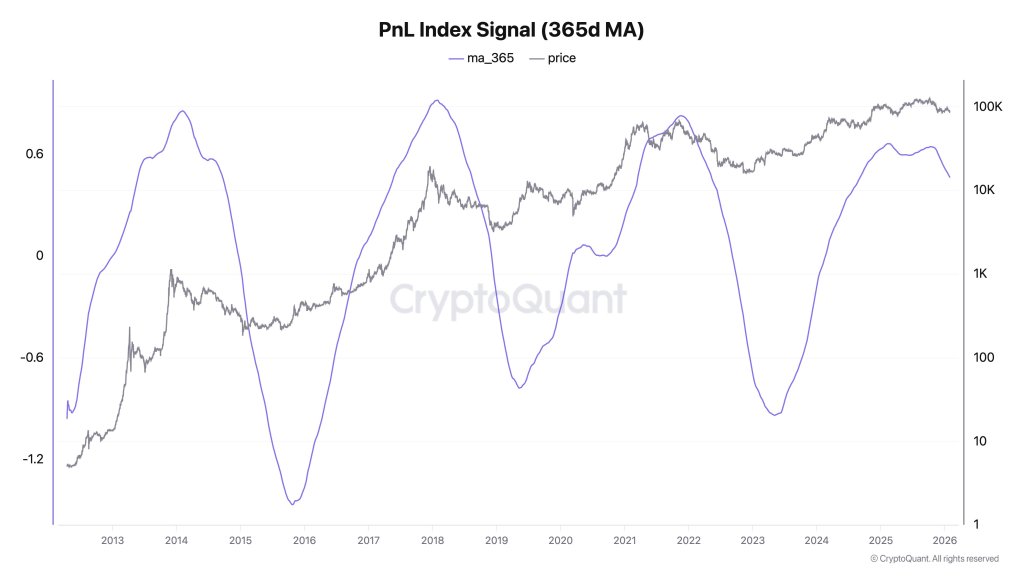
PnL Index Signal

His read is that the profit-taking has been there for a while, it was simply absorbed. Early holders, he wrote, were “sitting on big unrealized gains thanks to ETFs and MSTR buying,” and “have been taking profits since early last year, but strong inflows kept Bitcoin near 100K.” The change now, in his telling, is that the bid that mattered most has faded: “Now those inflows have dried up.”

That’s where the crash math changes. Ki described Strategy (MSTR) as “a major driver of this rally,” but argued the reflexive downside seen in prior cycles is unlikely without a decisive reversal from the company’s balance sheet strategy. “Unless Saylor significantly dumps his stack, we won’t see a -70% crash like previous cycles,” he wrote, carving out an explicit condition rather than presenting the drawdown as inevitable.

Even so, he didn’t claim the market has found a floor. “Selling pressure is still ongoing, so the bottom isn’t clear yet,” Ki said, adding that the more probable path is time, not a straight-line liquidation. His base case is “a wide-ranging sideways consolidation,” a regime where volatility can persist but direction becomes harder to sustain without new marginal buyers.

Stablecoin Liquidity Dries Up

CryptoQuant contributor Darkfost added color on what “no fresh capital” looks like in the plumbing. He argued stablecoin activity, often treated as a near-term proxy for deployable crypto liquidity, has rolled over sharply as uncertainty stays elevated.

“The crypto market is currently going through a delicate phase, marked by a structural lack of liquidity in a context of persistently high uncertainty,” he wrote, calling it an environment “not conducive to risk taking,” especially relative to assets like precious metals and equities that are still drawing flows.
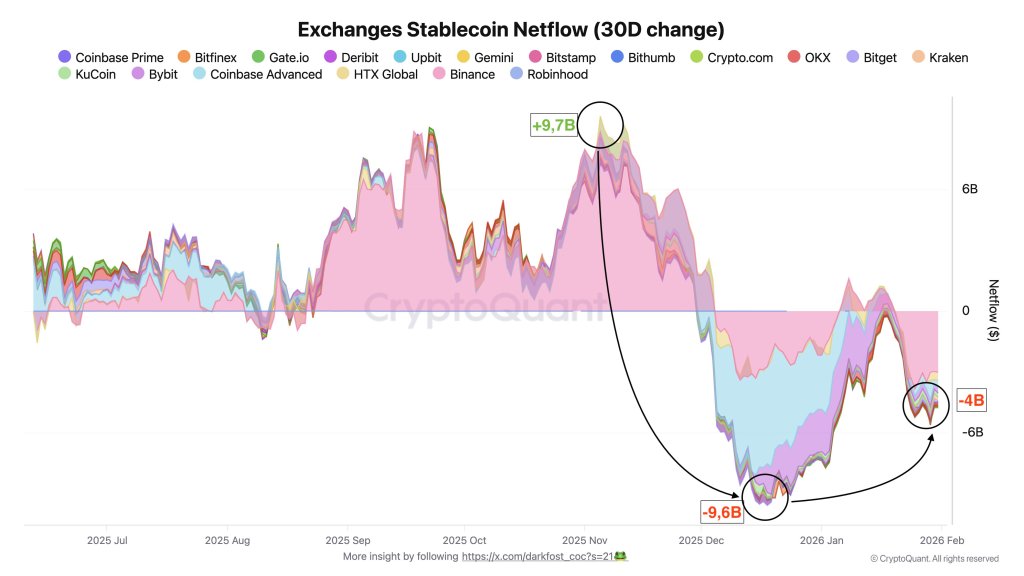
Exchanges stablecoin netflow

Darkfost said the stablecoin market had expanded by more than $140 billion since 2023, but that total stablecoin market capitalization began declining in December, “putting an end to this sustained growth trend.” The more actionable signal, he argued, is exchange flows: “Strong inflows generally indicate a willingness to gain exposure to the market, while outflows instead suggest capital preservation and a reduction in risk.”

He highlighted October as the last clear liquidity-heavy month, when “average monthly stablecoin netflows exceeded $9.7B,” with nearly $8.8B concentrated on Binance alone—conditions that “supported Bitcoin’s rally toward a new all time high.” Since November, he said, those inflows have been “largely wiped out,” with an initial $9.6 billion drop, then a brief stabilization, followed by renewed net outflows of more than $4 billion, including $3.1 billion from Binance.

At press time, BTC traded at $78,280.
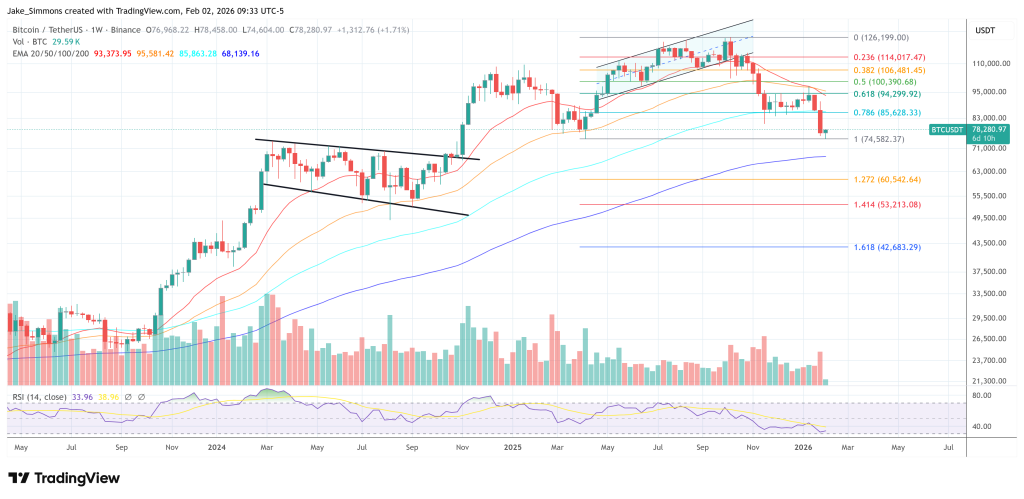
Bitcoin price chart
Disclaimer: The articles reposted on this site are sourced from public platforms and are provided for informational purposes only. They do not necessarily reflect the views of MEXC. All rights remain with the original authors. If you believe any content infringes on third-party rights, please contact [email protected] for removal. MEXC makes no guarantees regarding the accuracy, completeness, or timeliness of the content and is not responsible for any actions taken based on the information provided. The content does not constitute financial, legal, or other professional advice, nor should it be considered a recommendation or endorsement by MEXC.

You May Also Like

Tom Lee’s BitMine Hits 7-Month Stock Low as Ethereum Paper Losses Reach $8 Billion

Tom Lee’s BitMine Hits 7-Month Stock Low as Ethereum Paper Losses Reach $8 Billion

The post Tom Lee’s BitMine Hits 7-Month Stock Low as Ethereum Paper Losses Reach $8 Billion appeared on BitcoinEthereumNews.com. In brief Shares of BitMine Immersion
Share
BitcoinEthereumNews2026/02/06 04:47
Headwind Helps Best Wallet Token

Headwind Helps Best Wallet Token

The post Headwind Helps Best Wallet Token appeared on BitcoinEthereumNews.com. Google has announced the launch of a new open-source protocol called Agent Payments Protocol (AP2) in partnership with Coinbase, the Ethereum Foundation, and 60 other organizations. This allows AI agents to make payments on behalf of users using various methods such as real-time bank transfers, credit and debit cards, and, most importantly, stablecoins. Let’s explore in detail what this could mean for the broader cryptocurrency markets, and also highlight a presale crypto (Best Wallet Token) that could explode as a result of this development. Google’s Push for Stablecoins Agent Payments Protocol (AP2) uses digital contracts known as ‘Intent Mandates’ and ‘Verifiable Credentials’ to ensure that AI agents undertake only those payments authorized by the user. Mandates, by the way, are cryptographically signed, tamper-proof digital contracts that act as verifiable proof of a user’s instruction. For example, let’s say you instruct an AI agent to never spend more than $200 in a single transaction. This instruction is written into an Intent Mandate, which serves as a digital contract. Now, whenever the AI agent tries to make a payment, it must present this mandate as proof of authorization, which will then be verified via the AP2 protocol. Alongside this, Google has also launched the A2A x402 extension to accelerate support for the Web3 ecosystem. This production-ready solution enables agent-based crypto payments and will help reshape the growth of cryptocurrency integration within the AP2 protocol. Google’s inclusion of stablecoins in AP2 is a massive vote of confidence in dollar-pegged cryptocurrencies and a huge step toward making them a mainstream payment option. This widens stablecoin usage beyond trading and speculation, positioning them at the center of the consumption economy. The recent enactment of the GENIUS Act in the U.S. gives stablecoins more structure and legal support. Imagine paying for things like data crawls, per-task…
Share
BitcoinEthereumNews2025/09/18 01:27
European Blockchain Convention Drives Digital Finance Revival Amid 90% Blockchain Job Postings Decline

European Blockchain Convention Drives Digital Finance Revival Amid 90% Blockchain Job Postings Decline

The post European Blockchain Convention Drives Digital Finance Revival Amid 90% Blockchain Job Postings Decline appeared on BitcoinEthereumNews.com. This content is provided by a sponsor. PRESS RELEASE. Global leaders convene in Barcelona showcasing resilience as EU advances digital euro and fintech investment reaches €3.6bn in H1, 2025. Barcelona, Spain, September 22nd — The 11th European Blockchain Convention (EBC11) will gather global leaders in Barcelona on October 16-17 to challenge perceptions of European decline […] Source: https://news.bitcoin.com/european-blockchain-convention-drives-digital-finance-revival-amid-90-blockchain-job-postings-decline/
Share
BitcoinEthereumNews2025/09/23 07:16