

Cathie Wood Buys $24.8M in Crypto Stocks Despite Slump — What’s Ark Invest’s Real Plan?
Cathie Wood’s Ark Invest revealed on Monday that it stepped deeper into crypto-linked stock despite a broad slump in both cryptocurrency prices and exchange stocks.
The firm added roughly $24.8 million worth of positions despite the previous week being marked by falling volumes, declining liquidity, and renewed risk aversion across digital asset markets.
Trade disclosures released Monday show that Ark purchased shares of several crypto-exposed companies, including Robinhood, Circle, Block Inc., BitMine Immersion Technologies, Coinbase, and Bullish.
ARK Scoops Up Robinhood, BitMine, and Circle Despite Weak Crypto Week
The buying activity was spread mainly across the firm’s flagship ARK Innovation ETF and the ARK Blockchain & Fintech Innovation ETF, with additional exposure added through the ARK Next Generation Internet ETF.
The largest single purchase was 235,077 shares of Robinhood, valued at about $21.1 million at current prices, alongside 274,358 shares of BitMine worth roughly $6.2 million within the ARKK fund.
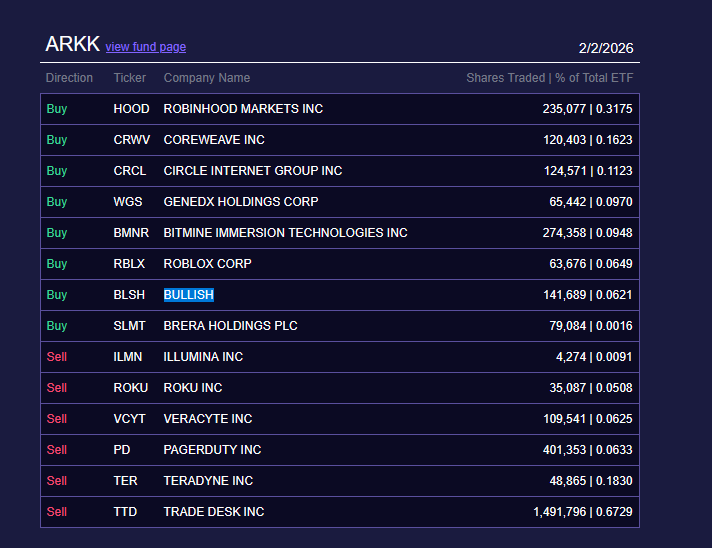 Source: Ark Invest
Other purchases include $9.4 million worth of Circle, $6 million worth of Bullish, $1.9 million worth of Block Inc., and $1.25 million worth of Coinbase.
The moves came as crypto-related stocks opened the week in negative territory.
Robinhood and Circle were down close to 10% and 8%, respectively, while BitMine and Bullish fell more than 9% and 4%.
 Source: Google Finance
Other major names tied to the sector, including Coinbase, Strategy, Metaplanet, and Galaxy Digital, also posted losses.
The pullback followed renewed weakness in Bitcoin, which fell below $80,000 in February for the first time since April 2025 and is now down more than 37% from its October peak.
The broader backdrop has been a sharp contraction in trading activity across centralized crypto exchanges.
Spot trading volumes have fallen from around $2 trillion in October to roughly $1 trillion by the end of January, according to industry data.
This slowdown has weighed heavily on exchange stocks, with shares of Coinbase having fallen more than 40% over the past six months, while Bullish is down nearly 57% over the same period.
Robinhood has been comparatively resilient, declining about 16%, but still trading well below its recent highs.
Cathie Wood Bets Big on Crypto Despite Coinbase Drag in Q4 2025
Ark’s purchases are not isolated moves, as the firm has consistently added to crypto-related positions during periods of weakness.
For example, it acquired $42 million worth of such stocks in November 2025 following the 9.6% Stock Crash.
Ark has also continued to add to its spot Bitcoin product, the ARK 21Shares Bitcoin ETF, even as prices retraced.
As of early February 2026, Ark Investment Management oversees roughly $16.8 billion in assets, with the ARK Innovation ETF accounting for about $6.98 billion.
Coinbase delivered ARK Invest’s largest quarterly drag in Q4 2025, as crypto market volatility sent the exchange’s shares sharply lower and weighed on Cathie Wood’s flagship ETFs.
ARK said Coinbase was the top detractor across its funds amid a 9% quarter-over-quarter decline in spot trading volumes.
Despite the setback, ARK struck an optimistic long-term tone.
In its Big Ideas 2026 report, the firm forecast the crypto market could grow to $28 trillion by 2030, led by Bitcoin, which ARK expects to account for about 70% of total market value as institutional adoption deepens.
Ark Invest’s real plan is to deepen its long-term structural bet on digital assets and blockchain adoption by increasing exposure to crypto-linked equities and Bitcoin during market dips.
Rather than short-term trading, Ark aims to integrate blockchain infrastructure into traditional finance, positioning Bitcoin as a core institutional asset and backing companies like Coinbase, Robinhood, Circle, and Block.
You May Also Like

Cashing In On University Patents Means Giving Up On Our Innovation Future

XRP Ledger Unlocks Permissioned Domains With 91% Validator Backing
