PayPal stock price tanked by nearly 20% on Tuesday, becoming one of the top laggards on Wall Street, after publishing weak financial results and a leadership changePayPal stock price tanked by nearly 20% on Tuesday, becoming one of the top laggards on Wall Street, after publishing weak financial results and a leadership change

Here’s why the PayPal stock price is imploding today

3 min read

PayPal stock price tanked by nearly 20% on Tuesday, becoming one of the top laggards on Wall Street, after publishing weak financial results and a leadership change. 

Summary
  • PayPal share price continued its strong downward trend.
  • The company published weak financial results and fired its CEO.
  • Its revenue and profits were weaker than expected.

PayPal shares crashed after weak earnings

PayPal, considered a top fintech company, is currently trading at around $42.19, down from its all-time high of $300. It has plunged to its lowest level since April 2017, with its market cap dropping from over $386 billion to $40 billion.

PayPal stock price crashed after the company published weak financial results. Its revenue rose by 4% in the fourth quarter to $8.7 billion, while its operating income jumped by 5% to $1.5 billion. 

The company expects its revenue and profit growth to continue to slow as competition intensifies. For example, its first-quarter guidance is that earnings per share will drop by mid-single digits. The same will happen this year when its EPS is expected to drop by mid-single digits. 

The slow growth explains why the company decided to replace its CEO. Alex Chriss has been replaced by Enrique Lores, an executive from HP. Jamie Miller, the CFO and Chief Operating Officer, will be the interim CEO before Lores takes over. The company said:

PayPal has been under pressure in the past few years as its growth slowed and competition rose. Its branded and unbranded businesses face substantial competition from companies such as Klarna, Affirm, Google, and Apple.

The most significant competition comes from stablecoins such as USDT, RLUSD, and USDC. Many users and companies are opting for stablecoin transactions because of their speed and convenience. 

PayPal launched the PayPal (PYUSD) stablecoin, whose supply has jumped to over $3.6 billion. The challenge for PayPal is how to monetize PYUSD, as the GENIUS Act limits how stablecoin companies make money. They can only invest in short-term US government bonds.

PayPal’s woes are reflected in its valuation. Its stock trades at a forward price-to-earnings ratio of 9.77, much lower than the S&P 500 average of 22.

PayPal stock price technical analysis
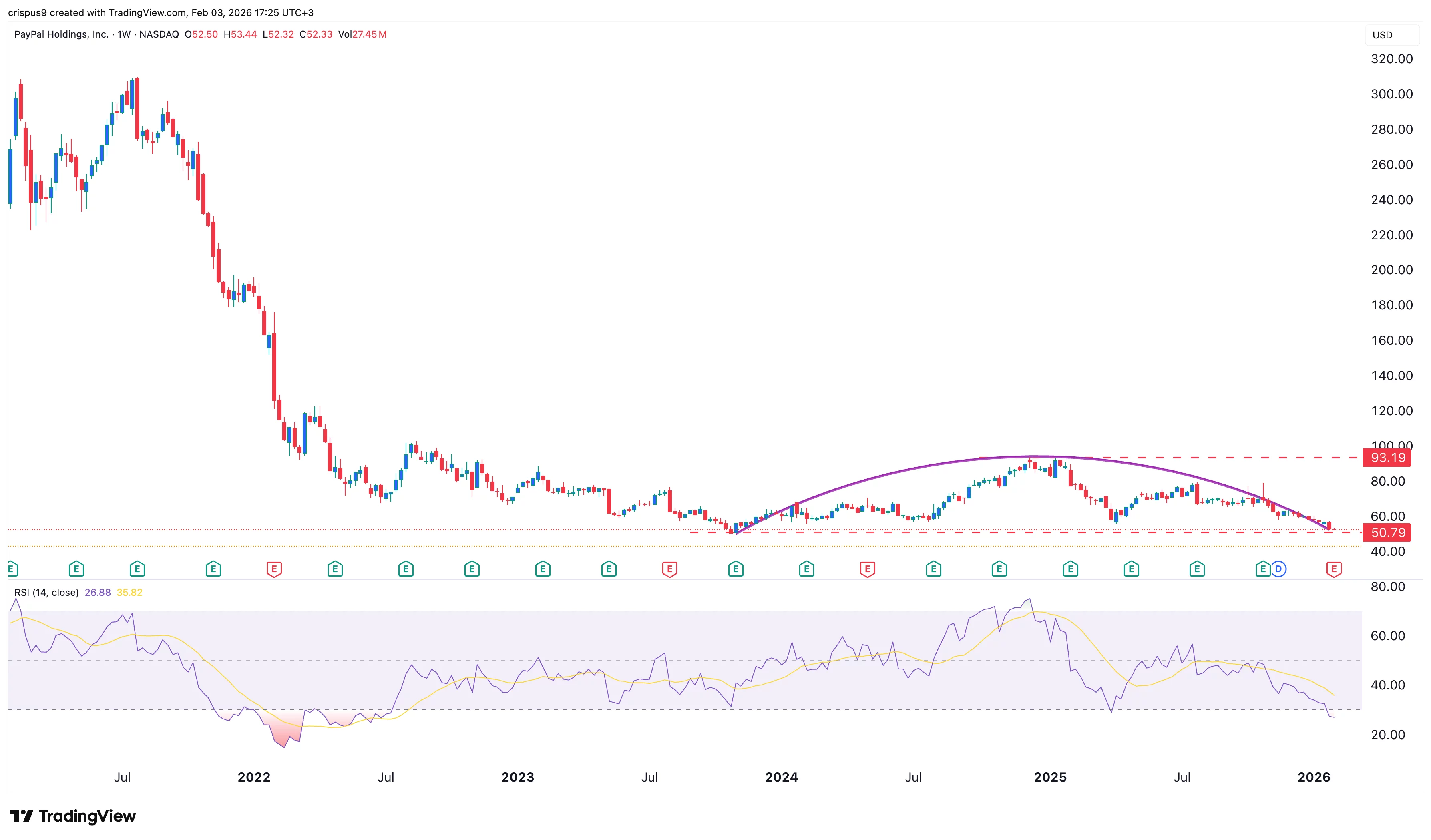
PayPal stock

The weekly timeframe chart shows that the PYPL stock has been in a strong downward trend in the past few weeks. It has dropped from a high of $83.20 in 2025 to $42 today. 

This crash occurred as the coin formed an inverted cup-and-handle pattern. It also formed a head-and-shoulders pattern. It remains below all moving averages, while the Relative Strength Index continues to fall.

Therefore, the most likely scenario is where the stock continues falling in the near term. However, a rebound is still possible as investors wait for Lore’s turnaround strategy.

Disclaimer: The articles reposted on this site are sourced from public platforms and are provided for informational purposes only. They do not necessarily reflect the views of MEXC. All rights remain with the original authors. If you believe any content infringes on third-party rights, please contact [email protected] for removal. MEXC makes no guarantees regarding the accuracy, completeness, or timeliness of the content and is not responsible for any actions taken based on the information provided. The content does not constitute financial, legal, or other professional advice, nor should it be considered a recommendation or endorsement by MEXC.

You May Also Like

Cashing In On University Patents Means Giving Up On Our Innovation Future

Cashing In On University Patents Means Giving Up On Our Innovation Future

The post Cashing In On University Patents Means Giving Up On Our Innovation Future appeared on BitcoinEthereumNews.com. “It’s a raid on American innovation that would deliver pennies to the Treasury while kneecapping the very engine of our economic and medical progress,” writes Pipes. Getty Images Washington is addicted to taxing success. Now, Commerce Secretary Howard Lutnick is floating a plan to skim half the patent earnings from inventions developed at universities with federal funding. It’s being sold as a way to shore up programs like Social Security. In reality, it’s a raid on American innovation that would deliver pennies to the Treasury while kneecapping the very engine of our economic and medical progress. Yes, taxpayer dollars support early-stage research. But the real payoff comes later—in the jobs created, cures discovered, and industries launched when universities and private industry turn those discoveries into real products. By comparison, the sums at stake in patent licensing are trivial. Universities collectively earn only about $3.6 billion annually in patent income—less than the federal government spends on Social Security in a single day. Even confiscating half would barely register against a $6 trillion federal budget. And yet the damage from such a policy would be anything but trivial. The true return on taxpayer investment isn’t in licensing checks sent to Washington, but in the downstream economic activity that federally supported research unleashes. Thanks to the bipartisan Bayh-Dole Act of 1980, universities and private industry have powerful incentives to translate early-stage discoveries into real-world products. Before Bayh-Dole, the government hoarded patents from federally funded research, and fewer than 5% were ever licensed. Once universities could own and license their own inventions, innovation exploded. The result has been one of the best returns on investment in government history. Since 1996, university research has added nearly $2 trillion to U.S. industrial output, supported 6.5 million jobs, and launched more than 19,000 startups. Those companies pay…
Share
BitcoinEthereumNews2025/09/18 03:26
Trump foe devises plan to starve him of what he 'craves' most

Trump foe devises plan to starve him of what he 'craves' most

A longtime adversary of President Donald Trump has a plan for a key group to take away what Trump craves the most — attention. EX-CNN journalist Jim Acosta, who
Share
Rawstory2026/02/04 01:19
Why Bitcoin Is Struggling: 8 Factors Impacting Crypto Markets

Why Bitcoin Is Struggling: 8 Factors Impacting Crypto Markets

Failed blockchain adoption narratives and weak fee capture have undercut confidence in major crypto projects.
Share
CryptoPotato2026/02/04 01:05