Vietnam Draft Rules Set Sights on 0.1% Tax on Crypto Transfers
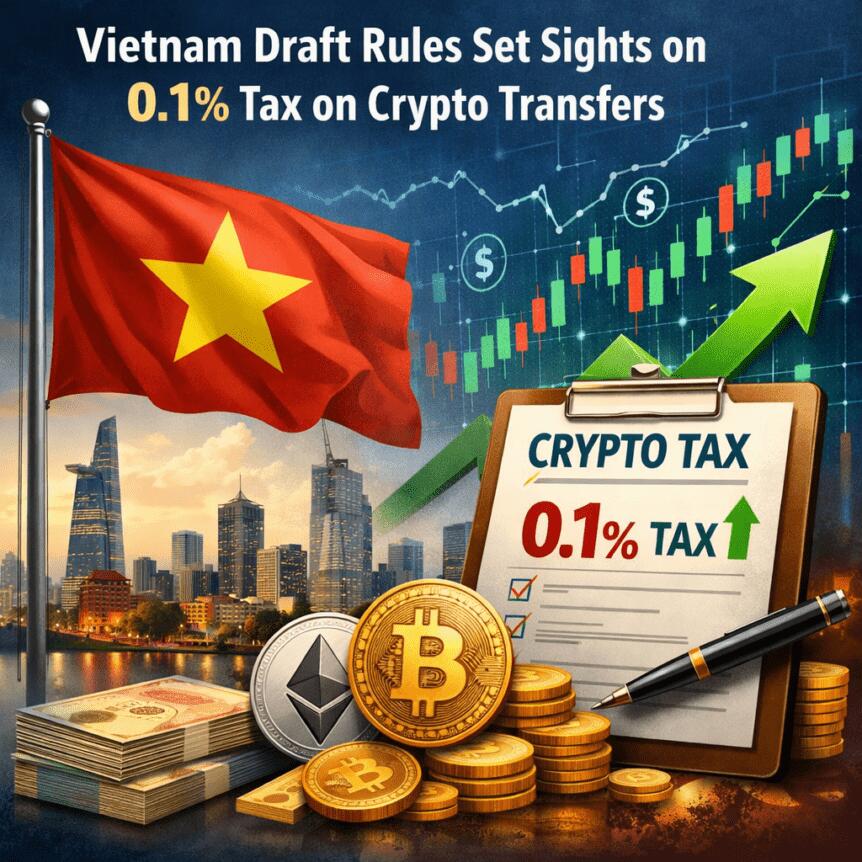
Vietnam is moving to formalize how crypto transactions are taxed and regulated, signaling a push toward a tightly controlled but economically significant digital asset market. A draft circular circulated by the Ministry of Finance would impose a 0.1% personal income tax on the value of each crypto transfer executed through licensed service providers, aligning digital asset activity with the country’s securities trading framework. While transfers and trading would be VAT-exempt, the plan taxes turnover, applying the levy to investors regardless of residency. For institutions, crypto-related income would be taxed at 20% corporate rate, calculated after deducting purchase costs and related expenses. The measures also set a high bar for exchanges, including a 10 trillion dong charter capital threshold and a 49% foreign-ownership cap, reflecting a cautious approach to market infrastructure.
The draft circular, released for public consultation, also formalizes a definition of crypto assets as digital assets issued, stored or transferred using cryptographic or similar technologies. It arrives as Vietnam accelerates a broader, five-year pilot program for a regulated crypto-asset market that began in September 2025. By October 2025, officials indicated no companies had applied to participate in the pilot, underscoring barriers related to capital requirements and eligibility criteria. Separately, authorities have begun opening licensing windows for digital asset trading platforms, signaling that the regulatory framework could start to take shape in early 2026.
As the policy discussion unfolds, Vietnam’s approach appears to be balancing tax revenue opportunities with stringent oversight of who can operate and how financial flows are monitored. The Ministry of Finance’s draft circulates alongside ongoing regulatory experiments and a push to bring crypto activity into formal channels, while the broader ecosystem weighs the implications for retail investors, institutions, and technology providers. The Hanoi Times highlighted the 0.1% PIT as the centerpiece of the tax framework, noting that the tax would be levied on transfers through licensed providers and would mirror the existing stock-trading levy in form and function. The article also points to a clear distinction between value-added tax treatment and turnover taxes, a nuance that could influence how exchanges structure their operations and how tax authorities monitor cross-border activity.
Vietnam formally defines crypto assets
In what appears to be a step toward regulatory clarity, authorities described crypto assets as digital instruments that rely on cryptographic or analogous technologies to issue, store and verify transfers. This definitional move is a precursor to stricter licensing criteria and more predictable tax treatment, which in turn could attract legitimate players while screening out speculative, non-compliant activity. The proposed regime sets a higher capital bar for exchanges than many industries require for traditional banks, signaling an intent to ensure resilience and risk controls in markets that are closely linked to global capital flows.
Under the proposed rules, operators seeking to run a digital asset exchange would need substantial capital, with charter requirements set at 10 trillion dong (about $408 million at current exchange rates). Foreign ownership would be allowed but capped at 49% of an exchange’s equity, limiting influence from outside the country while still enabling international participation. Such thresholds underscore the government’s preference for domestic guardianship of critical financial infrastructure, even as it permits foreign-backed ventures to participate under strict caps and regulatory oversight.
The broader regulatory arc has been visible since Vietnam launched a five-year crypto market pilot in September 2025, a landmark shift intended to test how a regulated ecosystem could coexist with a growing domestic economy. By early October, authorities acknowledged that no companies had yet submitted applications to join the pilot, a reflection of the substantial entry hurdles and careful qualification criteria in play. This admission came alongside reports that the pilot’s scope would eventually be complemented by formal licensing for trading platforms, a move that would bring crypto activity under formal government supervision and pave the way for standardized reporting and consumer protections.
Vietnam opens licensing for crypto exchanges
In the lag time between policy signals and practical rollout, Vietnam began accepting applications for exchange licenses, marking a tangible step toward operationalizing a regulated crypto market. The State Securities Commission of Vietnam (SSC) stated that applications would be accepted starting January 20, 2026, framing the licensing process as a deliberate, multi-year effort to bring crypto activities into a formal regulatory framework. The liquidity and risk-management requirements implied by the licensing window are designed to channel legitimate market participants into a controlled environment, potentially reducing fraud and improving transparency for investors and policymakers alike.
Key takeaways
- The Ministry of Finance’s draft circular would impose a 0.1% personal income tax on the value of each crypto transfer conducted through licensed providers, aligning crypto transfers with the country’s stock-trading levy.
- Crypto transfers and trading would be exempt from value-added tax, while turnover-based taxation would apply to investors regardless of residency status.
- Institutional investors earning income from crypto transfers would face a 20% corporate income tax on profits after deducting costs and expenses.
- Exchanges would face a high capital requirement of 10 trillion dong (roughly $408 million) and foreign ownership would be limited to 49% of equity.
- A formal definition of crypto assets would anchor regulatory rules, helping separate compliant activity from informal or illicit use cases.
- The country has launched a five-year pilot for a regulated crypto market (Sept 2025) with licensing for exchanges anticipated to begin in 2026, although initial participation had not materialized by Oct 2025.
Market context: The policy comes as many jurisdictions reassess how to regulate crypto markets, balancing tax revenue with consumer protection and financial stability. Vietnam’s approach leans toward rigorous control, reflecting a global trend toward centralized oversight while still signaling potential for regulated participation by international players under strict conditions.
Why it matters
The package signals a deliberate attempt to integrate crypto activity into the formal economy, with taxes and licensing acting as primary levers to enhance oversight. For retail investors, the PIT on transfers through licensed providers creates a clear tax path that will influence trading behavior and cost considerations. Institutions face a defined tax regime and a high bar for market entry, potentially filtering participants to those willing to navigate substantial capital prerequisites and regulatory compliance obligations.
From a market infrastructure perspective, the 10 trillion dong charter capital threshold and 49% foreign-ownership cap set a high ceiling for domestic exchanges, aiming to safeguard the financial system while still inviting foreign expertise. The definitional clarity around crypto assets helps align Vietnamese rules with broader financial standards, reducing ambiguity for developers, exchanges, and custodians seeking to establish local operations. Observers will watch how this framework interacts with ongoing pilot programs and whether the regulatory appetite broadens to accommodate more players over time.
For policymakers, the balance between revenue collection, investor protection, and market growth is delicate. Vietnam’s approach suggests a patient, data-driven trajectory: tax structures that incentivize compliance, capital requirements that deter low-capital risk, and licensing that creates an auditable, auditable market foundation. If successful, the model could influence neighboring economies contemplating similar regulated pathways for digital assets, especially in a region where adoption is uneven and regulatory certainty remains a key obstacle for institutional participation.
What to watch next
- January 20, 2026: Applications open for digital asset exchange licenses, establishing a formal entry point for market participants.
- Public responses to the draft circular: Feedback from domestic and international stakeholders could shape final text and practical implementation.
- Details on how PIT and corporate tax will be administered across different crypto products and services, including calculation methodologies and reporting requirements.
- Progress of the five-year pilot: uptake, participant eligibility, and any regulatory adjustments arising from early pilot findings.
- Any updates to foreign ownership rules or capital thresholds as exchanges begin building their local presence under clarified regulatory conditions.
Sources & verification
- Draft circular on crypto taxation and licensing circulated by Vietnam’s Ministry of Finance for public consultation.
- The Hanoi Times report outlining the 0.1% personal income tax on crypto transfers through licensed providers.
- Five-year crypto market pilot launched in September 2025, with a status update stating no applicants as of October 6, 2025.
- State Securities Commission of Vietnam (SSC) statement on the licensing window for digital asset exchanges and the January 20, 2026 start date.
- Coverage of Vietnam opening licensing for crypto exchanges and related regulatory developments referenced in contemporaneous reporting.
This article was originally published as Vietnam Draft Rules Set Sights on 0.1% Tax on Crypto Transfers on Crypto Breaking News – your trusted source for crypto news, Bitcoin news, and blockchain updates.
You May Also Like

Trump will never allow a MAGA defeat - and the implications are unthinkable

Solana Tops DEX Volume with $6.221 Billion in Trades