Market participants continue to search for reliable signals that can define the timing of Bitcoin’s next major expansion phase. While price forecasts, macro narrativesMarket participants continue to search for reliable signals that can define the timing of Bitcoin’s next major expansion phase. While price forecasts, macro narratives

If You’re Wondering When The Next Bitcoin Bull Run Will Begin, You Should See This Chart

2026/02/18 01:30
3 min read

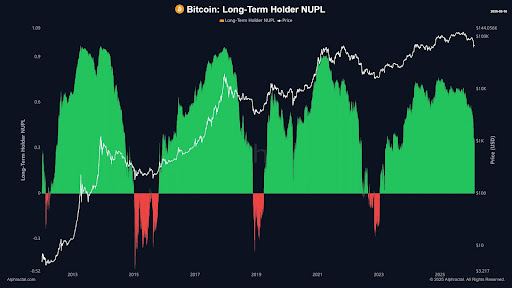
Market participants continue to search for reliable signals that can define the timing of Bitcoin’s next major expansion phase. While price forecasts, macro narratives, and ETF flows increasingly shape expectations, a chart published on February 16, 2025, by Alphractal founder and CEO Joao Wedson has added a new layer to that discussion. Focusing specifically on the profit positioning of long-term Bitcoin holders, this chart reveals a historic pattern about bull market timing.

What The Bitcoin Chart Tracks — And Why It Matters

In his post, Wedson presented a long-range chart built around the Long-Term Holder Net Unrealized Profit/Loss metric. The indicator measures the average unrealized gains or losses held by investors classified as long-term participants—wallets historically associated with stronger holding behavior and lower sell-side activity.

Related Reading: This Key Bitcoin Metric Signals That The Downside May Persist A Bit Longer

Rather than emphasizing short-term speculation, Wedson framed the metric as a lens into the financial condition of Bitcoin’s most resilient market cohort. According to the data shared, the current reading sits at 0.36. That level indicates long-term holders remain in aggregate profit, meaning their holdings, on average, are valued above acquisition cost.
Bitcoin

The chart visualizes this positioning through color-coded zones. Green regions represent periods where long-term holders hold unrealized profits. These phases have historically aligned with either late bull market environments or transitional consolidation ranges. The persistence of green, in Wedson’s presentation, signals that deep cycle stress has not yet fully materialized among conviction investors. By contrast, the most consequential signals in the chart appear when the metric shifts below zero.

When The Metric Turns Negative

Wedson’s analysis places primary emphasis on the moments when Long-Term Holder NUPL enters negative territory. In these intervals, even the most historically patient investors hold unrealized losses. The chart marks these periods in red, visually distinguishing them from profit-dominant phases.

Related Reading: Historical Pattern From 2017 Signals Bitcoin Price Crash To $35,000

Historically, those red zones have coincided with late bear-market conditions—periods characterized by widespread pessimism and compressed valuations. Wedson described this stage as one reflecting maximum market depression, where financial stress extends beyond speculative traders to reach long-term capital.

The chart’s historical mapping shows that these negative phases have preceded every major Bitcoin bull cycle. Each time the metric dropped below zero, it aligned with late-stage capitulation dynamics: seller exhaustion, reduced distribution pressure, and a transfer of coins toward entities with stronger holding capacity.

Within this framework, the red zone functions less as a signal of structural weakness and more as a reset phase. It marks the point where excess leverage and speculative positioning have been cleared, establishing conditions historically associated with cycle bottoms.

Wedson’s interpretation positions opportunity within these depression phases rather than during profit-heavy expansions. As illustrated in the chart, prior bull runs did not begin while long-term holders were comfortably in profit. They emerged after losses had permeated the cohort. With the metric still positive at 0.36, the chart suggests that, based strictly on historical precedent, the final capitulation preceding the next bull run has yet to occur.

Bitcoin
Market Opportunity
Major Logo
Major Price(MAJOR)
$0.07941
$0.07941$0.07941
+1.58%
USD
Major (MAJOR) Live Price Chart
Disclaimer: The articles reposted on this site are sourced from public platforms and are provided for informational purposes only. They do not necessarily reflect the views of MEXC. All rights remain with the original authors. If you believe any content infringes on third-party rights, please contact [email protected] for removal. MEXC makes no guarantees regarding the accuracy, completeness, or timeliness of the content and is not responsible for any actions taken based on the information provided. The content does not constitute financial, legal, or other professional advice, nor should it be considered a recommendation or endorsement by MEXC.

You May Also Like

New Zealand RBNZ Interest Rate Decision in line with expectations (2.25%)

New Zealand RBNZ Interest Rate Decision in line with expectations (2.25%)

The post New Zealand RBNZ Interest Rate Decision in line with expectations (2.25%) appeared on BitcoinEthereumNews.com. Gold is attempting a bounce from the $4,
Share
BitcoinEthereumNews2026/02/18 09:53
Mississippi holds hearing on xAI data center amid environmental lawsuit threat

Mississippi holds hearing on xAI data center amid environmental lawsuit threat

The Southern Environmental Law Center claims that a planned gas-fired power plant set to power xAI's Colossus II data center will be the largest new source of pollution
Share
Rappler2026/02/18 10:37
Cryptos Signal Divergence Ahead of Fed Rate Decision

Cryptos Signal Divergence Ahead of Fed Rate Decision

The post Cryptos Signal Divergence Ahead of Fed Rate Decision appeared on BitcoinEthereumNews.com. Crypto assets send conflicting signals ahead of the Federal Reserve’s September rate decision. On-chain data reveals a clear decrease in Bitcoin and Ethereum flowing into centralized exchanges, but a sharp increase in altcoin inflows. The findings come from a Tuesday report by CryptoQuant, an on-chain data platform. The firm’s data shows a stark divergence in coin volume, which has been observed in movements onto centralized exchanges over the past few weeks. Bitcoin and Ethereum Inflows Drop to Multi-Month Lows Sponsored Sponsored Bitcoin has seen a dramatic drop in exchange inflows, with the 7-day moving average plummeting to 25,000 BTC, its lowest level in over a year. The average deposit per transaction has fallen to 0.57 BTC as of September. This suggests that smaller retail investors, rather than large-scale whales, are responsible for the recent cash-outs. Ethereum is showing a similar trend, with its daily exchange inflows decreasing to a two-month low. CryptoQuant reported that the 7-day moving average for ETH deposits on exchanges is around 783,000 ETH, the lowest in two months. Other Altcoins See Renewed Selling Pressure In contrast, other altcoin deposit activity on exchanges has surged. The number of altcoin deposit transactions on centralized exchanges was quite steady in May and June of this year, maintaining a 7-day moving average of about 20,000 to 30,000. Recently, however, that figure has jumped to 55,000 transactions. Altcoins: Exchange Inflow Transaction Count. Source: CryptoQuant CryptoQuant projects that altcoins, given their increased inflow activity, could face relatively higher selling pressure compared to BTC and ETH. Meanwhile, the balance of stablecoins on exchanges—a key indicator of potential buying pressure—has increased significantly. The report notes that the exchange USDT balance, around $273 million in April, grew to $379 million by August 31, marking a new yearly high. CryptoQuant interprets this surge as a reflection of…
Share
BitcoinEthereumNews2025/09/18 01:01