Chainlink has deepened its grip on the oracle market after announcing a major partnership with Polymarket, the world’s largest on-chain prediction market, to enhance market resolution accuracy and speed. The deal cements Chainlink’s dominance at 62% of the oracle sector, according to DeFiLlama, indicating its growing role as key infrastructure for decentralized finance.Source: DefiLlama Chainlink Data Streams Now Power Bitcoin and Ether Prediction Markets on Polymarket According to the announcement, Polymarket has integrated Chainlink’s Data Streams and Automation services into its resolution process, with the system now live on the Polygon mainnet. The collaboration allows near-instant settlement of prediction markets, beginning with asset-pricing markets on assets such as Bitcoin and Ether. Chainlink’s decentralized networks deliver low-latency, timestamped data while eliminating single points of failure, ensuring that resolutions are both secure and verifiable. Polymarket, which has grown rapidly since launching in 2020, has positioned itself as a global hub for real-time information. The platform recently acquired QCEX, a CFTC-licensed exchange and clearinghouse, in a $112 million deal to prepare for a return to the U.S. market. It has also partnered with X to integrate personalized market recommendations into the social platform. The latest move with Chainlink further strengthens Polymarket’s infrastructure, reducing reliance on subjective voting systems and minimizing resolution risks in more complex market types. Chainlink co-founder Sergey Nazarov described the deal as a “pivotal milestone,” adding that resolving markets with tamper-proof computation and high-quality data transforms prediction markets into reliable signs “the world can trust.” The integration marks the beginning of a broader collaboration between the two companies, with plans to expand beyond asset-pricing into more subjective prediction categories. The agreement comes at a time when Chainlink has accelerated its expansion into traditional finance and government-linked data services. On August 11, the firm partnered with Intercontinental Exchange (ICE) to provide on-chain foreign exchange and precious metals rates through its Data Streams, using ICE’s Consolidated Feed sourced from over 300 marketplaces. Two weeks later, Japanese financial giant SBI Group revealed a collaboration with Chainlink to develop crypto tools for banks and institutions in Japan and the Asia-Pacific region, with an initial focus on tokenized bonds and stablecoin reserves. On August 28, the U.S. Department of Commerce began publishing official economic data on-chain via Chainlink, including GDP and inflation indicators, marking the first time government statistics were made verifiable on blockchain networks. With nearly $100 billion in total value locked in DeFi secured by its oracles and trillions of dollars in transaction value supported to date, Chainlink continues to assert itself as the backbone of decentralized data infrastructure. Polymarket Cleared by U.S. Regulators as Platform Eyes Major Expansion The U.S. Department of Justice (DOJ) and Commodity Futures Trading Commission (CFTC) in July closed their investigations into Polymarket without taking enforcement action. The probes, launched in late 2022, examined whether the New York-based platform continued to allow U.S. users access after agreeing to block them under a prior settlement. The regulatory closure marks a turning point for Polymarket, which has since secured clearance to re-enter the U.S. market. On September 3, the CFTC granted a no-action letter covering event contracts through QCX LLC and QC Clearing LLC, entities Polymarket acquired earlier this year in a $112 million deal. The relief provides a framework for offering compliant prediction contracts, shielding participants from enforcement tied to swap reporting and recordkeeping requirements. Polymarket has rapidly scaled into the largest prediction market globally, processing more than $8 billion in wagers, including $2.5 billion during the 2024 U.S. election cycle. In the first half of 2025 alone, users placed around $6 billion in bets. Currently, the total volume of prediction markets is $1.1 billion, with Polymarket accounting for more than 25 million positions and a user base of more than 1.2 million traders. The platform is also nearing a $200 million funding round led by Founders Fund that would value it at $1 billion. Meanwhile, Donald Trump Jr.’s 1789 Capital has joined as an investor and advisory partner, indicating growing institutional and political backing for the fast-expanding platformChainlink has deepened its grip on the oracle market after announcing a major partnership with Polymarket, the world’s largest on-chain prediction market, to enhance market resolution accuracy and speed. The deal cements Chainlink’s dominance at 62% of the oracle sector, according to DeFiLlama, indicating its growing role as key infrastructure for decentralized finance.Source: DefiLlama Chainlink Data Streams Now Power Bitcoin and Ether Prediction Markets on Polymarket According to the announcement, Polymarket has integrated Chainlink’s Data Streams and Automation services into its resolution process, with the system now live on the Polygon mainnet. The collaboration allows near-instant settlement of prediction markets, beginning with asset-pricing markets on assets such as Bitcoin and Ether. Chainlink’s decentralized networks deliver low-latency, timestamped data while eliminating single points of failure, ensuring that resolutions are both secure and verifiable. Polymarket, which has grown rapidly since launching in 2020, has positioned itself as a global hub for real-time information. The platform recently acquired QCEX, a CFTC-licensed exchange and clearinghouse, in a $112 million deal to prepare for a return to the U.S. market. It has also partnered with X to integrate personalized market recommendations into the social platform. The latest move with Chainlink further strengthens Polymarket’s infrastructure, reducing reliance on subjective voting systems and minimizing resolution risks in more complex market types. Chainlink co-founder Sergey Nazarov described the deal as a “pivotal milestone,” adding that resolving markets with tamper-proof computation and high-quality data transforms prediction markets into reliable signs “the world can trust.” The integration marks the beginning of a broader collaboration between the two companies, with plans to expand beyond asset-pricing into more subjective prediction categories. The agreement comes at a time when Chainlink has accelerated its expansion into traditional finance and government-linked data services. On August 11, the firm partnered with Intercontinental Exchange (ICE) to provide on-chain foreign exchange and precious metals rates through its Data Streams, using ICE’s Consolidated Feed sourced from over 300 marketplaces. Two weeks later, Japanese financial giant SBI Group revealed a collaboration with Chainlink to develop crypto tools for banks and institutions in Japan and the Asia-Pacific region, with an initial focus on tokenized bonds and stablecoin reserves. On August 28, the U.S. Department of Commerce began publishing official economic data on-chain via Chainlink, including GDP and inflation indicators, marking the first time government statistics were made verifiable on blockchain networks. With nearly $100 billion in total value locked in DeFi secured by its oracles and trillions of dollars in transaction value supported to date, Chainlink continues to assert itself as the backbone of decentralized data infrastructure. Polymarket Cleared by U.S. Regulators as Platform Eyes Major Expansion The U.S. Department of Justice (DOJ) and Commodity Futures Trading Commission (CFTC) in July closed their investigations into Polymarket without taking enforcement action. The probes, launched in late 2022, examined whether the New York-based platform continued to allow U.S. users access after agreeing to block them under a prior settlement. The regulatory closure marks a turning point for Polymarket, which has since secured clearance to re-enter the U.S. market. On September 3, the CFTC granted a no-action letter covering event contracts through QCX LLC and QC Clearing LLC, entities Polymarket acquired earlier this year in a $112 million deal. The relief provides a framework for offering compliant prediction contracts, shielding participants from enforcement tied to swap reporting and recordkeeping requirements. Polymarket has rapidly scaled into the largest prediction market globally, processing more than $8 billion in wagers, including $2.5 billion during the 2024 U.S. election cycle. In the first half of 2025 alone, users placed around $6 billion in bets. Currently, the total volume of prediction markets is $1.1 billion, with Polymarket accounting for more than 25 million positions and a user base of more than 1.2 million traders. The platform is also nearing a $200 million funding round led by Founders Fund that would value it at $1 billion. Meanwhile, Donald Trump Jr.’s 1789 Capital has joined as an investor and advisory partner, indicating growing institutional and political backing for the fast-expanding platform

Chainlink Cements 62% Dominance After Inking Major Polymarket Deal to Supercharge Prediction Market Accuracy

4 min read

Chainlink has deepened its grip on the oracle market after announcing a major partnership with Polymarket, the world’s largest on-chain prediction market, to enhance market resolution accuracy and speed.

The deal cements Chainlink’s dominance at 62% of the oracle sector, according to DeFiLlama, indicating its growing role as key infrastructure for decentralized finance.
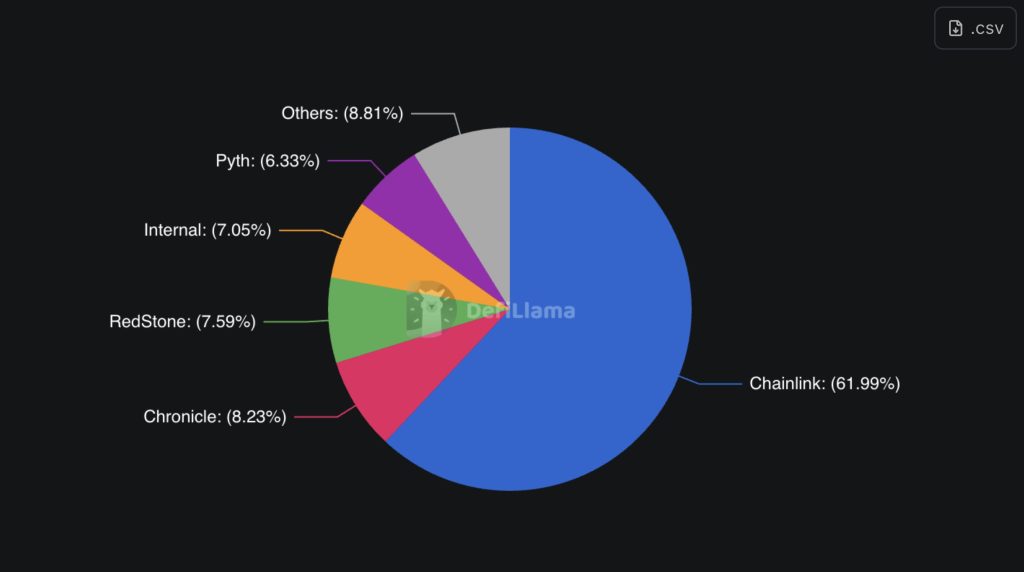
Source: DefiLlama

According to the announcement, Polymarket has integrated Chainlink’s Data Streams and Automation services into its resolution process, with the system now live on the Polygon mainnet.

The collaboration allows near-instant settlement of prediction markets, beginning with asset-pricing markets on assets such as Bitcoin and Ether.

Chainlink’s decentralized networks deliver low-latency, timestamped data while eliminating single points of failure, ensuring that resolutions are both secure and verifiable.

Polymarket, which has grown rapidly since launching in 2020, has positioned itself as a global hub for real-time information.

The platform recently acquired QCEX, a CFTC-licensed exchange and clearinghouse, in a $112 million deal to prepare for a return to the U.S. market. It has also partnered with X to integrate personalized market recommendations into the social platform.

The latest move with Chainlink further strengthens Polymarket’s infrastructure, reducing reliance on subjective voting systems and minimizing resolution risks in more complex market types.

Chainlink co-founder Sergey Nazarov described the deal as a “pivotal milestone,” adding that resolving markets with tamper-proof computation and high-quality data transforms prediction markets into reliable signs “the world can trust.”

The integration marks the beginning of a broader collaboration between the two companies, with plans to expand beyond asset-pricing into more subjective prediction categories.

The agreement comes at a time when Chainlink has accelerated its expansion into traditional finance and government-linked data services.

On August 11, the firm partnered with Intercontinental Exchange (ICE) to provide on-chain foreign exchange and precious metals rates through its Data Streams, using ICE’s Consolidated Feed sourced from over 300 marketplaces.

Two weeks later, Japanese financial giant SBI Group revealed a collaboration with Chainlink to develop crypto tools for banks and institutions in Japan and the Asia-Pacific region, with an initial focus on tokenized bonds and stablecoin reserves.

On August 28, the U.S. Department of Commerce began publishing official economic data on-chain via Chainlink, including GDP and inflation indicators, marking the first time government statistics were made verifiable on blockchain networks.

With nearly $100 billion in total value locked in DeFi secured by its oracles and trillions of dollars in transaction value supported to date, Chainlink continues to assert itself as the backbone of decentralized data infrastructure.

Polymarket Cleared by U.S. Regulators as Platform Eyes Major Expansion

The U.S. Department of Justice (DOJ) and Commodity Futures Trading Commission (CFTC) in July closed their investigations into Polymarket without taking enforcement action.

The probes, launched in late 2022, examined whether the New York-based platform continued to allow U.S. users access after agreeing to block them under a prior settlement.

The regulatory closure marks a turning point for Polymarket, which has since secured clearance to re-enter the U.S. market.

On September 3, the CFTC granted a no-action letter covering event contracts through QCX LLC and QC Clearing LLC, entities Polymarket acquired earlier this year in a $112 million deal.

The relief provides a framework for offering compliant prediction contracts, shielding participants from enforcement tied to swap reporting and recordkeeping requirements.

Polymarket has rapidly scaled into the largest prediction market globally, processing more than $8 billion in wagers, including $2.5 billion during the 2024 U.S. election cycle. In the first half of 2025 alone, users placed around $6 billion in bets.

Currently, the total volume of prediction markets is $1.1 billion, with Polymarket accounting for more than 25 million positions and a user base of more than 1.2 million traders.

The platform is also nearing a $200 million funding round led by Founders Fund that would value it at $1 billion.

Meanwhile, Donald Trump Jr.’s 1789 Capital has joined as an investor and advisory partner, indicating growing institutional and political backing for the fast-expanding platform.

Market Opportunity
Major Logo
Major Price(MAJOR)
$0.08676
$0.08676$0.08676
-0.77%
USD
Major (MAJOR) Live Price Chart
Disclaimer: The articles reposted on this site are sourced from public platforms and are provided for informational purposes only. They do not necessarily reflect the views of MEXC. All rights remain with the original authors. If you believe any content infringes on third-party rights, please contact [email protected] for removal. MEXC makes no guarantees regarding the accuracy, completeness, or timeliness of the content and is not responsible for any actions taken based on the information provided. The content does not constitute financial, legal, or other professional advice, nor should it be considered a recommendation or endorsement by MEXC.

You May Also Like

Cashing In On University Patents Means Giving Up On Our Innovation Future

Cashing In On University Patents Means Giving Up On Our Innovation Future

The post Cashing In On University Patents Means Giving Up On Our Innovation Future appeared on BitcoinEthereumNews.com. “It’s a raid on American innovation that would deliver pennies to the Treasury while kneecapping the very engine of our economic and medical progress,” writes Pipes. Getty Images Washington is addicted to taxing success. Now, Commerce Secretary Howard Lutnick is floating a plan to skim half the patent earnings from inventions developed at universities with federal funding. It’s being sold as a way to shore up programs like Social Security. In reality, it’s a raid on American innovation that would deliver pennies to the Treasury while kneecapping the very engine of our economic and medical progress. Yes, taxpayer dollars support early-stage research. But the real payoff comes later—in the jobs created, cures discovered, and industries launched when universities and private industry turn those discoveries into real products. By comparison, the sums at stake in patent licensing are trivial. Universities collectively earn only about $3.6 billion annually in patent income—less than the federal government spends on Social Security in a single day. Even confiscating half would barely register against a $6 trillion federal budget. And yet the damage from such a policy would be anything but trivial. The true return on taxpayer investment isn’t in licensing checks sent to Washington, but in the downstream economic activity that federally supported research unleashes. Thanks to the bipartisan Bayh-Dole Act of 1980, universities and private industry have powerful incentives to translate early-stage discoveries into real-world products. Before Bayh-Dole, the government hoarded patents from federally funded research, and fewer than 5% were ever licensed. Once universities could own and license their own inventions, innovation exploded. The result has been one of the best returns on investment in government history. Since 1996, university research has added nearly $2 trillion to U.S. industrial output, supported 6.5 million jobs, and launched more than 19,000 startups. Those companies pay…
Share
BitcoinEthereumNews2025/09/18 03:26
Trump foe devises plan to starve him of what he 'craves' most

Trump foe devises plan to starve him of what he 'craves' most

A longtime adversary of President Donald Trump has a plan for a key group to take away what Trump craves the most — attention. EX-CNN journalist Jim Acosta, who
Share
Rawstory2026/02/04 01:19
Why Bitcoin Is Struggling: 8 Factors Impacting Crypto Markets

Why Bitcoin Is Struggling: 8 Factors Impacting Crypto Markets

Failed blockchain adoption narratives and weak fee capture have undercut confidence in major crypto projects.
Share
CryptoPotato2026/02/04 01:05