TLDRs; Oracle ($ORCL) stock fell nearly 2% Wednesday as uncertainty over TikTok’s U.S. divestment deal pressured investor sentiment. A tentative framework would reduce ByteDance’s U.S. ownership below 20% while keeping Oracle as TikTok’s cloud provider. U.S. officials extended ByteDance’s divestment deadline to December 16, marking the fourth extension since the law was passed. The deal’s [...] The post Oracle ($ORCL): Down Nearly 2% as US-China TikTok Negotiations Drag On appeared first on CoinCentral.TLDRs; Oracle ($ORCL) stock fell nearly 2% Wednesday as uncertainty over TikTok’s U.S. divestment deal pressured investor sentiment. A tentative framework would reduce ByteDance’s U.S. ownership below 20% while keeping Oracle as TikTok’s cloud provider. U.S. officials extended ByteDance’s divestment deadline to December 16, marking the fourth extension since the law was passed. The deal’s [...] The post Oracle ($ORCL): Down Nearly 2% as US-China TikTok Negotiations Drag On appeared first on CoinCentral.

Oracle ($ORCL): Down Nearly 2% as US-China TikTok Negotiations Drag On

3 min read

TLDRs;

  • Oracle ($ORCL) stock fell nearly 2% Wednesday as uncertainty over TikTok’s U.S. divestment deal pressured investor sentiment.
  • A tentative framework would reduce ByteDance’s U.S. ownership below 20% while keeping Oracle as TikTok’s cloud provider.
  • U.S. officials extended ByteDance’s divestment deadline to December 16, marking the fourth extension since the law was passed.
  • The deal’s approval hinges on political talks between President Trump and President Xi, adding fresh layers of risk.

Oracle Corporation ($ORCL) shares dipped almost 1.82% in early Wednesday trading, reflecting market unease over the ongoing TikTok divestment saga.

The decline comes a day after the stock gained momentum on optimism surrounding a tentative deal, only for fresh political hurdles to spark renewed caution among investors.

At market open, Oracle stock stood at $301.06, shedding $5.59. The slide reflects broader volatility tied not only to the U.S.–China standoff over TikTok but also to uncertainty surrounding the timeline and terms of the agreement.
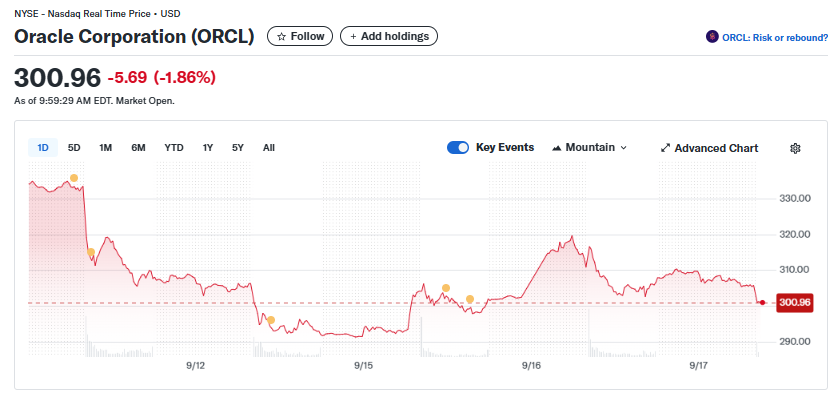
Oracle Corporation (ORCL)

Oracle’s Role in TikTok Deal

Oracle remains at the center of negotiations as a lead investor alongside Silver Lake and Andreessen Horowitz. The proposed structure would reduce ByteDance’s U.S. ownership stake to below 20%, a direct response to U.S. legislation requiring divestment or an outright ban.

Under the agreement, Oracle would continue serving as TikTok’s cloud provider, ensuring that U.S. user data is housed domestically and insulated from foreign access. While this arrangement reassures regulators, questions remain over whether ByteDance will retain any influence over TikTok’s core recommendation algorithm,  a sticking point in the deal.

Treasury officials describe the package as a “framework agreement”, signaling that negotiations are still fluid and subject to approvals by both President Donald Trump and Chinese President Xi Jinping. Talks are expected to intensify later this week, though previous extensions raise the possibility of further delays.

Political Backdrop Raises Stakes

The TikTok dispute is playing out against a backdrop of heightened U.S.–China tensions. In 2024, Congress passed a law mandating ByteDance divest TikTok or face removal from American app stores. Since then, the White House has issued multiple deadline extensions, with the latest running until December 16, 2025.

Unlike earlier cases involving Huawei and ZTE, where the U.S. imposed strict bans and sanctions, the TikTok situation highlights a different playbook: forced restructuring rather than outright exclusion. The intent, analysts say, is to maintain TikTok’s commercial viability while satisfying national security demands.

Still, the drawn-out process has fueled investor skepticism. Each new extension amplifies uncertainty, which markets often punish with volatility. For Oracle, which has pinned part of its growth narrative on cloud services, the protracted negotiations create a risk-versus-reward dynamic that investors must carefully assess.

What Comes Next for Oracle?

Market watchers believe the TikTok framework deal could close within 30 to 45 days, barring fresh political disruptions. However, with Trump and Xi both needing to weigh in, the final outcome remains uncertain.

For Oracle, the upside is clear: cementing its role as TikTok’s U.S. cloud partner could strengthen its market positioning in data services. On the flip side, prolonged delays or a collapsed deal could weigh on sentiment, particularly if TikTok faces operational constraints or an outright ban.

As of now, TikTok continues to operate in the U.S. while negotiations unfold. Investors will be watching closely for official statements in the coming weeks, with Oracle’s stock likely to remain sensitive to every twist in the saga.


The post Oracle ($ORCL): Down Nearly 2% as US-China TikTok Negotiations Drag On appeared first on CoinCentral.

Market Opportunity
Union Logo
Union Price(U)
$0.001559
$0.001559$0.001559
-0.25%
USD
Union (U) Live Price Chart
Disclaimer: The articles reposted on this site are sourced from public platforms and are provided for informational purposes only. They do not necessarily reflect the views of MEXC. All rights remain with the original authors. If you believe any content infringes on third-party rights, please contact [email protected] for removal. MEXC makes no guarantees regarding the accuracy, completeness, or timeliness of the content and is not responsible for any actions taken based on the information provided. The content does not constitute financial, legal, or other professional advice, nor should it be considered a recommendation or endorsement by MEXC.
Tags:

You May Also Like

Cashing In On University Patents Means Giving Up On Our Innovation Future

Cashing In On University Patents Means Giving Up On Our Innovation Future

The post Cashing In On University Patents Means Giving Up On Our Innovation Future appeared on BitcoinEthereumNews.com. “It’s a raid on American innovation that would deliver pennies to the Treasury while kneecapping the very engine of our economic and medical progress,” writes Pipes. Getty Images Washington is addicted to taxing success. Now, Commerce Secretary Howard Lutnick is floating a plan to skim half the patent earnings from inventions developed at universities with federal funding. It’s being sold as a way to shore up programs like Social Security. In reality, it’s a raid on American innovation that would deliver pennies to the Treasury while kneecapping the very engine of our economic and medical progress. Yes, taxpayer dollars support early-stage research. But the real payoff comes later—in the jobs created, cures discovered, and industries launched when universities and private industry turn those discoveries into real products. By comparison, the sums at stake in patent licensing are trivial. Universities collectively earn only about $3.6 billion annually in patent income—less than the federal government spends on Social Security in a single day. Even confiscating half would barely register against a $6 trillion federal budget. And yet the damage from such a policy would be anything but trivial. The true return on taxpayer investment isn’t in licensing checks sent to Washington, but in the downstream economic activity that federally supported research unleashes. Thanks to the bipartisan Bayh-Dole Act of 1980, universities and private industry have powerful incentives to translate early-stage discoveries into real-world products. Before Bayh-Dole, the government hoarded patents from federally funded research, and fewer than 5% were ever licensed. Once universities could own and license their own inventions, innovation exploded. The result has been one of the best returns on investment in government history. Since 1996, university research has added nearly $2 trillion to U.S. industrial output, supported 6.5 million jobs, and launched more than 19,000 startups. Those companies pay…
Share
BitcoinEthereumNews2025/09/18 03:26
XRP Ledger Unlocks Permissioned Domains With 91% Validator Backing

XRP Ledger Unlocks Permissioned Domains With 91% Validator Backing

XRP Ledger activated XLS-80 after 91% validator approval, enabling permissioned domains for credential-gated use on the public XRPL. The XRP Ledger has activated
Share
LiveBitcoinNews2026/02/06 13:00
XRPL Adds Institutional Lending and Privacy Tools in Ripple’s 2026 Roadmap

XRPL Adds Institutional Lending and Privacy Tools in Ripple’s 2026 Roadmap

Ripple shared a new Institutional DeFi roadmap showing how the XRP Ledger is being shaped for everyday use by banks, asset managers, and regulated financial firms
Share
Tronweekly2026/02/06 13:00