

Madagascar Protesters Turn to Offline Messaging App as Crisis Deepens

The surge marks the third time in September that civil unrest has driven protesters toward offline communication tools.
Protests Erupt Over Power Cuts
Demonstrations began on September 25, 2025, when hundreds of protesters took to the streets of Antananarivo, Madagascar’s capital. The catalyst was simple but devastating: residents were fed up with power cuts lasting more than 12 hours each day.
What started as peaceful protests quickly turned violent. By midday Thursday, looters targeted retail stores, banks, and electronics shops across the capital. Protesters set fire to cable car stations and the homes of three pro-government politicians. Five people died in the chaos, according to hospital sources.
Police responded with rubber bullets and tear gas. Authorities imposed a curfew from 7 p.m. to 5 a.m. to restore order. President Andry Rajoelina fired his energy minister on Friday, admitting the official “was not doing his job.”
The movement, called “Leo Délestage” (meaning “Fed up with load shedding”), was organized by three Antananarivo municipal officials. By Saturday, protesters returned to the streets with signs reading “We are poor, angry and unhappy” and “Madagascar is ours.”
Bitchat Searches Hit Peak Levels
As the protests intensified, interest in Bitchat skyrocketed. Google Trends data shows searches for “Bitchat” jumped from zero to 100 (peak popularity) on Friday in Madagascar, especially in Antananarivo. Related searches like “Bitchat download” and “how to use Bitchat” became breakout topics, meaning they experienced tremendous increases in activity.
Callebtc, a Bitcoin developer working on Bitchat, confirmed the surge on Sunday: “Bitchat downloads spiking in Madagascar.”
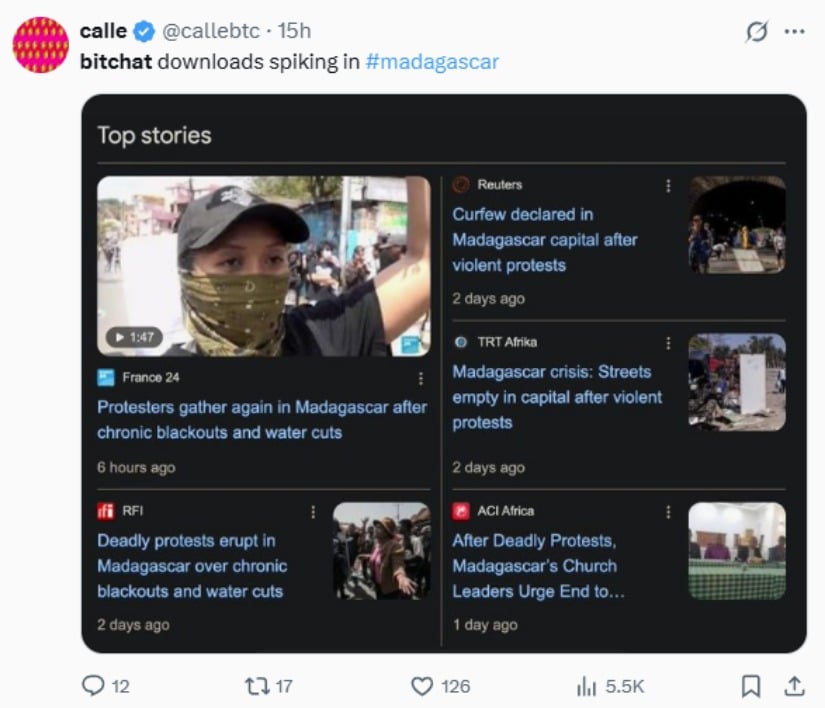
Source: @callebtc
Chrome-Stats data reveals the app has been downloaded 365,307 times since its July launch. More than 21,000 of those downloads came in the last 24 hours, and over 71,000 in the past week. While the data doesn’t specify regions, the timing matches Madagascar’s protest timeline.
Why Protesters Need Offline Apps
Madagascar faces severe digital inequality. Out of nearly 32 million people, only 6.6 million had internet access at the start of 2025, according to DataReportal. About 18 million mobile connections exist, but many only support voice calls and text messages without internet.
The World Bank estimates that 75% of Madagascar’s population lived below the poverty line in 2022. This makes Madagascar one of the poorest countries globally.
Bitchat solves a critical problem for protesters: how to communicate when internet access is limited or monitored. The app works entirely over Bluetooth, creating mesh networks between nearby devices. Messages can travel up to 300 meters by hopping through other users’ phones.
The app requires no accounts, email addresses, or phone numbers. Messages exist only in device memory and aren’t stored on any central database. End-to-end encryption protects conversations from surveillance.
A Pattern Emerges Across Asia and Africa
Madagascar is the third country in September to see Bitchat downloads surge during political unrest.
In early September, Nepal banned 26 major social media platforms during youth protests over government corruption. Bitchat downloads exploded from 3,300 to over 48,000 in just one week. Protesters used the app to coordinate demonstrations after losing access to Facebook, WhatsApp, YouTube, and Instagram.
Indonesia saw similar adoption in late August and early September. About 11,000 people downloaded Bitchat during protests against parliamentary allowances. The demonstrations escalated after police killed a 21-year-old rideshare driver with an armored vehicle.
The pattern is clear: when governments crack down on communication or internet access fails, people turn to decentralized alternatives.
What Makes Bitchat Different
Jack Dorsey, co-founder of Twitter and CEO of Block, launched Bitchat’s beta in July 2025. The app operates on Bluetooth Low Energy mesh networks, meaning it needs no internet connection or central servers.
The technology isn’t entirely new. Similar apps like Bridgefy gained attention during Hong Kong’s pro-democracy protests because they made it harder for authorities to detect communications. Bridgefy is partly funded by another Twitter co-founder, Biz Stone.
What sets Bitchat apart is its complete decentralization and privacy features. The network has no infrastructure dependencies. User IDs are randomly generated each session with nickname-based identification but no permanent binding.
Dorsey described the system in his white paper as providing “resilient communication that works anywhere people gather, regardless of internet availability.” The app supports room-based chats with hashtag-named groups and optional password protection.
The Road Ahead
Madagascar’s protests show no signs of stopping. Despite firing the energy minister, President Rajoelina faces continued demonstrations. Protest organizers are calling for peaceful gatherings to continue, and authorities expect more unrest in the coming days.
The surge in Bitchat adoption highlights growing demand for censorship-resistant communication tools. When traditional networks fail or governments impose restrictions, people seek alternatives that governments cannot easily control or monitor.
For Madagascar’s protesters, Bitchat offers a lifeline—a way to coordinate, share information, and maintain communication when basic infrastructure fails them. Whether the app can help resolve the deeper issues of poverty, corruption, and failing infrastructure remains to be seen. But for now, it’s giving protesters a voice when other channels fall silent.
When the Lights Go Out, the Network Stays On
The Bitchat phenomenon in Madagascar demonstrates how technology adapts to crisis. Three countries in one month turned to offline messaging during political turmoil. As internet censorship and infrastructure failures become more common, decentralized communication tools may shift from niche products to essential utilities. For Madagascar’s protesters facing 12-hour blackouts, that shift has already happened.
Ayrıca Şunları da Beğenebilirsiniz

Horror Thriller ‘Bring Her Back’ Gets HBO Max Premiere Date

How This New Altcoin Could Deliver 50x Before the Bull Market Ends
