

Tokenization May Scale DeFi to $2.7T by 2030, Says Standard Chartered
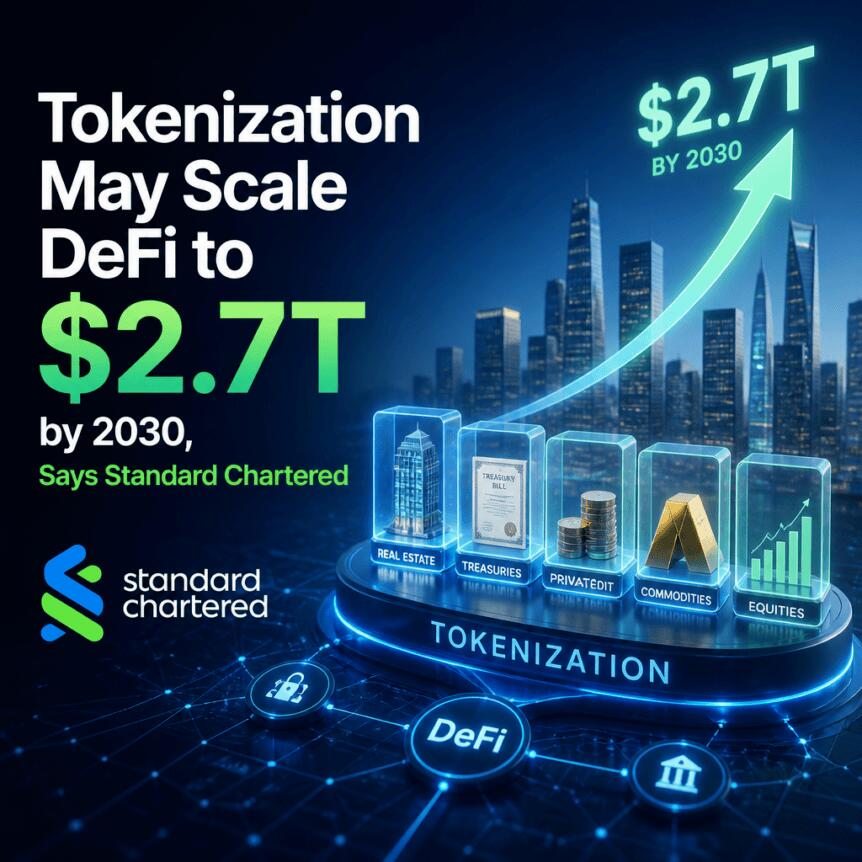
Standard Chartered is projecting a major expansion of decentralized finance activity tied to tokenized assets, forecasting that the total value of tokenized assets actively used in DeFi could rise from today’s small base to roughly $2.7 trillion by the end of 2030.
In a research note released on Monday, Geoff Kendrick, head of digital assets research at Standard Chartered, said the growth would be powered by two streams: tokenized real-world assets (RWAs) finding their way into onchain lending, liquidity and trading venues, and crypto-native assets being routed through DeFi protocols.
Key takeaways
- Standard Chartered expects tokenized assets active in DeFi to grow 37x to about $2.7 trillion by 2030.
- Only a small portion of currently circulating stablecoins and tokenized RWAs are used in DeFi today, according to the bank.
- Standard Chartered forecasts the share of tokenized value used in DeFi to increase to 30% by 2030, from around 3.5% currently.
- The bank sees Uniswap as a plausible hub for tokenized markets as more assets move onchain.
- Other industry voices warn that tokenization alone does not ensure liquidity or unified markets, and may increase fragmentation.
Standard Chartered’s 2030 DeFi tokenization forecast
Kendrick’s central estimate is that the amount of tokenized assets “active in DeFi” will expand by a factor of 37 by the end of 2030. He framed DeFi protocols as the next major channel for wealth-building and scaling exposure to onchain assets.
The bank’s assumptions start from a relatively low present-day level of DeFi participation. Kendrick said only about 3% of stablecoins and roughly 10% of tokenized RWAs are currently used in DeFi. From there, Standard Chartered projected a substantial shift in utilization: the proportion of tokenized assets used in DeFi should rise to about 30% by the end of 2030, up from around 3.5% at present.
While the directional logic is straightforward—more tokenization could mean more onchain activity—Standard Chartered’s own math implies a demanding pathway. Reaching the $2.7 trillion outcome would require both rapid growth in the underlying stock of onchain assets and a steep increase in the fraction of tokenized value actually routed into DeFi protocols.
Previous RWA outlook, and why DeFi adoption is the crux
The forecast builds on earlier work from Standard Chartered, including a previous projection that non-stablecoin tokenized RWAs could reach $2 trillion by the end of 2028. That earlier view highlighted tokenized money-market funds and US equities as major components of projected growth.
However, Monday’s note puts the spotlight on utilization rather than issuance. Tokenization may increase the total addressable market, but investors ultimately benefit from an ecosystem where tokenized assets can be accessed, traded, and used efficiently—often through DeFi infrastructure.
This is where Standard Chartered’s numbers become both persuasive and challenging. A near ninefold rise in the share of tokenized value used in DeFi would be required to support the $2.7 trillion estimate, suggesting that liquidity routing, custody, compliance frameworks, and market-making would all need to evolve alongside the growth of tokenized supply.
Liquidity fragmentation remains a key concern
Some market participants have cautioned that tokenization does not automatically solve liquidity and market-structure problems. Axis CEO Chris Kim previously told Cointelegraph that issuing “the same asset” across multiple blockchains and formats can lead to siloed liquidity, pricing gaps, and higher costs—factors that can limit how easily tokenized assets trade even as overall market size increases.
Similarly, Oya Celiktemur, Ondo Finance’s sales director for Europe, the Middle East and Africa, said at Paris Blockchain Week in April that tokenizing an illiquid asset does not “magically” make it liquid. The implication for Standard Chartered’s outlook is clear: the path to a larger DeFi share likely depends on whether market design and distribution reduce fragmentation rather than amplify it.
Why Uniswap could matter for tokenized markets
Kendrick also pointed to decentralized exchanges as potential distribution and liquidity layers for tokenized assets. In his view, Uniswap could develop into a key hub for trading tokenized markets as more of these assets move onto public blockchains.
He cited Uniswap’s scale, its brand recognition, and its long operational history through multiple crypto market cycles. Kendrick argued these strengths could be especially relevant to traditional financial institutions, which are likely to prioritize security, reliability, and established operational risk management when integrating tokenized RWAs into onchain systems.
Standard Chartered further suggested that if Uniswap can “commercialise enough” and secure enough TradFi partnerships to scale, its market cap-to-transaction fees multiple could rise—potentially narrowing the gap with Coinbase, according to the bank’s framing.
What to watch next
For investors and builders, the next signal will be whether tokenized assets increasingly find meaningful DeFi usage—moving beyond issuance headlines into sustained liquidity, cross-venue trading efficiency, and deeper integrations with major market participants. Standard Chartered’s forecast may be directionally aligned with tokenization trends, but the durability of that growth will likely hinge on whether fragmentation and liquidity limitations can be reduced as adoption accelerates.
This article was originally published as Tokenization May Scale DeFi to $2.7T by 2030, Says Standard Chartered on Crypto Breaking News – your trusted source for crypto news, Bitcoin news, and blockchain updates.


Ayrıca Şunları da Beğenebilirsiniz
Expert taken aback as Trump aides rejected 'outrageous' habeas corpus proposal

Ethereum Whale Moves $53.1 Million to FalconX, Hinting at Potential Sell-Off

Ondo Finance Launches USDY Yieldcoin on Stellar, Bringing Tokenized U.S. Treasuries to Users


Popüler Haberler
Daha fazla
