

Why Do Banks Sometimes Block Payments to Crypto Exchanges in India?
BitcoinWorld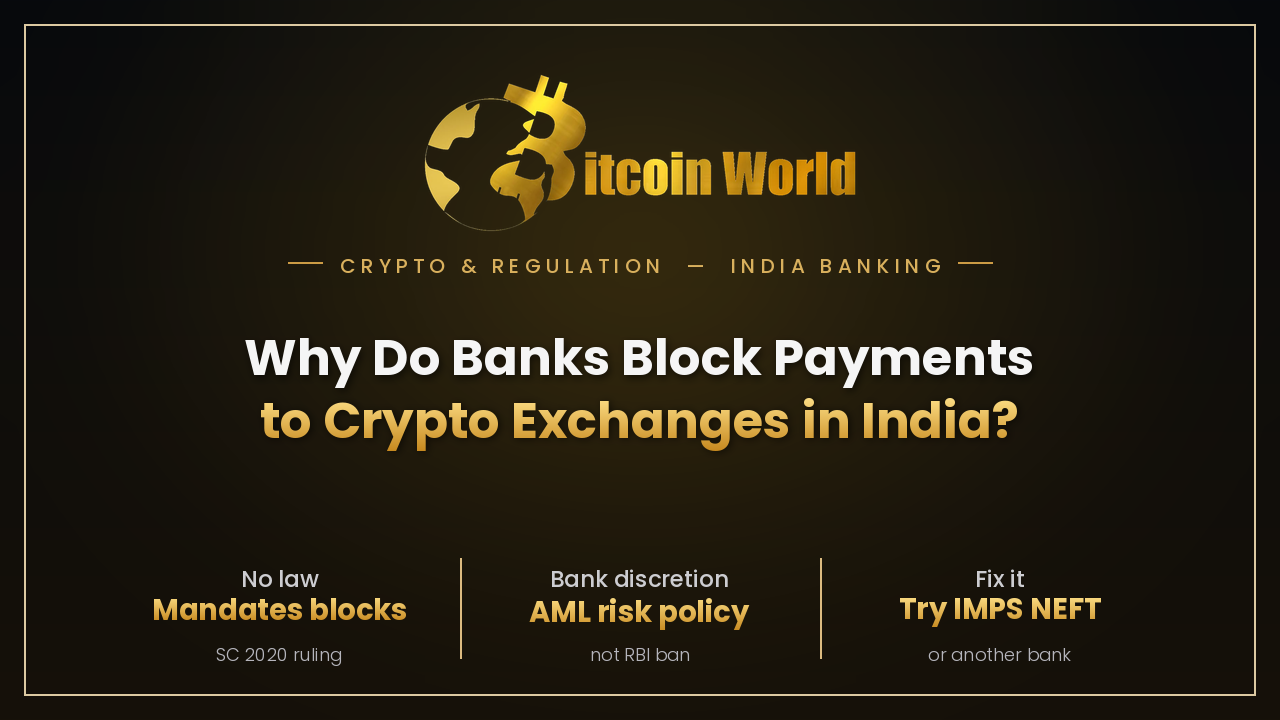
Why Do Banks Sometimes Block Payments to Crypto Exchanges in India?
Why Do Banks Sometimes Block Payments to Crypto Exchanges in India?
Banks blocking payments to crypto exchanges in India is one of the most common and most frustrating experiences for Indian crypto users – and the cause is not what most people assume. There is no current RBI circular or NPCI directive that mandates banks to block crypto exchange payments. The 2018 RBI banking ban was overturned by the Supreme Court in March 2020 and has not been reinstated. What drives the blocks is a combination of individual bank risk policies, AML monitoring systems, the RBI’s publicly cautious tone, and the growing scrutiny of crypto-related banking flows under PMLA. This article explains exactly why banks block these payments, which legal frameworks enable them to do so, how the blocks differ from a formal ban, and what Indian users can practically do when a payment fails.
Is There a Law That Requires Banks to Block Crypto Exchange Payments in India?
No law in India currently requires banks to block payments to crypto exchanges – the position is more nuanced than a simple ban.
- 2018 RBI circular overturned: The RBI’s April 2018 circular directing banks not to service crypto businesses was struck down by the Supreme Court on 4 March 2020 in IAMAI v. RBI as unconstitutional.
- No replacement directive: The RBI has not issued any equivalent circular since 2020 – banks are legally permitted to service FIU-registered crypto exchanges.
- 49 registered exchanges: As of January 2026, 49 exchanges (45 domestic, 4 offshore) are FIU-registered, meaning they operate within a legal compliance framework that banks can recognise.
- The blocks are discretionary: Each bank and payment app sets its own internal risk policy – what triggers a block at HDFC may not trigger one at Kotak.
- Regulatory tone matters: The RBI’s repeated public statements expressing concern about private crypto influence how bank compliance teams interpret their obligations, even without a directive.
What Actually Causes Banks to Block Crypto Exchange Payments?
Banks blocking crypto payments stems from multiple overlapping factors – none of which is a single law, but all of which produce real friction.
- Internal AML risk models: Banks use transaction monitoring software that flags unusual patterns – large deposits from or to unfamiliar counterparties, including crypto exchanges, can trigger automatic holds.
- RBI’s institutional caution: The RBI’s negative public stance on crypto creates a risk-averse culture inside bank compliance teams, who prefer to flag more rather than less.
- PMLA obligations: Under the Prevention of Money Laundering Act, banks must file Suspicious Transaction Reports (STRs) for unusual activity – some compliance teams treat all crypto exchange payments as requiring enhanced scrutiny.
- Unregistered exchange flows: Payments to non-FIU-registered foreign platforms carry FEMA contravention risk – banks are more likely to block these and have a clear legal reason to do so.
- Payment app-level blocks: UPI apps like PhonePe and Google Pay apply their own merchant category risk filters – crypto exchanges may be flagged at the payment app level before the bank is even involved.
- P2P trade scrutiny: INR transfers linked to P2P crypto trading receive the highest scrutiny because the counterparty is often unknown and the transaction pattern resembles money mule activity.
What Legal Powers Allow Banks to Restrict Crypto-Related Payments?
Banks restricting crypto payments can draw on several legal provisions even without a specific crypto ban.
- Banking Regulation Act, 1949: Banks have broad discretion to manage risk on their own accounts – they can impose additional checks or conditions on customer transactions without needing specific RBI approval.
- PMLA, 2002 (Section 12): Obligates banks to maintain records and report suspicious transactions – compliance teams interpret this as giving them authority to slow or block transactions pending verification.
- Section 102 CrPC / Section 106 BNSS: Allows police and cyber cells to instruct banks to freeze accounts where funds are suspected to be proceeds of crime – used in P2P fraud investigations.
- RBI’s risk management guidelines: Banks’ own risk management frameworks, endorsed by the RBI, allow them to categorise transaction types by risk and apply discretionary controls.
What Can Indian Crypto Users Do When a Bank Blocks a Payment?
When a bank blocks a crypto exchange payment, practical workarounds exist – and rights exist too.
- Try a different bank or UPI app: A payment blocked by HDFC may process through Axis or Kotak – bank-level risk policies vary significantly.
- Use IMPS or NEFT: These transfer methods are subject to less app-level filtering than UPI – most FIU-registered exchanges accept both.
- Use only FIU-registered exchanges: Payments to FIU-registered platforms have a documented legal status that banks can verify – reducing the likelihood of friction.
- Document the block: If a bank blocks a transaction without explanation, you can request written clarification under the Banking Regulation Act – banks are not entitled to block transactions arbitrarily without basis.
- Escalate to the banking ombudsman: If a bank persistently blocks legitimate transactions to registered exchanges without legal justification, the RBI Banking Ombudsman is the escalation path.
Frequently Asked Questions
Is it illegal for a bank to block payments to crypto exchanges in India?
No – Indian banks have legal discretion under the Banking Regulation Act and their own risk management frameworks to apply enhanced scrutiny or restrict transactions they classify as high-risk. There is no law requiring them to block crypto payments, but there is also no law preventing individual risk decisions. Using FIU-registered exchanges and maintaining documentation of your transactions significantly reduces the likelihood of a block and gives you grounds to challenge one.
Why do PhonePe and Google Pay sometimes block UPI payments to crypto exchanges?
UPI apps like PhonePe and Google Pay apply their own merchant risk category rules – crypto exchanges may be classified as high-risk merchants in their internal systems, triggering automatic payment declines. This is not an RBI or NPCI policy – it is a commercial risk decision by the payment app operator. The fix is to try a different UPI app, switch to a bank’s own UPI (e.g., via net banking), or use IMPS as an alternative.
What is the difference between a bank blocking a crypto payment and a bank account being frozen in India?
A payment block is a temporary decline on a specific outbound transaction – your account remains fully functional; only that particular payment is declined. A bank account freeze is a complete suspension of debit access, usually ordered by cyber police or law enforcement under Section 106 BNSS, and affects all transactions from the account. Payment blocks are common for crypto exchange deposits; full account freezes are more serious events typically triggered by a P2P fraud investigation linking your account to criminal proceeds.
Conclusion: Discretion, Not a Ban – and Why Compliance Is the Best Defence
Banks blocking payments to crypto exchanges in India reflects institutional caution, internal AML risk models, and the RBI’s negative public stance – not a legal prohibition. The Supreme Court settled the question of whether a blanket banking ban is constitutional in 2020, and no equivalent directive has replaced it. For Indian crypto users, the practical strategy is straightforward: use FIU-registered domestic exchanges, maintain documentation of every transaction, have IMPS or NEFT ready as a UPI alternative, and understand that a payment decline is a risk policy decision – not a criminal finding. As India’s comprehensive crypto legislation progresses, the clarity that banks need to reduce discretionary friction will eventually arrive. Until then, documentation and compliance are your best tools.
This post Why Do Banks Sometimes Block Payments to Crypto Exchanges in India? first appeared on BitcoinWorld.


Ayrıca Şunları da Beğenebilirsiniz

Ripple XRP Donation Match Backs Veteran Jobs Drive on July 4

Natural Cure Labs Rebrands to NCL, Launches New Website as Part of Broader Evolution

Agentshub.AI Launches true Agentic AI Platform to Build Autonomous AI Workforces in Minutes


Popüler Haberler
Daha fazla
