Starlink rival Amazon Leo has launched a waitlist for many countries, including Nigeria, to collect details of would-be…Starlink rival Amazon Leo has launched a waitlist for many countries, including Nigeria, to collect details of would-be…

Starlink rival, Amazon Leo launches waitlist for many countries, including Nigeria

2025/11/26 20:47

Starlink rival Amazon Leo has launched a waitlist for many countries, including Nigeria, to collect details of would-be early users of its satellite Internet service when it eventually rolls out. Recall that the company recently began its first public testing with select enterprise customers ahead of an anticipated wider commercial rollout in 2026.

The list provides for three broad categories of users:

  1. Government: Government agencies and service providers like schools, hospitals, etc.
  2. Personal: individual users like you
  3. Business: corporate users and business owners

It also provides three different router types:

  • Ultra: It will support download speeds of up to 1Gbps and upload speeds of 400Mbps. Amazon boasts that it will be the world’s fastest satellite Internet antenna.
  • Nano: the smallest and lightest antenna, and most likely going to be the most affordable. The antenna weighs around 1kg. It will have a square dish panel that measures less than 18cm from side to side. It supports download speeds of up to 100Mbps.
  • Pro: Bulkier and heavier, measuring approximately 28cm across and weighing 2.4kg. It will offer download speeds of up to 400Mbps.

To apply, simply click here to start.
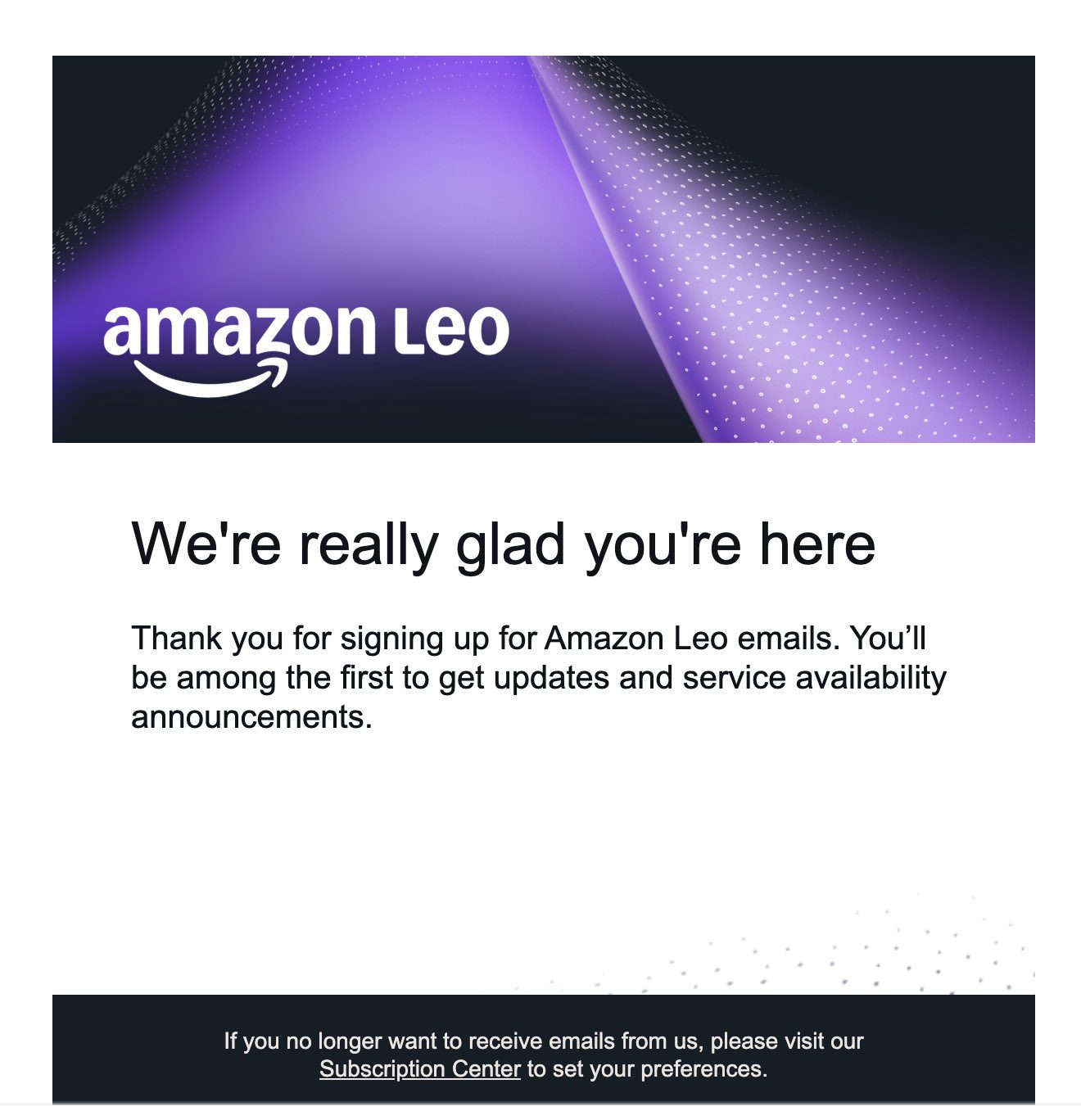
Starlink rival, Amazon Leo launches waitlist for many countries, including NigeriaYou will get a welcome email, like this, after you join the waitlist…

Recall that Amazon has partnered with Vanu, a US-based company, to deploy cellular towers in far-flung and rural parts of Southern Africa. There isn’t an announcement for a distribution structure for West Africa yet.

What you need to know about Amazon Leo

Previously known as Project Kuiper, Leo launched its first operational batch of internet satellites into low Earth orbit (LEO) last year. The mission, dubbed “KA-01” (Kuiper Atlas 1), saw 27 satellites lifted off aboard a United Launch Alliance (ULA) Atlas V rocket from Cape Canaveral Space Force Station in Florida in September.

The project now has a fleet of 153 production satellites in orbit and aims to expand to 1,618 satellites by 30 July 2026. Although this pales when compared with Starlink’s 10,000 satellites, the Amazon-owned company claims that its top-end product will offer speeds of up to 1Gbps.

Amazon’s ambitious initiative to provide global broadband access has been at least 10 years in the making. The company aims to deploy a constellation of more than 3,200 LEO satellites to deliver fast, reliable internet to customers worldwide, including underserved regions.

The first phase of the deployment will consist of 578 satellites orbiting around 630km above the Earth’s surface, slightly higher than Starlink’s fleet. Using these satellites, Amazon is rolling out 12 ground stations to provide backhaul connectivity to the Internet.

While SpaceX’s Starlink has a head start with its reusable Falcon 9 rockets and a licensed capacity for 12,000 first-generation satellites (plus 7,500 more for its second generation), Amazon is betting on its technological prowess and global reach to carve out a competitive niche.

The company has secured 80 launch missions with multiple providers, including ULA, Arianespace, and Jeff Bezos’ Blue Origin, to build out its initial constellation.

Experts believe that the setup process is likely to take at least one more year, with the earliest optimistic global launch date being late 2026 or early 2027.

Sorumluluk Reddi: Bu sitede yeniden yayınlanan makaleler, halka açık platformlardan alınmıştır ve yalnızca bilgilendirme amaçlıdır. MEXC'nin görüşlerini yansıtmayabilir. Tüm hakları telif sahiplerine aittir. Herhangi bir içeriğin üçüncü taraf haklarını ihlal ettiğini düşünüyorsanız, kaldırılması için lütfen [email protected] ile iletişime geçin. MEXC, içeriğin doğruluğu, eksiksizliği veya güncelliği konusunda hiçbir garanti vermez ve sağlanan bilgilere dayalı olarak alınan herhangi bir eylemden sorumlu değildir. İçerik, finansal, yasal veya diğer profesyonel tavsiye niteliğinde değildir ve MEXC tarafından bir tavsiye veya onay olarak değerlendirilmemelidir.

Ayrıca Şunları da Beğenebilirsiniz

IP Hits $11.75, HYPE Climbs to $55, BlockDAG Surpasses Both with $407M Presale Surge!

IP Hits $11.75, HYPE Climbs to $55, BlockDAG Surpasses Both with $407M Presale Surge!

The post IP Hits $11.75, HYPE Climbs to $55, BlockDAG Surpasses Both with $407M Presale Surge! appeared on BitcoinEthereumNews.com. Crypto News 17 September 2025 | 18:00 Discover why BlockDAG’s upcoming Awakening Testnet launch makes it the best crypto to buy today as Story (IP) price jumps to $11.75 and Hyperliquid hits new highs. Recent crypto market numbers show strength but also some limits. The Story (IP) price jump has been sharp, fueled by big buybacks and speculation, yet critics point out that revenue still lags far behind its valuation. The Hyperliquid (HYPE) price looks solid around the mid-$50s after a new all-time high, but questions remain about sustainability once the hype around USDH proposals cools down. So the obvious question is: why chase coins that are either stretched thin or at risk of retracing when you could back a network that’s already proving itself on the ground? That’s where BlockDAG comes in. While other chains are stuck dealing with validator congestion or outages, BlockDAG’s upcoming Awakening Testnet will be stress-testing its EVM-compatible smart chain with real miners before listing. For anyone looking for the best crypto coin to buy, the choice between waiting on fixes or joining live progress feels like an easy one. BlockDAG: Smart Chain Running Before Launch Ethereum continues to wrestle with gas congestion, and Solana is still known for network freezes, yet BlockDAG is already showing a different picture. Its upcoming Awakening Testnet, set to launch on September 25, isn’t just a demo; it’s a live rollout where the chain’s base protocols are being stress-tested with miners connected globally. EVM compatibility is active, account abstraction is built in, and tools like updated vesting contracts and Stratum integration are already functional. Instead of waiting for fixes like other networks, BlockDAG is proving its infrastructure in real time. What makes this even more important is that the technology is operational before the coin even hits exchanges. That…
Paylaş
BitcoinEthereumNews2025/09/18 00:32
Ethereum Name Service price prediction 2025-2031: Is ENS a good investment?

Ethereum Name Service price prediction 2025-2031: Is ENS a good investment?

Key takeaways: The Ethereum Name Service is a network that enables crypto enthusiasts to rename their cryptocurrency addresses into something simpler, making them easier to remember. Renaming crypto addresses through ENS will enable users to recollect and write them quickly. Even though Ethereum Name Service is based on the Ethereum blockchain, it uses its cryptocurrency, […]
Paylaş
Cryptopolitan2025/09/18 01:38
Why IPO Genie ($IPO) Is Being Called a Top Crypto Presale by Analysts

Why IPO Genie ($IPO) Is Being Called a Top Crypto Presale by Analysts

IPO Genie ($IPO) is being called a top crypto presale by analysts, offering AI-driven market insights, robust tokenomics, and data-backed investor growth.
Paylaş
Blockchainreporter2025/12/18 22:00