

Why Crypto Is Crashing Today: BOJ Interest Rate Fears Trigger Global Sell-Off

The post Why Crypto Is Crashing Today: BOJ Interest Rate Fears Trigger Global Sell-Off appeared first on Coinpedia Fintech News
The crypto market is extending losses as Bitcoin and altcoins face a sharp Friday sell-off, with prices sliding 5–10% across major tokens. While the timing may feel familiar, the pressure is not random. Markets are reacting to tightening global liquidity conditions, driven largely by renewed concerns over Japan’s interest rate policy and its impact on risk assets worldwide.
BOJ Interest Rate Signals Drain Liquidity From Risk Assets
Investor sentiment turned sharply lower after reports suggested the Bank of Japan could move toward another interest rate hike at its December 18–19 meeting. Japanese bond yields jumped following the news, triggering a pullback across global markets. For years, Japan’s ultra-low interest rates acted as a backbone for cheap global liquidity, allowing funds to deploy capital into higher-risk assets such as equities and crypto.
As expectations shift toward tighter policy, that cheap liquidity is being withdrawn. Funds are reducing exposure, leverage is coming down, and risk assets are bearing the brunt. This has resulted in broad-based selling across stocks, Bitcoin, and altcoins, with the impact amplified by thin liquidity during late-week trading.
Bitcoin Price Crash Deepens as Key Levels Break
Bitcoin’s decline accelerated after it failed to hold critical support near $92,000. Once that level was lost, liquidation pressure spread quickly across derivatives markets, dragging prices lower. The breakdown triggered a familiar pattern seen during illiquid market conditions, where forced selling intensifies moves beyond what fundamentals alone would suggest.
Market watchers are now closely tracking the $86,000 area, with downside risk extending toward a sweep of previous lows in the $78,000–$80,000 range.
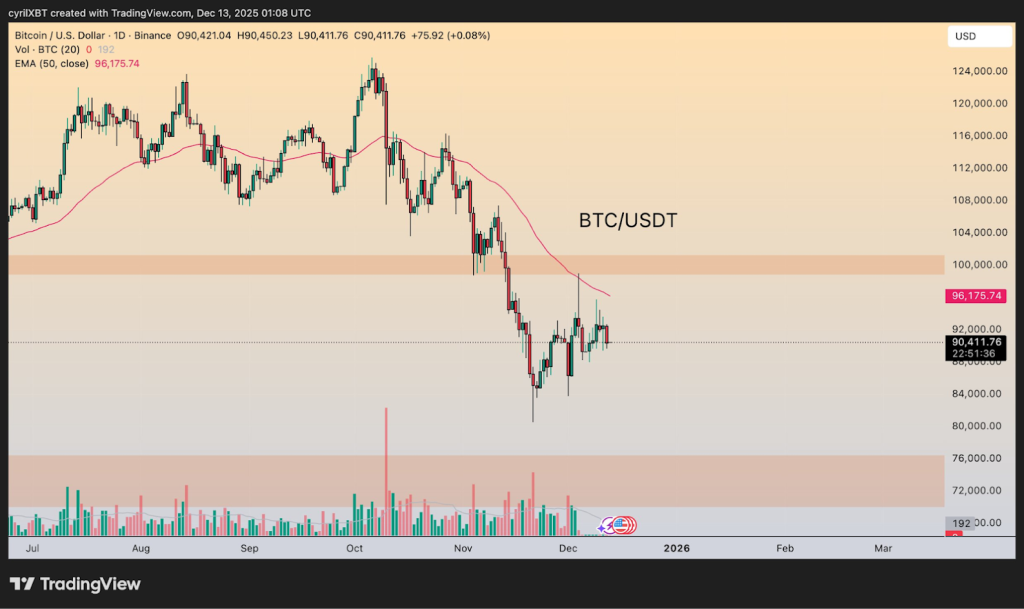
Bitcoin could see another leg lower toward $74,000, where bullish divergence may begin to form.
- Also Read :
- “Bitcoin Price Not in Bear Market”, Says Raoul Pal Amid Recent Correction
- ,
While a short-term bounce is possible later this month or over the holiday period, expectations remain cautious, with further weakness potentially carrying into January before any sustained recovery takes shape.
What Comes Next for the Crypto Market
The sell-off has also been reinforced by the December 19 quarterly options expiry, a period that often brings heightened volatility and downside pressure before markets stabilize. If the Bank of Japan confirms a rate hike, a sharp but brief sell-off cannot be ruled out. On the other hand, if policymakers delay action, risk assets could see a short-term relief rally into month-end.
For now, the move highlights how closely Bitcoin remains tied to global financial conditions. The current decline is being driven less by crypto-specific developments and more by macro forces reshaping liquidity across markets. As long as uncertainty around interest rates and funding costs persists, volatility is likely to remain elevated.
Never Miss a Beat in the Crypto World!
Stay ahead with breaking news, expert analysis, and real-time updates on the latest trends in Bitcoin, altcoins, DeFi, NFTs, and more.
 Subscribe to News
FAQs
Crypto prices are dropping due to global liquidity tightening, driven by potential Bank of Japan interest rate hikes affecting risk assets worldwide.
Higher Japanese rates reduce cheap global liquidity, prompting investors to cut exposure to risk assets like Bitcoin and altcoins.
Short-term bounces are possible, but macro uncertainty may keep volatility high until early January before a sustained recovery.
Quarterly options expiries, like December 19, often increase volatility, triggering sell-offs as traders adjust positions.
Ayrıca Şunları da Beğenebilirsiniz

TrendX Taps Trusta AI to Develop Safer and Smarter Web3 Network

Nvidia wants to boost H200 chip production to appease China
