Overview
Two very different benchmarks are taking shape in humanoid robotics. On one side is Unitree Robotics, about to become the first humanoid robotics stock on China's A-share market, having shipped more than 5,500 humanoids in 2025 for a world-leading 32.4% share, selling its G1 from around $13,500, and running profitably for years. On the other is Tesla's Optimus, which Elon Musk says will represent 80% of Tesla's future value, with plans for a million units a year at $20,000 to $25,000 per unit, yet whose ground-up V3 redesign remained unrevealed as of the July 22 second quarter call, with Fremont production lines still being installed and public sales still pointed at the end of 2027. One is a realist you can buy from today. The other is a scale maximalist promising to rewrite history. The comparison gains urgency in August, as Unitree opens IPO subscriptions on August 10 with a listing expected around August 19, giving public markets their first chance to continuously price one of these two approaches. For global investors shut out of A-share subscriptions, understanding the differences, and how to gain exposure before and after the listing, are the two most practical questions on the table.
Key Takeaways
Unitree posted 2025 revenue of 1.708 billion yuan, up 335%, with a 60.27% gross margin and adjusted net profit of 600.1 million yuan, profitable since 2020, shipping more than 5,500 humanoids for a world-leading 32.4% share.
Tesla's Optimus V3 remained unrevealed as of the July 22 Q2 call, with production lines being installed at Fremont, output "anticipated later this year," a ramp Musk warns will be "quite flat and long," and public sales pointed at end of 2027.
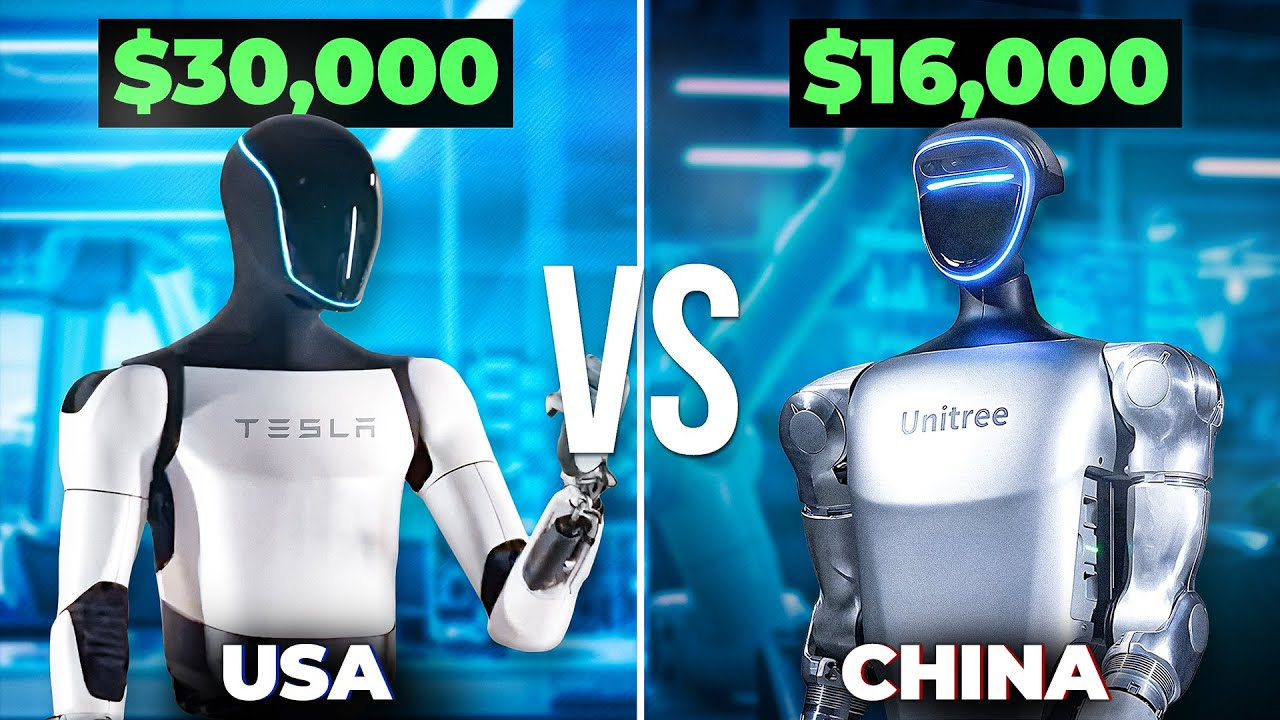
Prices differ by more than an order of magnitude, with Unitree's G1 at about $13,500 (from 99,000 yuan domestically) and the R1 from roughly $4,900, versus Optimus at an estimated $50,000 to $150,000 current build cost, where $20,000 to $30,000 is a target price at million-unit scale.
The business model divide is fundamental, with Unitree selling hardware today on a volume-over-price open ecosystem strategy with visible revenue and profit, while Tesla deploys internally first, betting on the FSD vision and Cortex compute data flywheel before selling at scale.
Unitree's IPO subscription runs August 10 at a base valuation near 42 billion yuan with a listing expected around August 19, while Optimus has no standalone security, leaving investors only indirect exposure through Tesla stock.
For investors unable to join A-share subscriptions, MEXC offers USDT-settled UNITREE stock futures with pre-listing access, 24/7 trading, long and short positioning, and maximum leverage raised from 10x to 25x on August 4.
Two Entirely Different Humanoid Roadmaps
Put Unitree and Optimus in one comparison table and the first thing visible is not a spec gap but a philosophical one.
Unitree's path can be summarized as starting from a cheap real product. Founded in 2016 as a quadruped maker, it took over 60% of the global robot dog market by undercutting Western rivals by an order of magnitude, then transplanted the same motors, reducers and motion control stack into humanoid form. Per its prospectus, humanoids have grown from 27.6% of 2024 revenue to more than half, with over 5,500 units shipped in 2025, the most worldwide. It sells to universities, developers, performance companies and factories, making the robot exist first as a purchasable commodity and iterating intelligence afterward.
Tesla's path works backward from the endgame. Per
Musk's remarks at the All-In Summit, Optimus V3 will cost $20,000 to $25,000 per unit at one million units a year, and Optimus will eventually represent 80% of Tesla's value. The robots work inside Tesla's own factories first, building a data flywheel from FSD's visual intelligence and Cortex supercomputer training, with external sales following once the product and cost curve mature. It is scale maximalism in its purest form.
Neither path is inherently right or wrong, but their verifiability differs completely. Every Unitree number (shipments, revenue, margin) sits in an audited prospectus. Optimus's core numbers (a million units, $20,000, 80% of value) remain targets, not facts.
Technology Which Robot Is Stronger
Hardware and Motion Control
Unitree's edge is engineered motion control. The dynamic capabilities of its G1 and H series (running, vaulting, dancing) are extensively validated in public, built on in-house motors and joint modules that balance cost and performance, which is what allows it to sell humanoids at the $10,000 level. The rapid drop in average selling price (from 590,000 to 166,400 yuan) is itself proof of cost-down engineering capability.
Tesla's edge is the ceiling of its dexterous hands and AI stack. Per
the tracked record of the Optimus program, the Gen 3 hand design carries 22 degrees of freedom per hand with 50 actuators across both in a tendon-driven layout, paired with the AI5 chip and Grok voice interaction, targeting thousands of fine manipulation tasks. If delivered, its manipulation ceiling exceeds anything in mass production today. It must be stressed, however, that the ground-up V3 had never been publicly shown as of late July, and circulating V3 spec sheets are recycled older data or speculation.
AI and the Data Flywheel
This is Tesla's theoretically deepest moat. FSD's massive real-world visual data, Cortex training compute, and manipulation data flowing back from factory robots form a closed flywheel. Unitree has no comparable data asset, and its answer is openness, flooding the market with cheap hardware to attract global developers while drawing external intelligence from China's embodied AI ecosystem, including major model providers. One builds its own brain, the other crowdsources one. The winner depends on whether general robot intelligence ultimately favors vertical integration or horizontal specialization, a question with no answer today.
Manufacturing Maturity
The current gap here is objective. Unitree has delivered at volume and profitably for years. On Tesla's side, per
tracking by Electrek and others, Optimus timelines have slipped repeatedly, external estimates of actual output run far below stated targets, and the Q2 call confirmed lines still being installed with a "flat and long" ramp ahead. On how many units can be built now, Unitree leads. On how many can be built in five years, Tesla's manufacturing system remains among the most credible candidates.
Price An Order of Magnitude Apart
Price is where the difference is most tangible. Unitree's G1 sells for about $13,500 overseas and from 99,000 yuan domestically, the R1 reaches down to roughly $4,900, and the Go2 robot dog starts at $1,600. These are prices you can order against today.
Optimus has no price, only price targets. Musk's long-run goal is $20,000 to $30,000 at scale, in some venues below $20,000, but external estimates put the current build cost at $50,000 to $150,000 per unit, and nothing is for sale. In other words, Unitree competes with real prices while Tesla competes with a future-price narrative. For buyers, the market for humanoids you can actually purchase is currently priced almost entirely by Chinese makers, and the recent US import curbs on foreign-made robots read in part as a policy response to exactly that price gap.
Business Model Selling Shovels vs Building the Gold Mine
Unitree runs the classic hardware playbook, sell product, earn margin, fund R&D from profit. A 60.27% gross margin is elite for hardware, and 85% of IPO proceeds going to R&D shows it knows intelligence is the gap to close. The risks are equally clear, volume-over-price is compressing profit (first-half 2026 adjusted net profit guided down 6% to 22%), and US import curbs have closed one of its largest overseas markets.
Tesla runs a platform company's wager, robots first create implicit value as internal labor while feeding AI training, with value ultimately released as general labor at scale. The ceiling is enormous (80% of Tesla's value) and the floor is deep (if intelligence progress disappoints, upfront investment cannot be recovered through sales). The way investors pay for Optimus is by accepting the option premium embedded in Tesla's overall stock.
In one line, Unitree is a business that already works and is getting harder, while Optimus is an option that does not yet work and could be enormous.
Capital Markets One Trades Directly One Only Indirectly
The comparison enters capital markets in August. Unitree's subscription runs August 10 at a base valuation near 42 billion yuan, with a listing expected around August 19, making it the world's first directly tradable, profitable pure-play humanoid stock. Optimus has no standalone security, so investors buy Tesla and accept the robot business bundled with autos, energy and FSD.
But A-share subscription thresholds shut out most global investors, with the STAR Market requiring 500,000 yuan in assets and 24 months of trading experience, and overseas investors unable to participate directly at all. That is the gap filled by the USDT-settled UNITREE stock futures on
MEXC, which carry five practical advantages over traditional channels.
First, early positioning. Traditional investors must wait for listing day, while UNITREE futures are already open before the debut, letting price discovery form early and sparing traders the scramble of the opening print. Second, no lottery caps. A-share subscription is effectively a raffle with low win rates and fixed quotas, while futures positions can be sized as desired within platform rules. Third, 24/7 access. A-shares trade four hours a day and close on weekends, while news that moves Unitree (US policy, overseas orders, sector headlines) can land at any hour, and an always-on market means never waiting overnight to react. Fourth, two-way trading. Bulls can go long, and anyone who considers the issue price overheated can go short, something nearly impossible in the early days of an A-share debut where securities lending is impractical. Fifth, leverage flexibility. Per
MEXC's August 4 announcement, maximum leverage on UNITREEUSDT has been raised from 10x to 25x, materially improving capital efficiency.
The counterweight must be stated just as clearly. Leverage cuts both ways, and at 25x an adverse move of roughly 4% can trigger liquidation, precisely when a new listing is at its most volatile, as CXMT's 466% debut showed extreme moves have precedent in both directions. Before using high leverage, be certain you understand the contract mechanics, liquidation rules and your own risk tolerance, and starting with small size and low multiples is the sounder approach.
What to Watch Next and Where the Risks Sit
Four Markers That Will Decide the Comparison
First, Unitree's offer price set on August 6 and its post-listing valuation, the sector's first public pricing anchor. Second, the timing and real specifications of Tesla's V3 reveal, the first hard checkpoint for the Optimus narrative. Third, the overseas revenue share in Unitree's first post-listing quarterly report, the direct test of the US import curbs. Fourth, the trajectory of average humanoid prices and margins at both companies, since the intensity of the price war sets the profit model for the whole industry.
Risks to Recognize Clearly
For Unitree, the risk is the triple overlay of decelerating growth (from 332% to around 40%), halving average prices and export restrictions. For Tesla, the risk is continued timeline slippage, with a historical record of robot output targets that has not been kind. For traders, the risk is volatility itself, since new-listing futures combined with high leverage amplify losses just as they amplify gains, making position discipline more important than directional conviction.
Exclusive View from James Mitchell
What genuinely matters in this comparison is not whose robot is stronger but that two capital forms of the same hardware revolution are about to be priced side by side for the first time. Once Unitree lists, the market will assign a price-to-earnings multiple to real profit from selling real robots, while Tesla's stock will keep embedding the option value of a million future robots. The relative movement of those two numbers will become the best dashboard for market confidence in humanoid commercialization. If Unitree's multiple stays rich while Tesla's robot option compresses, the market is choosing to believe in the present. The reverse means it believes in the endgame.
Two misreadings look likely. The first is investing with a spec-sheet mindset. Optimus leads on paper in dexterity and the data flywheel, but investing prices the time distribution of cash flows, and Unitree's cash flows arrive today while Tesla's arrive after 2028, a difference the discount rate environment (with long-end Treasury yields still above 5.2%) punishes far more severely in the latter case. The second is equating Unitree's low prices with low-end positioning. At 99,000 yuan for the G1, Unitree is deliberately using price warfare to raise the industry's entry barrier, structurally identical to DJI's playbook in drones. Cheap is the strategy, not the constraint.
What investors should track next is the cross validation of three signals. The premium of Unitree's August 6 offer price over the 42 billion yuan base, since institutional book-building is the most honest first vote. The convergence between UNITREE futures pricing and the eventual A-share print around listing, since markets that trade early tend to answer before official pricing does. And the concrete capability envelope of Tesla's next public V3 demonstration, especially uncut continuous task footage.
For cross-asset investors, the broader lesson is that humanoid robotics is retracing the capital path of electric vehicles, with Chinese makers building shipment advantages through manufacturing and price while US players sustain valuation premiums through AI and ecosystem narratives, and derivatives markets now let global investors switch exposure between the two narratives without being bound by any single market's access thresholds or trading hours. That democratization of instruments is itself the biggest difference between this hardware revolution and the last one.
FAQ
What is the core difference between Unitree and Tesla Optimus?
The business model difference exceeds the technology difference. Unitree sells hardware today, shipping more than 5,500 humanoids in 2025 on 1.708 billion yuan of revenue with years of profitability, and its products can be bought now. Tesla deploys internally first and sells later, with Optimus running only in its own factories, V3 unrevealed, public sales pointed at end of 2027, and value resting on the FSD data flywheel and million-unit scale narrative. In short, Unitree is a realized business while Optimus is a high-ceiling option.
How large is the price gap?
More than an order of magnitude. Unitree's G1 sells for about $13,500 (from 99,000 yuan domestically) and the R1 from roughly $4,900, all real prices available for order. Optimus is not for sale, with current build cost externally estimated at $50,000 to $150,000 per unit, and Musk's $20,000 to $30,000 figure is a target at million-unit annual scale, not a current price. The market for purchasable humanoids is currently priced almost entirely by Unitree and other Chinese makers.
Who leads on technology?
Each leads somewhere. Unitree leads in engineered motion control and cost, with publicly validated dynamic capability and mass delivery already achieved. Tesla leads in the theoretical ceiling of its hand design (22 degrees of freedom per hand, tendon-driven) and AI stack (FSD vision, Cortex compute, Grok interaction), but V3 had never been publicly shown as of late July and production lines were still being installed. On verifiable present capability Unitree leads, and on paper long-term ceiling Tesla leads.
How can investors get exposure to Unitree?
Three routes. Mainland investors with STAR Market permissions can join the August 10 subscription, subject to the 500,000 yuan asset and 24-month experience thresholds. Investors can buy the A-shares after listing through qualified channels. Or investors can use MEXC's USDT-settled UNITREE stock futures, which offer pre-listing access, 24/7 trading, long and short positioning and up to 25x leverage, suited to global investors without A-share accounts, though leveraged trading carries significant risk and requires honest assessment of one's tolerance.
What advantages do UNITREE futures on MEXC offer over traditional channels?
Five. Early access, with trading open before listing day for early participation in price discovery. No lottery caps, unlike A-share subscription raffles, with positions sized as needed within platform rules. Around-the-clock trading, 24/7 rather than A-shares' four hours a day with weekend closures, so news can be acted on anytime. Two-way trading, with shorting available while securities lending on a fresh A-share debut is nearly impossible. And leverage flexibility, with maximum leverage raised from 10x to 25x on August 4 for higher capital efficiency, alongside proportionally higher risk.
What should traders know before using 25x leverage?
High leverage cuts both ways. At 25x, an adverse move of roughly 4% can trigger forced liquidation, and new-listing-linked instruments sit in exactly the most volatile phase, with CXMT's 466% debut proving extreme moves occur in both directions. Understand the contract specifications, funding rates and liquidation mechanics fully before participating, start with small size and low multiples, use stop losses, and never commit funds you cannot afford to lose. Maximum leverage may be unavailable in certain countries or regions, with the trading page as the authoritative reference.
When can Tesla Optimus actually be bought?
It cannot be bought now, and there are no official pre-orders or waitlists, so any claim offering Optimus pre-orders is a scam. Per Tesla's July 22 second quarter call, first-generation Optimus lines are being installed at Fremont with production anticipated later this year and a ramp Musk warns will be flat and long. Enterprise sales point earliest to late 2026 into 2027, public consumer sales target the end of 2027, and most analysts view 2028 to 2029 as the more realistic window.
Disclaimer
This content is provided for informational purposes only and does not constitute investment advice, financial advice, legal advice, tax advice or a recommendation to buy or sell any asset. Prices of equities, new listings, futures, leveraged products and crypto assets can move sharply, with newly listed instruments and high-leverage contracts particularly volatile and capable of causing substantial losses up to the entire principal within very short periods. Leveraged trading is not suitable for all investors, and maximum leverage may be unavailable in certain countries or regions, with the trading page as the authoritative reference. The company data, listing timeline expectations and technology comparisons presented here are built on public information, several Tesla Optimus figures are company targets or external estimates rather than verified facts, and actual outcomes may differ materially, with the official announcements of the relevant companies and exchanges taking precedence. Readers should conduct their own research and reach independent conclusions based on their financial circumstances, investment objectives and risk tolerance, consulting licensed professionals where appropriate. The MEXC Crypto Pulse Team accepts no liability for any direct or indirect losses arising from the use of or reliance on this content.
About the Author
James Mitchell specializes in technical analysis, market trends, and trading strategies for both Bitcoin and altcoins. Based in London, he has over 10 years of experience in financial markets. Before joining MEXC Learn, James worked as a senior analyst at a leading European investment firm, where he developed expertise in risk management and quantitative trading. His transition to cryptocurrency markets began in 2017, and he has since become recognized for his data-driven approach. He holds a Master's degree in Financial Economics from the London School of Economics. His analytical approach combines traditional technical analysis with on-chain metrics to provide readers with actionable insights.
Areas of Expertise:
Research References