

South Korea Expands Capital Market Reform by Adding Tokenized Securities
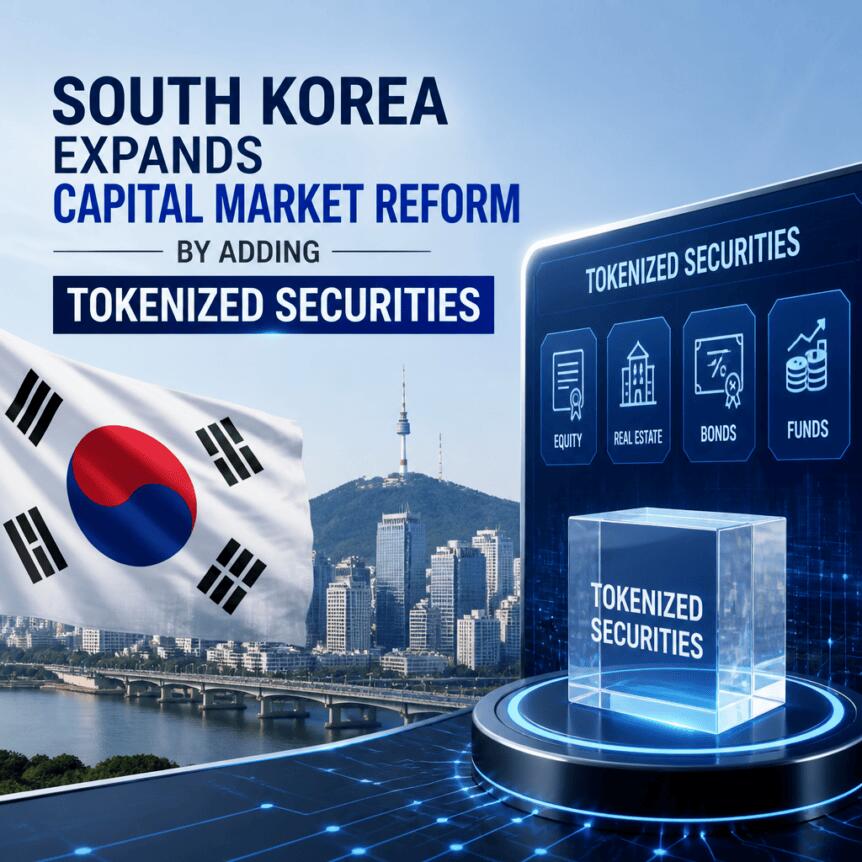
South Korea is folding its token securities work into a broader government push to modernize capital markets, as regulators plan faster settlement, longer trading hours and additional technology upgrades. The Financial Services Commission (FSC) said it has launched a capital market infrastructure review involving multiple agencies and market operators, with tokenized securities to be handled through a separate public-private track before being aligned with the wider reform agenda.
On Tuesday, the FSC announced the start of its capital market infrastructure review meeting, aimed at coordinating reforms across government bodies. The regulator said the token securities agenda will be discussed through a dedicated public-private council and later connected to the larger initiative—an approach that effectively keeps the legislative and technical details for tokenized assets on a separate timetable while still targeting system-level integration.
Key takeaways
- The FSC has begun a cross-government capital market infrastructure review that will coordinate reforms such as faster settlement and expanded trading access.
- Token securities will remain governed through a separate public-private council for now, before being linked to the broader infrastructure roadmap.
- Plans include a roadmap to shorten the securities settlement cycle (targeted for October) and a Korea Securities Depository (KSD) settlement system for over-the-counter trades in unlisted shares and certain fractional investment products by the end of 2026.
- South Korea’s token securities framework was enabled by January amendments recognizing blockchain-based distributed ledgers as securities registries, with a scheduled effective date in February 2027.
- Samsung SDS has been contracted to build a token securities management platform connecting KSD’s existing electronic securities account system with blockchain-based data, with completion targeted for February 2027.
A broader modernization plan, with token securities kept in a parallel track
The FSC’s move places tokenized securities within a wider overhaul of South Korea’s financial market plumbing rather than treating them as a standalone experiment. The regulator said the capital market infrastructure review is intended to coordinate reforms across agencies and market participants, while token securities discussions will continue through a public-private council.
In commentary on the initiative, FSC Vice Chairman Kwon Dae-young said the effort is guided by four policy priorities: trust, shareholder protection, innovation and market access. That framing matters for investors and market operators because tokenized securities regulation is likely to live or die on whether new systems can be reconciled with existing investor-protection and reporting standards.
Settlement speed and KSD systems point to “mainstreaming” tokenization
While token securities have their own legal timeline, the infrastructure review includes operational upgrades that could influence how quickly blockchain-based assets can be used alongside conventional market workflows. According to the FSC, the reform package includes a roadmap to shorten the securities settlement cycle, expected by October. The regulator also described a KSD system for settling over-the-counter (OTC) trades in unlisted shares and fractional investment products, targeted for completion by the end of 2026.
If delivered as scheduled, those milestones would help reduce one of the practical frictions around securities tokenization: integration with established settlement and custody processes. For market participants, shortening settlement cycles and building depository-linked infrastructure could make tokenized products easier to operationalize, since the reporting and settlement logic would be more closely aligned with the processes investors already understand.
Token securities law already passed—implementation is now the focus for 2027
South Korea’s token securities effort predates the latest infrastructure review. In January, the National Assembly approved amendments that recognize blockchain-based distributed ledgers as valid securities registries and allow the issuance and circulation of token securities.
The FSC said the resulting framework is scheduled to take effect in February 2027. That start date depends on regulators finalizing subordinate rules and supporting infrastructure. The FSC also indicated that, at the second meeting of its public-private token securities council in May, it was targeting July for the release of proposed subordinate regulations and guidelines.
For builders and compliance teams, this is a critical distinction: the high-level legal permission is already in place, but detailed operational requirements—such as how tokenized securities records are maintained, verified and integrated into existing securities infrastructure—will be shaped by the subordinate regulations released later in the process.
Infrastructure work underway: KSD platform integration targeted for February 2027
Technical infrastructure is already moving forward. In May, Samsung SDS said it had won a Korea Securities Depository (KSD) contract to build a token securities management platform. The goal, as described at the time, is to connect KSD’s existing electronic securities account system with blockchain-based data.
Samsung SDS said it aims to complete the platform by February 2027, aligning the technical readiness with the broader token securities framework effective date. According to the FSC, detailed token securities plans will continue to be developed and discussed by the public-private council before being connected to the wider capital market infrastructure review.
This coordination step is likely to affect how smoothly tokenized securities transition from a legal concept into a production-ready market feature. Integrating with the depository’s existing account systems is particularly important because depositories are central to ownership records, settlement workflows and operational continuity—areas where regulators generally seek reliability and auditability.
For market participants, the key near-term items to watch are the October settlement-cycle roadmap and the end-2026 KSD OTC settlement system timeline, alongside the July release of subordinate regulations from the token securities public-private council. The sequence of these milestones will offer the clearest signal on how quickly South Korea can move from permission to practical, depository-linked tokenization at scale.
This article was originally published as South Korea Expands Capital Market Reform by Adding Tokenized Securities on Crypto Breaking News – your trusted source for crypto news, Bitcoin news, and blockchain updates.


You May Also Like
Law Enforcement, Catholic Groups Send Letters to U.S. Government Warning CLARITY Act Would Create Crypto Crime Loopholes

Prediction: Home Depot Will Hit $400 on This Date
Germany’s Ifo Survey Points to Tentative Recovery, Commerzbank Says



