

Conservative economist tells WSJ: Trump is destroying the economy
A conservative-leaning economist argued in The Wall Street Journal on Monday that President Donald Trump’s trade policies are destroying America’s economy — and two liberal-leaning experts who spoke with AlterNet agreed with him.
After mentioning that Trump refused to renew the U.S.-Mexico-Canada Agreement (USMCA) earlier this month, American Institute for Economic Research senior research fellow David Hebert wrote that Trump is creating a climate of economic uncertainty that will disincentivize business investment.
“The main value of a trade agreement isn’t that it lowers tariffs but that it eliminates doubt,” Hebert argued. “USMCA’s greatest achievement was never a slate of tariff rates, exceptions and rules. It was the confidence that the rules would stay stable long enough for companies to make plans and act on them. A parts supplier in Michigan could sign a 10-year lease and order supplies because the terms governing what crossed the border were set.”
By praising the USMCA, Hebert put himself on the side of Trump’s first term trade policies (the deal was signed in 2020 to replace the 1994 trade agreement NAFTA) but distancing himself from his second term approach. Rejecting the notion that trade deficits are a problem by saying "your persistent trade deficit with the grocery store doesn’t mean you are losing,” Hebert prioritized the need for businesses to feel a sense of confidence about the future policies that will impact their financial bottom lines.
“The incentives that annual reviews create are predictable,” Hebert wrote. “Industries seeking tighter rules of origin, higher domestic-content requirements and new carve-outs will have annual opportunities to lobby Washington. The benefits will accrue to those with the resources and connections to influence the process. Trade lawyers, lobbyists and consultants who bill by the hour have had their work extended and made more expensive. The costs will be dispersed across consumers, who will pay higher prices, and workers, who will see promotions, raises and opportunities delayed.”
He continued, “No one represents the workers who might have found jobs at a factory that is never built.” Overall everyone except business owners “that treat the annual review and lobbying expenses as an investment in securing greater returns from a favorable rule of origin rather than by making a better product” will lose.
“Investment requires confidence, and confidence requires stability,” Hebert concluded. “That stability is what the administration chose not to renew.”
Speaking exclusively with AlterNet, Ed Gresser, the Vice President and Director for Trade and Global Markets at the liberal-leaning think tank Progressive Policy Institute, described Hebert’s position as “plausible.”
“I think the administration isn't so much looking at what's badly wrong with it, but whether it can show an achievement — or, if not, whether it can show it's intimidating some corners in some way,” Gresser told AlterNet. “So I think Hebert is right to take the best interpretation of what they're doing: they're hoping to get small, individual policy achievements at the expense of a larger-scale increase in costs and loss of stability and predictability.”
While adding that both the Mexican and Canadian governments are likely to consider “reasonable changes” to the USMCA, Gresser doubted that any new trade deal will “leave Americans significantly better off than they would've been otherwise.”
When asked about Hebert’s observation that “the benefits will accrue to those with the resources and connections to influence the process,” and whether that is similar to President Grover Cleveland describing protectionism as a “communism of pelf” in 1894, Gresser compared the policies not to communism but to socialism.
“I don't think of it as communism, although the Trump administration is actually a very big-government presidency — taking stakes in big companies and trying to manage them in a fairly inappropriate way,” Gresser told AlterNet. “So it's a bit odd to see them drumming up fears of socialism, since that's very much in the background of a lot of what they've done."
Dr. Robert Shapiro, undersecretary of commerce for economic affairs in the administration of President Bill Clinton and principal economic adviser to Clinton's 1992 campaign, told AlterNet that Trump’s policies will create tremendous uncertainty.
“It's about uncertainty,” Shapiro explained. “Every investment is based on an assessment of the likely future demand for whatever you're investing in, and how much it's going to cost to produce it. So there are assumptions about labor costs, material costs and other input costs — and again, about demand. If you have a set of arrangements that give you some confidence about the price of your inputs coming from Mexico or Canada, or about demand for goods in Canada — and don't forget, we have virtually no trade deficit with Canada; we have enormous trade, and it goes in both directions — so it's certainly right, and it's not just about investments based on these probabilities that the trade agreement can help reduce uncertainty about.”
Shapiro continued, “It's also about how much you're going to produce today, apart from investment, because you've got thousands of companies selling goods or services into Canada. And so there's uncertainty about whether this will lead to more conflict with Canada, which would hurt Canadian demand for US goods, or whether Canada will impose a new tariff in retaliation for ours that makes my goods less competitive there. Of course it's bad — it's bad for American workers, it's bad for American investment.”
He speculated that Trump is renegotiating the USMCA because he wants to “divert attention from the economic failures of his presidency — as if to say: the problem isn't that I raised all prices through tariffs, the problem isn't that I raised prices by choosing to go to war with Iran — the problem is Canada.”
Asked about whether Hebert’s characterization of Trump’s trade policies can be described as a Clevelandesque “communism of pelf,” Shapiro instead used the term “crony capitalism.”
“Trump operates with a form of crony capitalism,” Shapiro said. “The people who get US contracts, the people who get preferences on tariffs, are those who have influence with him. It ranges from the absurd — where the guy who did the coating for the swimming pool gets a no-bid contract to do the reflecting pool — to all the other no-bid contracts. That's all crony capitalism. And certainly, opening this up could create more opportunities for that.”
Overall Trump’s tariffs have not yielded any demonstrable economic benefits. Back in February, Allison McManus and Dawn Le of the liberal-leaning think tank Center for American Progress released a report revealing that “far from the manufacturing sector ‘roaring back’ as Trump promised, the United States has lost more than 100,000 manufacturing jobs over the past year. These actions have pushed the country’s closest trading partners to seek deals elsewhere, including with China: Canada, India, Japan, South Korea, and the European Union have all recently sought new agreements without the United States.”
At least one conservative predicts that these tariffs will cost Trump in the upcoming midterm elections.
“Voters are rarely able to connect policy to outcomes, but they have done so in the case of tariffs,” wrote The Bulwark's Mona Charen, who served as a communications adviser to President Ronald Reagan. “Back in 2024, Americans were about equally divided on the question of trade, with some favoring higher tariffs and roughly similar numbers opting for lower tariffs. Experience has changed their views.”
- george conway
- noam chomsky
- civil war
- Kayleigh mcenany
- Melania trump
- drudge report
- paul krugman
- Lindsey graham
- Lincoln project
- al franken bill maher
- People of praise
- Ivanka trump
- eric trump


You May Also Like
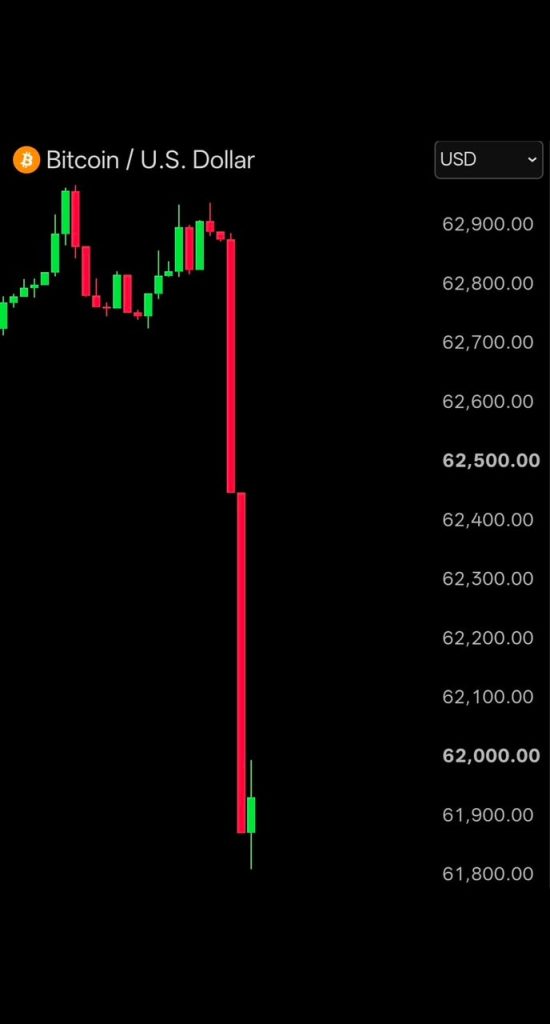
Bitcoin Price News: BTC Price Holds Above $62K Even After Strategy Sold $216 Million Worth of Bitcoin

JPMorgan sends blunt verdict on oil, economy

Circus Appoints Former Aviation and Automotive Executive as Co-CEO and CFO



