

WLFI price rejects after liquidity grab, bearish SFP emerges
WLFI price prints a bearish SFP after sweeping major liquidity at the swing high, signalling increased downside risk if price fails to reclaim key value area levels.
- WLFI’s recent rejection shows fading bullish strength after an aggressive liquidity sweep.
- Current positioning below $0.16 keeps sellers in control of short-term direction.
- A move into $0.12 would provide the next major reaction zone for traders.
World Liberty Financial (WLFI), the Trump family’s crypto firm, has delivered a sharp rejection after sweeping liquidity above its recent swing high, forming a clear bearish Swing Failure Pattern. This development follows an impulsive rally from the predetermined $0.11 support, but momentum has now shifted as sellers step in aggressively.
Crypto tensions are climbing in Washington, with senators now demanding a probe into World Liberty Financial, adding further uncertainty around the asset’s short-term trajectory. The evolving structure places the focus on value area levels that will determine whether WLFI extends lower or manages a reclaim to regain bullish footing.
WLFI price key technical points
- Bearish SFP confirms a failed breakout, placing pressure on WLFI as trapped longs unwind.
- Value area high at $0.16 acts as the decisive pivot, where a breakdown signals continuation to the downside.
- High-time-frame support at $0.12 is the next major target, marking a key reaction zone if bearish momentum persists.
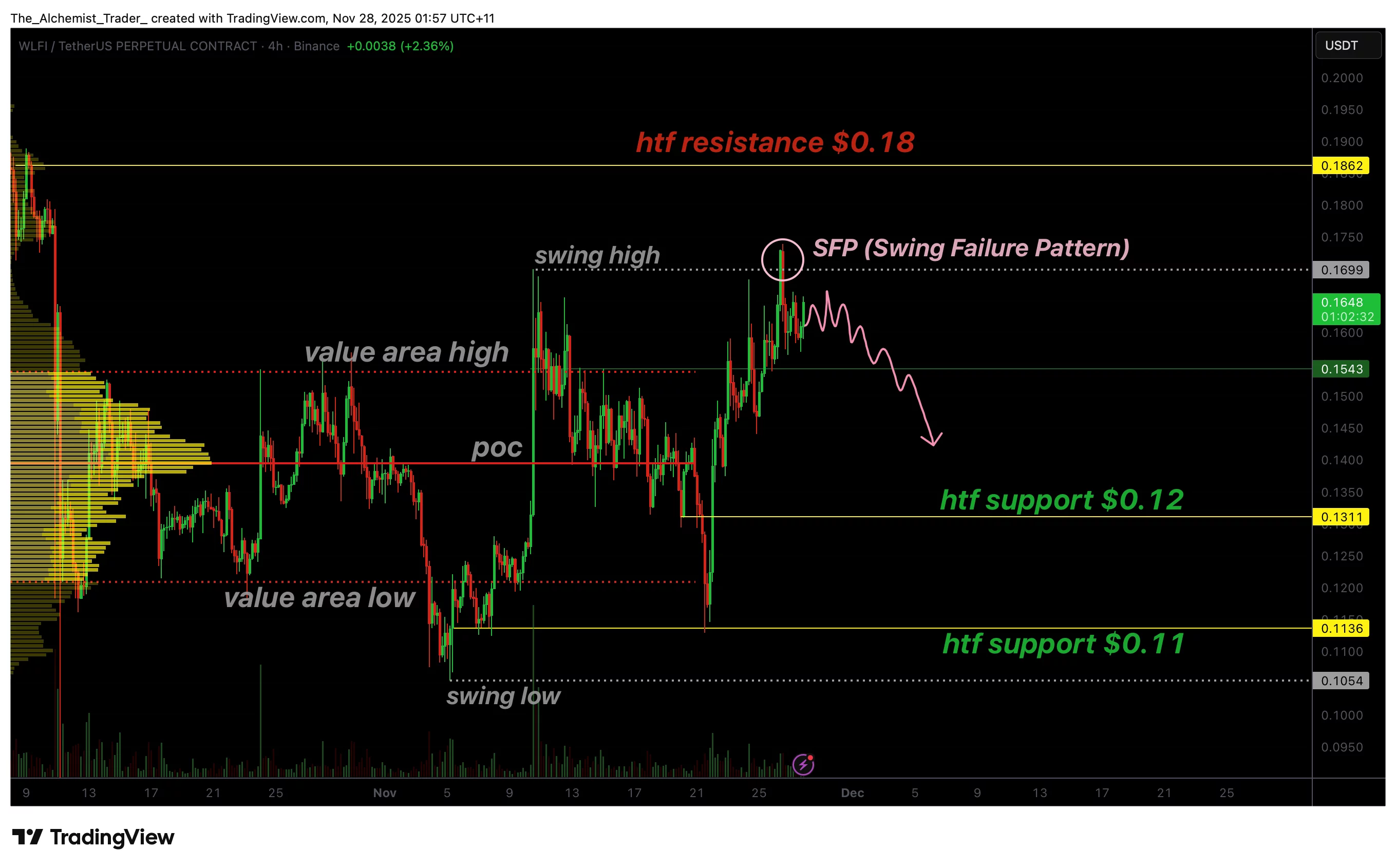
WLFI’s recovery from $0.11 initiated a strong surge toward the previous swing high, but the move quickly showed signs of exhaustion. Once liquidity was taken above that high, price immediately reversed, forming a textbook Swing Failure Pattern, a signal that buyers failed to sustain the breakout and were likely absorbed by larger-time-frame sellers. This has shifted sentiment and structure toward a more cautious, bearish outlook.
The region around $0.16, representing the value area high, is now the defining level in the short term. As long as WLFI trades beneath this threshold, the SFP remains fully active and downside continuation remains the higher-probability scenario.
A reclaim would significantly weaken the bearish case, but order flow suggests buyers remain hesitant while sellers reclaim control of the chart. Volume during the rejection further supports the view that the SFP is not a minor deviation but a meaningful structural break.
If WLFI remains capped below the SFP zone and value area high, the next logical target becomes the high-time-frame support near $0.12. This region previously acted as a critical base for upward expansion and represents the strongest demand zone locally.
A move into this area would not be unexpected, especially considering the impulsive nature of the rejection and the broader market’s tendency to retest major supports following liquidity grabs.
What to expect in the coming price action
If WLFI cannot reclaim the $0.16 value area high, bearish continuation into $0.12 remains the most probable outcome. A strong reclaim of the SFP region would be required to invalidate this downside trajectory.
You May Also Like

How do I teach myself real estate? A practical self-study roadmap

USDC Treasury mints 250 million new USDC on Solana
![[Tech Thoughts] DICT’s bug bounties and ethical hacking at a glance](https://www.rappler.com/tachyon/2026/01/DICT-hacker-bug-bounty-jan-30-2026.jpg)