Zama and the Kohaku upgrade enable Shibarium to offer private, quantum-resistant smart contracts. The TokenPlay AI deal turns SHIB into a real in-app currency. According to Zama’s updated roadmap, the public testnet is now live on Sepolia, and the team is aiming to launch on Ethereum in the fourth quarter. After that, they’re looking to [...]]]>Zama and the Kohaku upgrade enable Shibarium to offer private, quantum-resistant smart contracts. The TokenPlay AI deal turns SHIB into a real in-app currency. According to Zama’s updated roadmap, the public testnet is now live on Sepolia, and the team is aiming to launch on Ethereum in the fourth quarter. After that, they’re looking to [...]]]>

Shiba Inu Team Unveils Transformative Privacy Upgrade for Shibarium & BONE

2025/11/28 18:40
  • Zama and the Kohaku upgrade enable Shibarium to offer private, quantum-resistant smart contracts.
  • The TokenPlay AI deal turns SHIB into a real in-app currency.

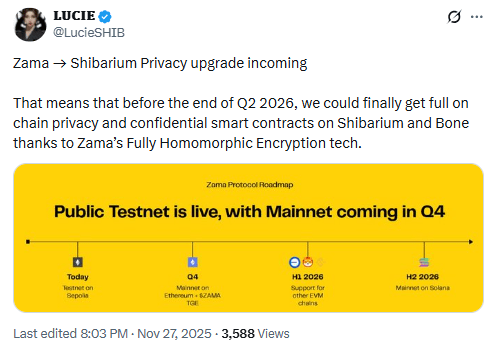
According to Zama’s updated roadmap, the public testnet is now live on Sepolia, and the team is aiming to launch on Ethereum in the fourth quarter. After that, they’re looking to roll out support for other EVM chains in the first half of 2026, followed by an expansion to Solana’s mainnet in the second half of the year.
Source: X

Against this backdrop, Shiba Inu ecosystem team member Lucie wrote on X that Zama’s technology will power a Shibarium privacy upgrade. She said that before the end of the second quarter of 2026, Shibarium and Bone could gain full on-chain privacy and confidential smart contracts through Zama’s fully homomorphic encryption stack. If the timeline holds, Shibarium would align its privacy rollout with Zama’s broader multi-chain expansion.

Kohaku Upgrade Lays the Crypto Foundations for Shibarium

Meanwhile, the Kohaku upgrade, unveiled by Vitalik Buterin at Devcon 2025, as noted in our earlier post, introduces a modular privacy framework for Ethereum that Shibarium can inherit. It brings quantum-resistant signatures based on Dilithium schemes and a new stealth-address standard so wallets can receive funds without exposing public identity. Ethereum researchers argue this shift is needed before quantum computers can break today’s ECDSA signatures, which they tentatively place around 2028.

Kohaku also changes Shibarium’s economics once it plugs into the framework. Privacy transactions that rely on zero-knowledge proofs use far more gas than standard transfers, with benchmarks suggesting workloads equivalent to roughly 15–20 normal token moves. On Shibarium, that extra computation is paid in BONE, which turns the token into fuel for heavy cryptographic processing instead of only serving as a basic gas asset.

The higher gas load then feeds into Shibarium’s burn contracts, where accumulated BONE is swapped for SHIB and permanently removed from circulation, potentially accelerating the burn cycle if private volume grows.

Regulatory design is part of Kohaku as well. The framework bundles “Privacy Pools”, which let users prove their funds are not tied to sanctioned or hacked wallets without disclosing full transaction histories. For Shibarium, adopting these tools would offer what the Shib team calls “clean privacy,” aimed at institutions that need confidentiality but must follow anti-money-laundering rules.

Shibarium’s sidechain architecture cannot rely on automatic inheritance. Developers must manually adapt the privacy SDK to Heimdall and Bor nodes and optimize wallets and validators for data-heavy private blocks.

Shiba Token’s TokenPlay AI Deal Adds Utility for SHIB

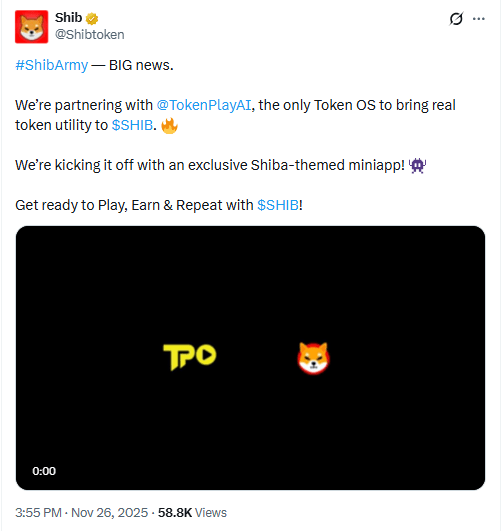
Moreover, Shiba Token announced a new partnership with TokenPlay AI. The deal, as highlighted in our previous article, connects SHIB to a “token OS” that can run Shiba-themed apps inside chat, gaming, and interactive dashboards.
Source: X

Through this integration, SHIB can move from passive holding to active in-app use. Users will be able to earn and spend SHIB inside the first Shiba-branded miniapp and then cycle it through repeat gameplay and rewards.

]]>
Disclaimer: The articles reposted on this site are sourced from public platforms and are provided for informational purposes only. They do not necessarily reflect the views of MEXC. All rights remain with the original authors. If you believe any content infringes on third-party rights, please contact [email protected] for removal. MEXC makes no guarantees regarding the accuracy, completeness, or timeliness of the content and is not responsible for any actions taken based on the information provided. The content does not constitute financial, legal, or other professional advice, nor should it be considered a recommendation or endorsement by MEXC.

You May Also Like

Ripple CEO Confirms Privacy as Next Stage for XRP’s Institutional Expansion

Ripple CEO Confirms Privacy as Next Stage for XRP’s Institutional Expansion

Ripple advances XRP privacy to attract major institutional blockchain adoption. Confidential transactions and smart contracts set to reshape XRP Ledger. New privacy features aim to balance compliance with institutional confidentiality. The XRP community witnessed a significant revelation after Ripple CEO Brad Garlinghouse confirmed that privacy will drive the next phase of XRP’s institutional adoption. According to Vet, the discussion between him and Garlinghouse centered on strengthening privacy within the XRP ecosystem. This development aligns with the broader goal of creating a compliant yet confidential environment for institutional transactions. Ripple has progressively built the XRP Ledger into a robust infrastructure for real-world use cases. It has introduced decentralized identifiers, on-chain credentials, and permissioned domains to ensure compliance and security. Moreover, the network now features multipurpose tokens that simplify tokenization while its native decentralized exchange merges AMM liquidity with a traditional order book. Despite these advancements, one crucial element remains—privacy. Also Read: Swift Exec Mocks XRP as “Fax Machine,” Sparks Furious Clash with Crypto Fans Developers and Ripple Leadership Target Privacy Layer for Institutional Use Developers and Ripple executives agree that privacy will complete the ecosystem’s institutional framework. The upcoming privacy layer includes functions under proposal XLS-66, allowing institutions to lend and borrow assets using tokenized collateral. This system leverages zero-knowledge proofs to conceal sensitive balance and transaction data while maintaining compliance visibility for regulators. Hence, institutions can protect competitive data without compromising transparency. Ripple’s Senior Director of Engineering, Ayo Akinyele, emphasized the scale of this transformation. He stated that trillions in institutional assets will likely transition on-chain over the next decade. To achieve this, his team is developing confidential multipurpose tokens scheduled for launch in the first quarter of 2026. These tokens will enable private collateral management and secure asset handling across financial platforms. Smart Contracts and Privacy Bridge to Institutional Era Smart escrows proposed under XLS-100 and upcoming smart contracts in XLS-101 are expected to support these privacy-driven functions. Together, they will form the foundation for private institutional transactions within the XRP Ledger. This strategic focus marks a defining step toward positioning XRP as a trusted infrastructure for large-scale financial institutions. As privacy becomes the bridge connecting compliance with confidentiality, Ripple’s roadmap signals its readiness to lead blockchain adoption in traditional finance. Also Read: Shiba Inu Approaches Critical Price Zone as Bulls and Bears Battle for Control The post Ripple CEO Confirms Privacy as Next Stage for XRP’s Institutional Expansion appeared first on 36Crypto.
Share
Coinstats2025/10/05 22:14