India’s Parliament this week argued about bringing asset tokenization into the country’s formal legal framework, as lawmakers debated whether digital fractionalIndia’s Parliament this week argued about bringing asset tokenization into the country’s formal legal framework, as lawmakers debated whether digital fractional

India Pushes Tokenization Bill to Open Billion-Dollar Real Estate to Middle Class — Will It Pass?

India’s Parliament this week argued about bringing asset tokenization into the country’s formal legal framework, as lawmakers debated whether digital fractional ownership could widen access to wealth while keeping capital anchored at home.

Speaking in the Rajya Sabha on Tuesday, Member of Parliament Raghav Chadha urged the government to introduce a dedicated Tokenization Bill that would allow assets such as real estate, infrastructure projects, and intellectual property to be divided into digital units and purchased in small portions.

Chadha framed the proposal as a financial inclusion measure, drawing a parallel with India’s Unified Payments Interface, which transformed everyday payments by lowering entry barriers for millions of users.

Can Tokenization Unlock Wealth for India’s Middle Class, or Is Regulation Holding It Back?

Chadha told lawmakers that India’s middle class remains largely limited to savings accounts, fixed deposits, and mutual funds, with little exposure to assets that typically generate higher long-term returns.

He argued that tokenization could allow ordinary investors to buy small stakes in office buildings, highways, and other capital-intensive projects, while also providing faster liquidity without relying on brokers or complex paperwork.

He called for bespoke legislation and a regulatory sandbox that would allow new models to be tested under supervision, rather than being forced into existing and often ill-fitting rules.

With a population estimated at about 1.46 billion people and a median age under 30, the country has seen sharp reductions in extreme poverty, which is now estimated at around 1% using the $2.15-per-day benchmark.
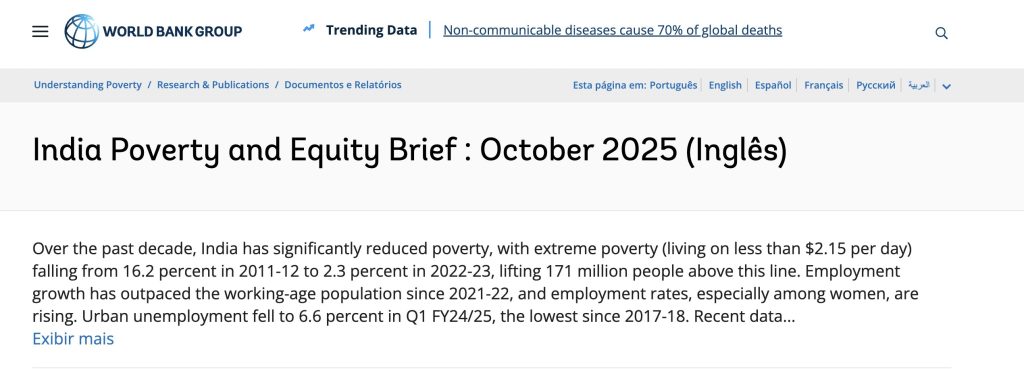
Source: World Bank Group

Broader poverty measures still show large gaps, however, with more than a quarter of the population falling under the lower-middle-income poverty line.

Only a smaller portion of household wealth is actively deployed in financial markets, leaving limited room for diversification into assets such as carbon credits, infrastructure, or commercial property.

Early Tokenization Efforts Emerge as Regulators Urge Caution

Supporters of tokenization say fractional ownership could lower minimum investment thresholds and draw parts of this idle capital into more productive use.

Critics note that the pool of people able to participate meaningfully remains constrained by income levels and uneven financial literacy.

India already has early experiments in this space. In GIFT City, platforms such as Tokeny and Terazo have worked on regulated tokenized real estate structures, typically using special purpose vehicles and public blockchains like Polygon.

These efforts operate under existing securities and virtual digital asset rules, rather than a unified tokenization law.

The Reserve Bank of India and the Securities and Exchange Board of India have both allowed limited pilots but have stressed caution, especially around investor protection and settlement risk.

State-Level Momentum Grows, Yet India Falls Behind on Asset Tokenization

Momentum has also come from state governments. In November, Maharashtra Chief Minister Devendra Fadnavis said the state was working toward a framework that could unlock an estimated ₹50 trillion in idle capital by digitizing asset transfers, particularly in Mumbai’s real estate market.

The announcement followed RBI disclosures that its wholesale central bank digital currency pilots for financial instruments had improved settlement efficiency, reinforcing interest in blockchain-based infrastructure.

Despite this activity, India still trails countries that have moved faster on asset tokenization.

Jurisdictions such as the UAE, Singapore, Germany, Hong Kong, and the United States have adopted clearer legal standards allowing regulated platforms to offer fractional ownership to retail investors.

In Dubai, for example, property tokenization pilots have reduced entry points from millions of dirhams to a few thousand, while Singapore’s Project Guardian has focused on institutional-grade frameworks that can later scale to the public.

Indian policymakers have been wary of moving too quickly, citing complex land titles, fragmented state laws, and data privacy concerns.

The result is that tokenization remains narrow in scope, even as crypto adoption at the grassroots level is high.

Market Opportunity
OpenLedger Logo
OpenLedger Price(OPEN)
$0.16451
$0.16451$0.16451
-8.42%
USD
OpenLedger (OPEN) Live Price Chart
Disclaimer: The articles reposted on this site are sourced from public platforms and are provided for informational purposes only. They do not necessarily reflect the views of MEXC. All rights remain with the original authors. If you believe any content infringes on third-party rights, please contact [email protected] for removal. MEXC makes no guarantees regarding the accuracy, completeness, or timeliness of the content and is not responsible for any actions taken based on the information provided. The content does not constitute financial, legal, or other professional advice, nor should it be considered a recommendation or endorsement by MEXC.

You May Also Like

Ethereum unveils roadmap focusing on scaling, interoperability, and security at Japan Dev Conference

Ethereum unveils roadmap focusing on scaling, interoperability, and security at Japan Dev Conference

The post Ethereum unveils roadmap focusing on scaling, interoperability, and security at Japan Dev Conference appeared on BitcoinEthereumNews.com. Key Takeaways Ethereum’s new roadmap was presented by Vitalik Buterin at the Japan Dev Conference. Short-term priorities include Layer 1 scaling and raising gas limits to enhance transaction throughput. Vitalik Buterin presented Ethereum’s development roadmap at the Japan Dev Conference today, outlining the blockchain platform’s priorities across multiple timeframes. The short-term goals focus on scaling solutions and increasing Layer 1 gas limits to improve transaction capacity. Mid-term objectives target enhanced cross-Layer 2 interoperability and faster network responsiveness to create a more seamless user experience across different scaling solutions. The long-term vision emphasizes building a secure, simple, quantum-resistant, and formally verified minimalist Ethereum network. This approach aims to future-proof the platform against emerging technological threats while maintaining its core functionality. The roadmap presentation comes as Ethereum continues to compete with other blockchain platforms for market share in the smart contract and decentralized application space. Source: https://cryptobriefing.com/ethereum-roadmap-scaling-interoperability-security-japan/
Share
BitcoinEthereumNews2025/09/18 00:25
MMDA, sleep health organization launch drowsy driving campaign ahead of holidays

MMDA, sleep health organization launch drowsy driving campaign ahead of holidays

The Metro Manila Development Authority (MMDA) and the Philippine Society of Sleep Medicine (PSSM) on Wednesday launch an awareness campaign to prevent drowsy driving
Share
Bworldonline2025/12/18 12:05
A Netflix ‘KPop Demon Hunters’ Short Film Has Been Rated For Release

A Netflix ‘KPop Demon Hunters’ Short Film Has Been Rated For Release

The post A Netflix ‘KPop Demon Hunters’ Short Film Has Been Rated For Release appeared on BitcoinEthereumNews.com. KPop Demon Hunters Netflix Everyone has wondered what may be the next step for KPop Demon Hunters as an IP, given its record-breaking success on Netflix. Now, the answer may be something exactly no one predicted. According to a new filing with the MPA, something called Debut: A KPop Demon Hunters Story has been rated PG by the ratings body. It’s listed alongside some other films, and this is obviously something that has not been publicly announced. A short film could be well, very short, a few minutes, and likely no more than ten. Even that might be pushing it. Using say, Pixar shorts as a reference, most are between 4 and 8 minutes. The original movie is an hour and 36 minutes. The “Debut” in the title indicates some sort of flashback, perhaps to when HUNTR/X first arrived on the scene before they blew up. Previously, director Maggie Kang has commented about how there were more backstory components that were supposed to be in the film that were cut, but hinted those could be explored in a sequel. But perhaps some may be put into a short here. I very much doubt those scenes were fully produced and simply cut, but perhaps they were finished up for this short film here. When would Debut: KPop Demon Hunters theoretically arrive? I’m not sure the other films on the list are much help. Dead of Winter is out in less than two weeks. Mother Mary does not have a release date. Ne Zha 2 came out earlier this year. I’ve only seen news stories saying The Perfect Gamble was supposed to come out in Q1 2025, but I’ve seen no evidence that it actually has. KPop Demon Hunters Netflix It could be sooner rather than later as Netflix looks to capitalize…
Share
BitcoinEthereumNews2025/09/18 02:23