Portugal is fast-tracking its energy transformation, targeting 80% renewable power generation by 2026 and setting an example on the global stage.  According to Portugal is fast-tracking its energy transformation, targeting 80% renewable power generation by 2026 and setting an example on the global stage.  According to

SparkWave Energy, GeoAI startup Planno speed up discovery of high-value commercial rooftops for solar development

Portugal is fast-tracking its energy transformation, targeting 80% renewable power generation by 2026 and setting an example on the global stage. 

According to Redes Energéticas Nacionais (REN), wind and hydropower have performed exceptionally well. Wind farms, for example, produced 110.4 GWh in a single day in November 2024, representing 86% of national consumption.

However, solar is quickly catching up. In June 2025, solar surpassed wind generation in Portugal’s energy mix for the first time as Portugal’s cumulative solar power generation reached 2,865 GWh, equivalent to 10.9% of the country’s renewable electricity production. 

With continued policy support for renewables, growing awareness of the benefits of clean energy, the expansion of self-consumption schemes, greater availability of financing options and ongoing efforts to streamline permitting procedures, the solar market in Portugal is thriving. 

Yet the story is just beginning. Despite the huge uptick in solar power generation, Portugal has a vast amount of untapped potential. The solar market is projected to grow at a compound annual growth rate (CAGR) of over 6.5% from 2024 to 2029. 

Commercial and industrial rooftops have an important role to play in this journey, offering an immediate and low-cost way to increase solar generation capacity across Portugal, without the high upfront investment associated with the development of solar parks and other bespoke infrastructure initiatives. 

Now, Portugal’s solar journey is set to accelerate even further following news that Planno and SparkWave Energy are entering into a new partnership. 

Scaling smart renewable-energy adoption across Portugal 

SparkWave Energy is one of Portugal’s fastest-growing solar developers. Backed by the renewables giant, Octopus Energy Generation, the company is currently rolling out a major portfolio of C&I solar projects in Portugal, targeting a considerable installed capacity by 2027.

The new partnership will equip SparkWave Energy with Planno’s GeoAI software to speed up the discovery of high-value commercial rooftops and expand its national development pipeline to scale renewable energy across the region. 

By adopting Planno’s technology, SparkWave Energy aims to strengthen its rooftop pipeline, identify top-tier sites faster, and optimize project selection as Portugal’s distributed generation market is expected to add more than 500 MW annually in the coming years.

“Portugal is becoming a global example of fast, smart renewable-energy adoption,” says Tiago Andrade e Sousa, CEO of SparkWave Energy. 

“Market reforms and exceptional solar conditions create enormous opportunities for commercial and industrial self-consumption. We’ve already helped countless businesses cut emissions through solar. Now, with Planno’s powerful GeoAI solution, we can identify and qualify high-potential rooftops in a fraction of the time, enabling a new phase of growth”, added the executive.

Transition to renewable energy through tech 

Planno offers an AI-powered platform that helps solar developers identify and pre-qualify commercial and industrial (C&I) rooftop opportunities. 

According to Planno’s national geospatial analysis, Portugal hosts 79,000 C&I rooftops with 15.4 GW of solar capacity waiting to be developed. Yet with only 15% currently installed, Portugal’s C&I sector remains one of the region’s biggest untapped clean-energy opportunities.

Commenting on the new partnership, Daniel Domingues, CEO of Planno, said, “SparkWave Energy is demonstrating how private energy players can accelerate the transition to renewable energy through decisive investment and technology. We’re proud to support their mission to install significant additional capacity by 2027 by leveraging our technology, contributing to Portugal’s rapidly growing solar market.”

By automating solar rooftop lead generation with AI and geospatial data, Planno accelerates the discovery of prime rooftops and connects with customers faster than ever before. Its unique approach integrates proprietary and third-party data, creating comprehensive customer profiles for efficient and effective expansion. Planno is reshaping the solar industry by enabling a more efficient, data-driven approach to rooftop development.

The partnership will support SparkWave Energy as it accelerates site development and streamlines prospecting across the country.

Investing in renewable energy

Spark Wave Energy is backed by Octopus Energy Generation, one of Europe’s largest renewable-energy investors, managing 3.2 GW of projects across 17 countries. 

SWE will offer the best market conditions to both businesses and energy communities, making implementation practical and swift. With a business model focused on 100% investment in projects, design, implementation, management, and maintenance, SWE enters the market to challenge the status quo of companies operating in solar self-consumption.

Market Opportunity
Startup Logo
Startup Price(STARTUP)
$0.0003501
$0.0003501$0.0003501
-7.23%
USD
Startup (STARTUP) Live Price Chart
Disclaimer: The articles reposted on this site are sourced from public platforms and are provided for informational purposes only. They do not necessarily reflect the views of MEXC. All rights remain with the original authors. If you believe any content infringes on third-party rights, please contact [email protected] for removal. MEXC makes no guarantees regarding the accuracy, completeness, or timeliness of the content and is not responsible for any actions taken based on the information provided. The content does not constitute financial, legal, or other professional advice, nor should it be considered a recommendation or endorsement by MEXC.

You May Also Like

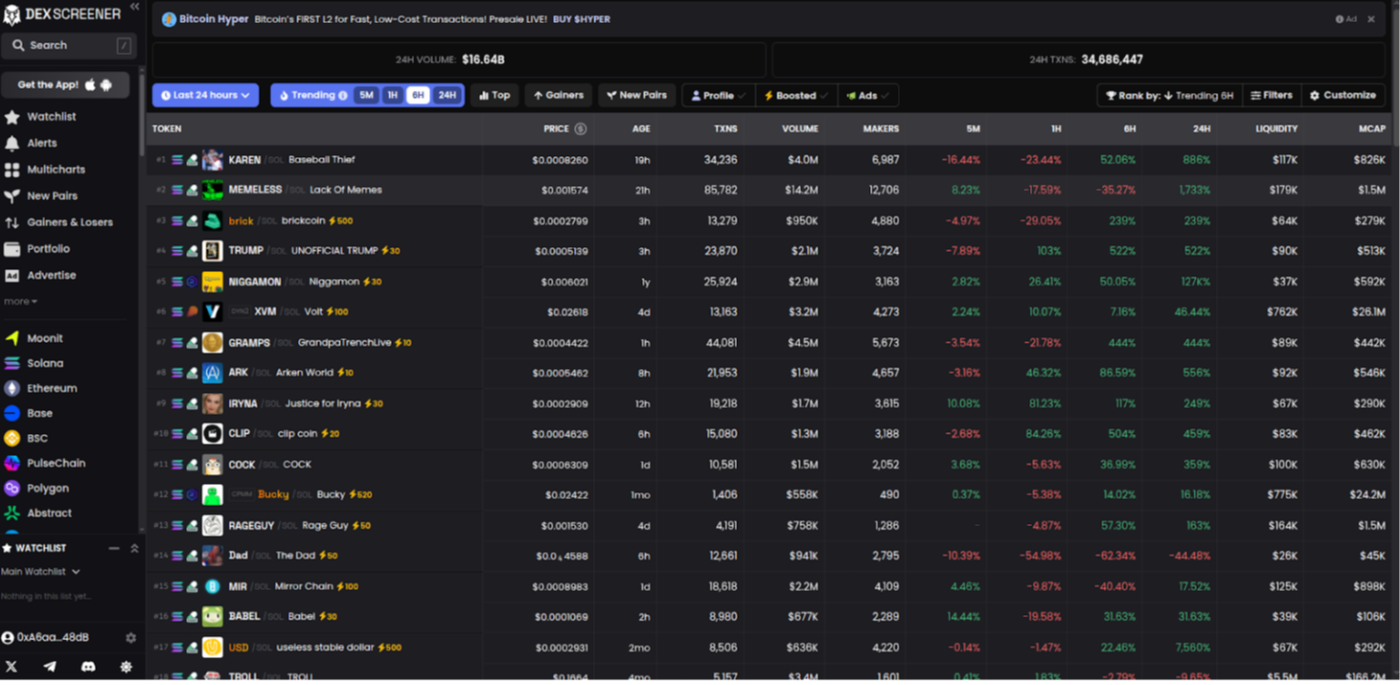
Building a DEXScreener Clone: A Step-by-Step Guide

Building a DEXScreener Clone: A Step-by-Step Guide

DEX Screener is used by crypto traders who need access to on-chain data like trading volumes, liquidity, and token prices. This information allows them to analyze trends, monitor new listings, and make informed investment decisions. In this tutorial, I will build a DEXScreener clone from scratch, covering everything from the initial design to a functional app. We will use Streamlit, a Python framework for building full-stack apps.
Share
Hackernoon2025/09/18 15:05
Which DOGE? Musk's Cryptic Post Explodes Confusion

Which DOGE? Musk's Cryptic Post Explodes Confusion

A viral chart documenting a sharp decline in U.S. federal employment during President Trump's second term has sparked unexpected confusion in cryptocurrency markets
Share
Coinstats2025/12/20 01:13
Google's AP2 protocol has been released. Does encrypted AI still have a chance?

Google's AP2 protocol has been released. Does encrypted AI still have a chance?

Following the MCP and A2A protocols, the AI Agent market has seen another blockbuster arrival: the Agent Payments Protocol (AP2), developed by Google. This will clearly further enhance AI Agents' autonomous multi-tasking capabilities, but the unfortunate reality is that it has little to do with web3AI. Let's take a closer look: What problem does AP2 solve? Simply put, the MCP protocol is like a universal hook, enabling AI agents to connect to various external tools and data sources; A2A is a team collaboration communication protocol that allows multiple AI agents to cooperate with each other to complete complex tasks; AP2 completes the last piece of the puzzle - payment capability. In other words, MCP opens up connectivity, A2A promotes collaboration efficiency, and AP2 achieves value exchange. The arrival of AP2 truly injects "soul" into the autonomous collaboration and task execution of Multi-Agents. Imagine AI Agents connecting Qunar, Meituan, and Didi to complete the booking of flights, hotels, and car rentals, but then getting stuck at the point of "self-payment." What's the point of all that multitasking? So, remember this: AP2 is an extension of MCP+A2A, solving the last mile problem of AI Agent automated execution. What are the technical highlights of AP2? The core innovation of AP2 is the Mandates mechanism, which is divided into real-time authorization mode and delegated authorization mode. Real-time authorization is easy to understand. The AI Agent finds the product and shows it to you. The operation can only be performed after the user signs. Delegated authorization requires the user to set rules in advance, such as only buying the iPhone 17 when the price drops to 5,000. The AI Agent monitors the trigger conditions and executes automatically. The implementation logic is cryptographically signed using Verifiable Credentials (VCs). Users can set complex commission conditions, including price ranges, time limits, and payment method priorities, forming a tamper-proof digital contract. Once signed, the AI Agent executes according to the conditions, with VCs ensuring auditability and security at every step. Of particular note is the "A2A x402" extension, a technical component developed by Google specifically for crypto payments, developed in collaboration with Coinbase and the Ethereum Foundation. This extension enables AI Agents to seamlessly process stablecoins, ETH, and other blockchain assets, supporting native payment scenarios within the Web3 ecosystem. What kind of imagination space can AP2 bring? After analyzing the technical principles, do you think that's it? Yes, in fact, the AP2 is boring when it is disassembled alone. Its real charm lies in connecting and opening up the "MCP+A2A+AP2" technology stack, completely opening up the complete link of AI Agent's autonomous analysis+execution+payment. From now on, AI Agents can open up many application scenarios. For example, AI Agents for stock investment and financial management can help us monitor the market 24/7 and conduct independent transactions. Enterprise procurement AI Agents can automatically replenish and renew without human intervention. AP2's complementary payment capabilities will further expand the penetration of the Agent-to-Agent economy into more scenarios. Google obviously understands that after the technical framework is established, the ecological implementation must be relied upon, so it has brought in more than 60 partners to develop it, almost covering the entire payment and business ecosystem. Interestingly, it also involves major Crypto players such as Ethereum, Coinbase, MetaMask, and Sui. Combined with the current trend of currency and stock integration, the imagination space has been doubled. Is web3 AI really dead? Not entirely. Google's AP2 looks complete, but it only achieves technical compatibility with Crypto payments. It can only be regarded as an extension of the traditional authorization framework and belongs to the category of automated execution. There is a "paradigm" difference between it and the autonomous asset management pursued by pure Crypto native solutions. The Crypto-native solutions under exploration are taking the "decentralized custody + on-chain verification" route, including AI Agent autonomous asset management, AI Agent autonomous transactions (DeFAI), AI Agent digital identity and on-chain reputation system (ERC-8004...), AI Agent on-chain governance DAO framework, AI Agent NPC and digital avatars, and many other interesting and fun directions. Ultimately, once users get used to AI Agent payments in traditional fields, their acceptance of AI Agents autonomously owning digital assets will also increase. And for those scenarios that AP2 cannot reach, such as anonymous transactions, censorship-resistant payments, and decentralized asset management, there will always be a time for crypto-native solutions to show their strength? The two are more likely to be complementary rather than competitive, but to be honest, the key technological advancements behind AI Agents currently all come from web2AI, and web3AI still needs to keep up the good work!
Share
PANews2025/09/18 07:00