

How Ethereum Whale Selling in 2026 Pressures ETH Price Outlook
This article was first published on The Bit Journal.
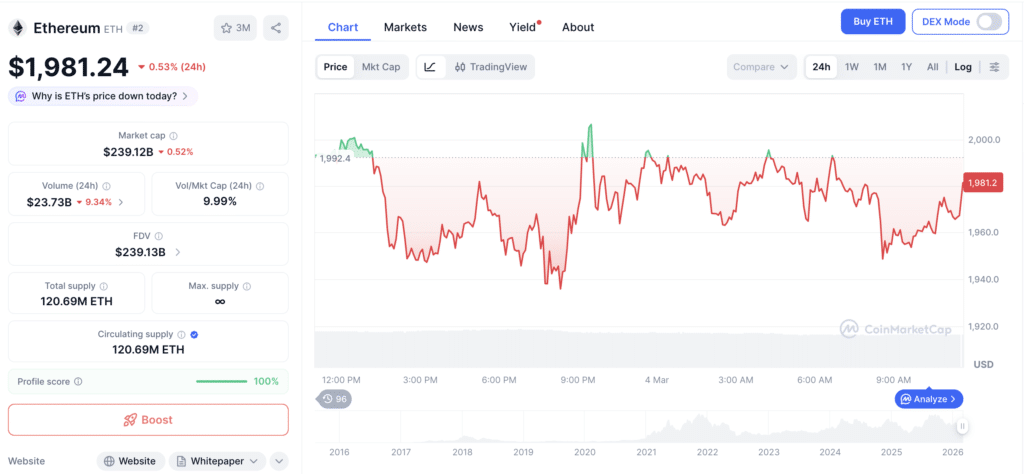
Ethereum whale selling in 2026 is intensifying, putting the crypto market at a critical juncture and raising alarms about a potential shift in ETH’s near‑term trajectory. Ethereum price today hovers around $1,971.47 USD with a massive 24‑hour trading volume of $23,735,262,636 USD, highlighting the tug-of-war between deep-pocketed holders and broader market participants.
At the time of writing, ETH had fallen by 1.11% in the last 24 hours: its market cap is now $237,940,819,163 USD, and the current circulating supply is around 120,692,150 ETH. Thus, this tussle between whale selling and ETH accumulation 2026 is leading analysts to analyse Ethereum on-chain data for support/resistance & breakout signs.
 How Ethereum Whale Selling in 2026 Pressures ETH Price Outlook 1
The Balance Between Whale Pressure And Accumulation
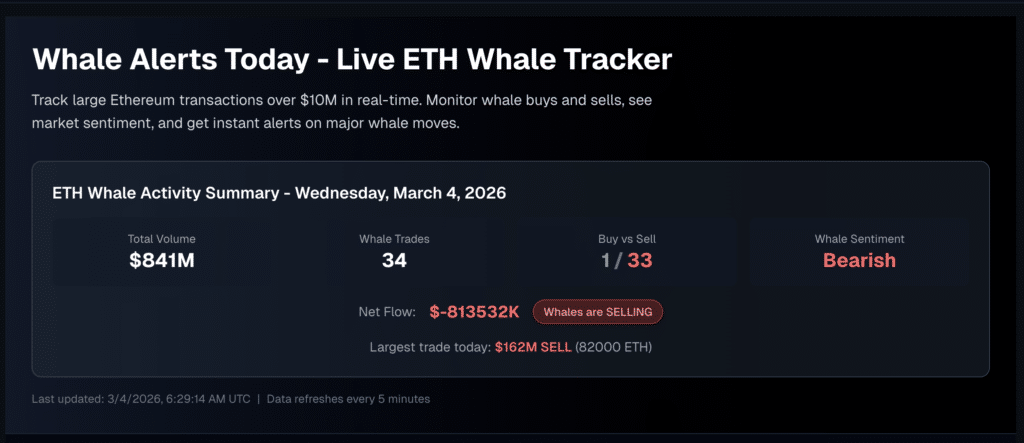
Ethereum whale sales have increased exchange influx and established prominent resistance around crucial zones, despite some ETH accumulation 2026 from large holders. On‑chain signals indicate mixed flows, with some whales trimming positions and sending ETH to exchanges while other large–sized entities persist in accumulating at discounts.
This push‑pull of whale behavior creates a truce line, analysts say, a fragile construct of support and resistance that is being incessantly tested, making it difficult to nail the ETH price breakout range. These dynamics frame broader Ethereum market analysis, which must take place at the confluence of liquidity patterns and holder intent, as much or more than price action.
 How Ethereum Whale Selling in 2026 Pressures ETH Price Outlook 2
Bulls and Bears Battle Over Key Technical Zones Amid Whale-Induced Volatility
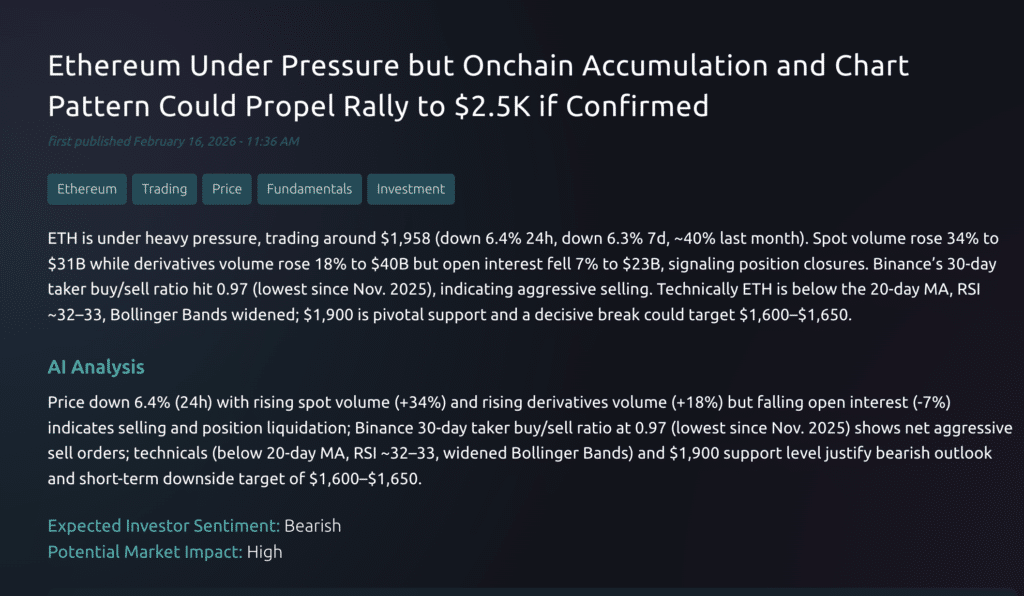
In mid‑2026, ETH is mostly going sideways with large swings caused by whale activity, contributing to a consolidation in Ethereum that frustrates bulls and bears alike. As Ethereum whale selling intensifies, key support and resistance bands for ETH have cycled around $1,900–$2,050 for weeks, keeping short‑term traders on the sidelines.
Market technicians note that these violent gaps in critical zones can lead to unpredictable price action, especially as whale movements heavily influence liquidity. This dynamic complicates ETH technical analysis today, as traditional indicators struggle to capture the messy effects that large wallet flows impose on charts.
 How Ethereum Whale Selling in 2026 Pressures ETH Price Outlook 3
Whale Selling vs. Historical Accumulation Waves
Historical snapshots of Ethereum price action show that whale activity has repeatedly influenced strong directional moves, whether through accumulation or distribution. Recent waves of whale accumulation in prior cycles hinted at deep value buying that often preceded robust uptrends.
In contrast, Ethereum whale selling in 2026 signals caution as these large entities opt to take profits or rebalance holdings amid uncertainty. Comparing past accumulation surges with present selling pressures offers essential context for Ethereum investor sentiment, suggesting that market psychology is still tentative on meaningful price expansion.
How Whale Dynamics are Reflected in Futures and Derivatives Markets
Whale influence doesn’t stop at spot markets; it extends into Ethereum futures market analysis, where leveraged positions and funding rates are highly sensitive to expectations around whale selling. When influential holders sell large chunks of ETH, futures markets adjust quickly, often reflecting more bearish sentiment and wider funding rate disparities.
Traders watching these derivative flows interpret them as leading indicators of where price might head next, especially when whale activity contributes to abrupt shifts. The tug‑of‑war between accumulation and distribution is becoming a theme of how futures sentiment aligns with broader ETH price prediction models.
Institutional and Retail Sentiment Amid Whale Movements
While whale selling creates pressure, institutional and retail sentiment shows a complex picture where some entities see value at current levels even as large holders reduce exposure. This divergence can be understood as a reflection of Ethereum accumulation vs whale selling, where smart money positions itself strategically, yet larger hands may still execute profit‑taking strategies.
Retail participation tends to magnify volatility when large holders act, often leading markets through exaggerated price swings. Understanding this interplay is central to any effective Ethereum market analysis, revealing how sentiment among different cohorts impacts price direction.
Liquidity, Exchange Flows, and Price Discovery
Liquidity ebb and flow is at the core of how Ethereum whale selling shapes price discovery. Large outflows from exchanges due to accumulation generally tighten supply and support bullish prospects, while inflows driven by whale selling can flood markets with liquidity, pressuring prices downward.
This delicate liquidity balance has intensified in 2026, leaving traders scanning exchange balance sheets and on‑chain data for insights into where whales are moving ETH next. These patterns often spell early warnings for broader price action, helping refine strategies tied to ETH price prediction models.
Potential Scenarios for an ETH Price Breakout
Looking ahead, the probability of a sustained ETH price breakout hinges on whether accumulation inflows can outweigh persistent whale selling pressure. If whales shift toward net buying at key support levels or halt large exchange deposits, markets could pivot toward renewed upside momentum.
Conversely, continued selling at strategic zones can keep price action constrained, reinforcing the Ethereum consolidation phase narrative. This ongoing tug‑of‑war sets up a high‑stakes environment where every whale move becomes a pivotal data point for market watchers.
Conclusion
In 2026, Ethereum whale selling has emerged as a critical factor shaping price action and volatility. Combined with mixed accumulation flows and delicate technical levels, this dynamic underscores the market’s uncertain path toward any meaningful breakout. Traders and analysts must watch on‑chain flows, liquidity trends, and whale behavior closely to anticipate shifts. For those navigating the ETH market, staying informed and adaptive is key to managing risk and identifying opportunities.
Frequently Asked Questions About Ethereum whale selling
How does Ethereum whale selling affect the price?
Whale selling can increase supply into the market, pressuring prices at key levels.
Is whale selling always bearish?
Not necessarily; selling can be part of broader rebalancing or profit‑taking without long‑term bearish meaning.
Can accumulation offset whale selling?
Yes, significant accumulation can create support and potentially mitigate downward pressure.
What should traders watch?
Exchange flows, whale transactions, and on‑chain metrics are key signals to monitor.
Appendix: Glossary of Key Terms
Whales: how big holders sell large amounts of ETH
Ethereum price: What is the ETH/USD market price today?
Collection of ETH 2026: The action of investors accumulating substantial bargain price positions in ETH in the year 2026.
On-chain Information from the blockchains that can be used for market analysis.
Support and resistance: Levels of a price where assets are expected to stop falling or, in the case of resistance, rising.
Consolidation: A period of sideways price movement, without a clear trend.
Futures market: A financial market that allows traders to speculate on future asset prices.
References
CoinMarketCap
Whale Alert
ALPHA DASHBOARD
Disclaimer:
This article is for informational purposes only and does not constitute financial or investment advice. Markets are volatile, and prices can change at any time.
Read More: How Ethereum Whale Selling in 2026 Pressures ETH Price Outlook">How Ethereum Whale Selling in 2026 Pressures ETH Price Outlook


You May Also Like

EUR/GBP Exchange Rate Surges as Bank of England Rate Hike Expectations Intensify – Market Analysis

Why Businesses Need Professional Machine Design and Development Services




