Senate Bill Targets Sports-Betting Ban on Crypto Prediction Markets
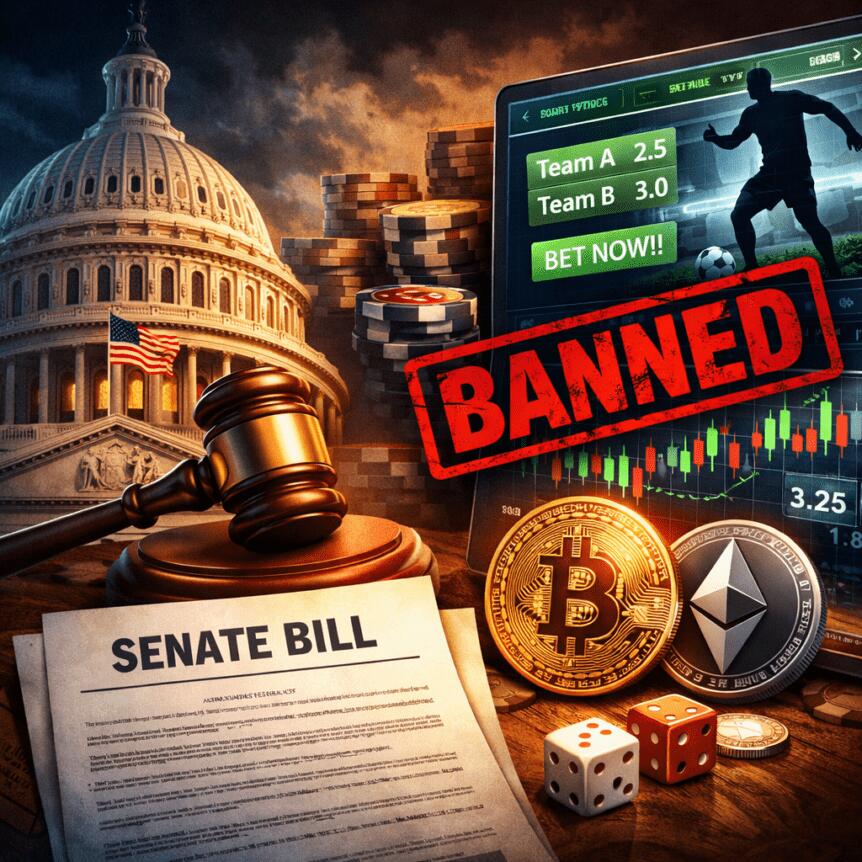
A bipartisan effort in Washington is gearing up to curb the use of CFTC-regulated prediction markets for sports betting and casino-style contracts, intensifying a broader regulatory push around these platforms. The move comes as lawmakers weigh how to balance potential innovation with consumer protection and state gaming prerogatives.
According to a Wall Street Journal report, Senators Adam Schiff and John Curtis are expected to unveil a measure on Monday that would bar listing sports bets and other casino-style contracts on prediction markets regulated by the Commodity Futures Trading Commission (CFTC). The authors of the bill argue that such activities should be governed at the state level rather than under federal oversight. “Too many young people in Utah are getting exposed to addictive sports betting and casino-style gaming contracts that belong under state control, not under federal regulators,” Curtis told the WSJ.
In a related development, Schiff has already introduced the DEATH BETS Act, which seeks to prohibit CFTC-regulated prediction markets from listing contracts tied to war, terrorism, assassination, and individual death. The bill text was released on March 10, and represents a more targeted expansion of the same policy impulse that informs the forthcoming bipartisan measure.
For readers tracking the broader regulatory arc, the evolving stance toward prediction markets intersects with renewed insider-trading concerns amid geopolitical volatility and a growing appetite in Congress to constrain markets tied to volatile events.
Key takeaways
- Lawmakers are preparing a bipartisan bill to bar CFTC-regulated prediction markets from listing sports betting and casino-style contracts, signaling a potential tightening of federal oversight.
- Senator John Curtis frames the move as protecting state sovereignty over gambling policy, while Senator Schiff’s DEATH BETS Act targets contracts linked to war, terrorism, assassination, and individual death.
- Sports-related contracts dominate activity on prediction-market platforms, with Dune data showing nearly half of Polymarket’s weekly notional volume and a substantial majority for Kalshi stemming from sports bets.
- CFTC activity is ramping up, including a staff advisory classifying event contracts as a financial asset class and an Advanced Notice of Proposed Rulemaking that could reshape how the CEA applies to these markets.
- Judicial and regulatory developments across Ohio and Nevada illustrate ongoing friction between federal authority and state gambling laws, creating a rapidly shifting risk landscape for operators and users.
Bipartisan bid targets prediction markets
The forthcoming bill, described by sources as a bipartisan initiative, would bar listing sports betting and “casino-style” contracts on prediction markets that fall under CFTC regulation. If enacted, the proposal would add a significant federal constraint at a moment when prediction-market platforms are expanding offerings beyond traditional politics and current events into entertainment and sports-oriented contracts. The aim, as outlined by Curtis, is to keep certain activities within state purview while reducing exposure to what lawmakers view as harmful or addictive products.
The DEATH BETS Act, introduced by Schiff, takes a similarly restrictive stance but with a focused scope on contracts tied to deadly human events. The combination of these measures underscores a broader shift in how policymakers are approaching the intersection of prediction markets, risk, and public policy. Schiff’s office released the bill text, and the proposal is expected to shape conversations around the future of these markets in the federal legislative agenda.
Regulatory push broadens beyond Congress
Beyond proposed legislation, the regulatory climate for prediction markets has intensified in recent weeks. The CFTC, which oversees designated contract markets (DCMs) like Polymarket and Kalshi, issued a staff advisory on March 12 that classifies event contracts as a “financial asset class.” In parallel, the agency released an Advanced Notice of Proposed Rulemaking to solicit input on how the Commodity Exchange Act should apply to prediction markets, signaling a potential overhaul of the regulatory framework governing these platforms.
These moves come amid a broader debate over federal versus state authority in the sector. While CFTC Chair Michael Seligman has argued that prediction markets fall under federal jurisdiction, lower courts have started to scrutinize that claim. An Ohio court ruling in early March found that Kalshi had not shown the CEA would necessarily preempt Ohio’s sports-gambling laws or that its contracts fell under the CFTC’s exclusive domain. Separately, a Nevada judge temporarily blocked Kalshi from offering sports, election, and entertainment event contracts for 14 days, citing the likelihood of violating state gambling statutes.
The regulatory climate thus blends rulemaking, judicial testing of preemption, and legislative action, creating a complex backdrop for operators as they navigate product design, compliance, and potential market exits or pivots. Kalshi and Polymarket remain under CFTC oversight as DCMS, but the ongoing legal and policy struggle injects a notable degree of uncertainty for market participants.
Sports markets drive trading volume and attention
Despite the policy spotlight, the economics of prediction markets continue to be driven by fast-moving event contracts—particularly in sports. Data from Dune Analytics highlights how sports bets dominate activity on major platforms. Polymarket’s weekly notional volume was heavily skewed toward sports contracts, accounting for about 47.7% of the week’s notional volume, while Kalshi’s sports-related contracts represented roughly 78.8% of its weekly activity. In raw figures, sports betting contributed approximately $1.2 billion in weekly notional trading for Polymarket and about $2.6 billion for Kalshi.
For investors and users, that concentration matters. A regulatory clampdown that constrains sports-related products could materially reduce liquidity, alter price discovery, and shift user interest toward other categories or away from prediction markets altogether. Operators might respond by adjusting product lines, tightening risk controls, or seeking additional state-level licenses to preserve some degree of activity within a more defined legal perimeter.
State and federal lines sharpened by courts and regulators
The tension between federal supervision and state-level gaming law has sharpened as courts weigh in on the reach of the CEA and the CFTC’s jurisdiction. The Ohio ruling suggested that federal preemption may not be as certain in practice as asserted in some regulatory circles, while Nevada’s temporary injunction against Kalshi underscores how state regulators can effectively pause or limit activity that touches local gambling statutes. These rulings do not settle the policy debate, but they do provide a glimpse into how turning points in law and regulation could shape the trajectory of prediction markets in the United States.
Meanwhile, the CFTC’s latest moves—namely the advisory and the open docket for public feedback—signal that the agency intends to be a central actor in shaping what is permissible. Market participants should monitor how the agency balances innovation with consumer protections and how courts continue to interpret the relationship between federal regulation and state gambling laws.
What happens next and why it matters
The unfolding story has clear implications for traders, developers, and investors in the prediction-market space. If Congress passes a bill restricting sports betting and casino-style contracts on CFTC-regulated markets, liquidity and product breadth could shrink, potentially pushing users toward state-regulated venues or other platforms with narrower offerings. Conversely, continued regulatory and judicial caution could preserve a larger role for prediction markets in information markets, research, and hedging across political and non-political events, albeit under tighter rules.
As lawmakers prepare to introduce the bipartisan measure and as CFTC rulemaking and court decisions proceed, industry participants should brace for a period of continued policy flux. The outcome will likely influence capital flows, platform strategies, and the pace at which prediction markets evolve from novelty to established financial infrastructure.
Readers should watch the forthcoming bill’s language, committee actions, and any amendments, alongside the CFTC’s rulemaking timetable and related court decisions. The convergence of policy, law, and market dynamics in the coming months will help define the operating landscape for prediction markets in the United States.
In the meantime, the market’s sensitivity to regulatory signals remains high, and investors should prepare for shifts in liquidity and product offerings as the regulatory framework takes clearer shape.
This article was originally published as Senate Bill Targets Sports-Betting Ban on Crypto Prediction Markets on Crypto Breaking News – your trusted source for crypto news, Bitcoin news, and blockchain updates.
You May Also Like

From Early Trading Losses to Global Impact: Somesh’s Journey to Building an Int’l Trading Community

Ethereum koers toont zeldzaam dubbel koopsignaal en richt zich op $4.550