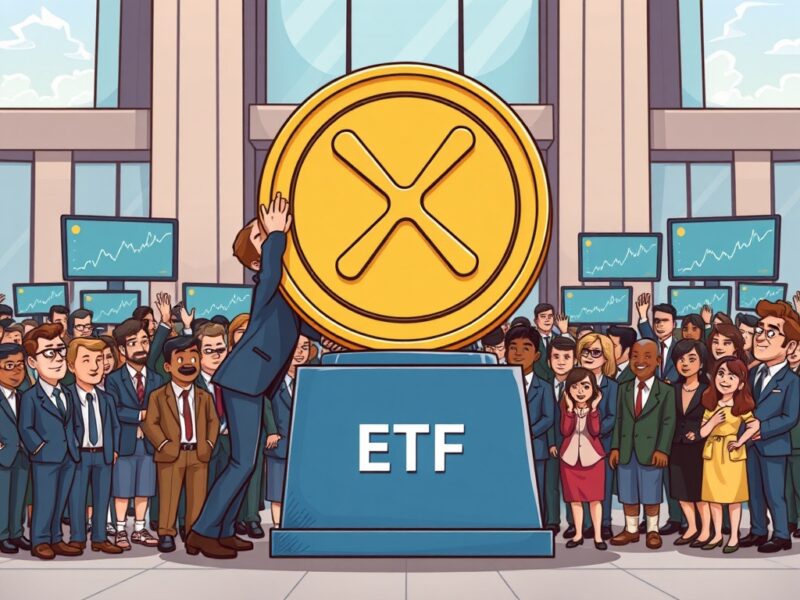
ETF

A crypto ETF is a regulated investment fund that tracks the price of one or more digital assets and trades on traditional stock exchanges like the NYSE or Nasdaq.Following the success of Bitcoin and Ethereum ETFs, the 2026 market now includes Solana ETFs and diversified Altcoin Baskets. ETFs serve as the primary vehicle for institutional capital and retirement funds (401k/IRA) to enter the Web3 space. This tag tracks regulatory approvals, AUM (Assets Under Management) inflows, and the impact of Wall Street on crypto liquidity.

39820 Articles
Created: 2026/02/02 18:52
Updated: 2026/02/02 18:52
MAGACOIN FINANCE, Bitcoin & Dogecoin – 3 Best Crypto Presales for 30x ROI

MAGACOIN FINANCE, Bitcoin & Dogecoin – 3 Best Crypto Presales for 30x ROI

The post MAGACOIN FINANCE, Bitcoin & Dogecoin – 3 Best Crypto Presales for 30x ROI appeared on BitcoinEthereumNews.com. Crypto News Discover why MAGACOIN FINANCE, Bitcoin, and Dogecoin are ranked as the 3 best crypto presales for 2025. Analysts predict up to 30x ROI — don’t miss your chance to invest early in these high-potential crypto assets. One of the hottest strategies to get ahead in the rapidly changing crypto world is for savvy investors to look for the best crypto presales in 2025. These presale tokens come with the possibility of going up in value by multiples, giving investors a scarce chance to jump on a project before it becomes popular. This week, three standout projects are being ranked among the best crypto presales to buy now: MAGACOIN FINANCE, Bitcoin (BTC), and Dogecoin (DOGE) —tipped for 30x ROI potential by leading analysts. These tokens are prime candidates for explosive growth due to certain factors. Let’s analyze those factors one by one. MAGACOIN FINANCE — The Breakout Presale With 30x Potential At the top of the best crypto presales list is MAGACOIN FINANCE, a powerful new project capturing major attention in the early investment community. Experts believe it has the right mix of early-stage potential, strong community support, and growth-focused tokenomics. It’s gaining attention as a high-upside choice for those seeking big returns this cycle. The countdown is live and only a limited number of tokens remain. Demand is surging before the next price jump. MAGACOIN FINANCE has been selected as one of the best altcoins to buy for investors building aggressive bull run portfolios. For investors seeking massive upside in early-stage crypto, MAGACOIN FINANCE ranks among the best crypto presales available this year — and possibly this cycle. Bitcoin (BTC) — Market Leader Now Entering a Strategic Accumulation Phase While Bitcoin is recording strong surges, many analysts are treating the current market consolidation near $113,000–$114,000 as a rare…

Author: BitcoinEthereumNews
Whale Rotation Alert: Bitcoin Dump, Ethereum Accumulation Rising

Whale Rotation Alert: Bitcoin Dump, Ethereum Accumulation Rising

The post Whale Rotation Alert: Bitcoin Dump, Ethereum Accumulation Rising appeared on BitcoinEthereumNews.com. A major Bitcoin whale has begun offloading massive amounts of BTC while simultaneously accumulating ETH. Such whale activity has typically influenced sentiment and liquidity, with ETH stacking rising in pace as BTC reserves are reduced, as analysts watch to see whether whale conviction could tilt the balance between the two largest cryptocurrencies. Whale Unwinds 15,000 BTC Position A Bitcoin whale who once held 15,000 BTC is selling massive amounts of BTC and buying ETH, making waves across the crypto market. Analyst CryptoGucci has revealed on X that this wallet, which originally held 15,000 BTC, was moved from cold storage 7 years ago, and has aggressively sold thousands of BTC while buying up massive amounts of ETH. In the past 24 hours, the whale has deposited 2,370 BTC worth $266 million in exchanges and has been steadily selling more BTC every few hours. This whale has been stacking ETH at scale. The whale’s holdings now sit at 167,629 ETH across 5 wallets, worth $706 million, which is spread across spot ETH, perpetual contracts, and Aave ETH positions in WETH and aEthWETH. Ethereum is rapidly gaining traction among corporate treasuries. According to CryptoRank_io’s update, the public companies now hold 2% of ETH’s total supply, marking a significant milestone in institutional adoption. Since April 1st, corporate ETH holdings have skyrocketed from $70 million to an impressive $10.9 billion, which reflects a surge in institutional confidence.  Over the same period, the public companies BTC holdings also increased from 3.07% to 3.93% of total supply, showing a steady accumulation of both top crypto assets. BitMine is leading the pack, which now holds over 1.5 million ETH, making it the largest corporate ETH treasury in the world. Bitcoin And Ethereum Market Positioning HolaItsAk47 also stated the conversation around the 2025 bull run is heating up, and…

Author: BitcoinEthereumNews
Quarter Billion in Ethereum Shorts Get Rekt as ETH Nears All-Time High

Quarter Billion in Ethereum Shorts Get Rekt as ETH Nears All-Time High

The post Quarter Billion in Ethereum Shorts Get Rekt as ETH Nears All-Time High appeared on BitcoinEthereumNews.com. In brief Ethereum jumped nearly 15% Friday after Fed Chair Jerome Powell hinted at rate cuts, but the token stalled just short of eclipsing its all-time high of $4,878. More than $340 million in Ethereum long and short positions were liquidated in the last 24 hours, making up over half of all crypto market liquidations. Regulatory tailwinds, corporate treasury purchases, and ETF inflows have strengthened demand for the asset, but failed to push it past a price record it’s failed to beat in nearly four years. Ethereum short traders lost hundreds of millions of dollars Friday as ETH came within inches of breaking past its all-time high price, but ultimately failed to rise to the occasion. In the last 24 hours alone, over $259 million worth of ETH short positions have been liquidated, according to data from CoinGlass. Another $80 million in long positions on the cryptocurrency have expired as well—bringing the total value of ETH liquidations in the last day to over $340 million. That figure makes up over half of all liquidations across the entire crypto market in the last 24 hours. Just north of $668 million in crypto derivatives have been wiped out in the last day, a clear signal that, at least for the moment, all eyes are on ETH.  The cryptocurrency has been on a tear in August after a largely lackluster year, but fell off again this week amidst macroeconomic uncertainty. Then, a long-awaited signal this morning from Federal Reserve Chair Jerome Powell, indicating that the U.S. central bank might soon cut interest rates, sent Ethereum and other altcoins surging. Immediately following the announcement, ETH popped nearly 15%, briefly eclipsing $4,842 in value. The token’s previous all-time high price of $4,878 was reached nearly four years ago, on November 10, 2021—at the peak…

Author: BitcoinEthereumNews
Crypto Treasury: Wall Street’s “Emperor’s New Clothes” and the Crypto Market’s “Historical Reversal”

Crypto Treasury: Wall Street’s “Emperor’s New Clothes” and the Crypto Market’s “Historical Reversal”

Author: Haotian While everyone is celebrating Wall Street's "financial alchemy"—the DAT model—has anyone considered whether DATs are actually turning history backwards? Here are some perspectives: First, let’s understand what DAT, PS, PE, and PN are... DAT (Digital Asset Treasury) is a platform that raises funds by issuing shares to investors and then using the funds to purchase crypto assets (such as BTC and ETH) to form a reserve fund. Ideally, this system achieves a positive cycle of issuing shares, purchasing crypto assets, and then issuing more shares and purchasing more crypto assets. I won't go into other concepts here, from traditional finance's PE (price-to-earnings ratio, how much you pay for every dollar of profit, the stuff of value investing), PS (price-to-sales ratio, how much you pay for every dollar of revenue, the so-called "price-to-dream ratio"), to my made-up PN (price to narrative ratio, how much you pay for a story, pure speculation). The detailed views are as follows. Any similar or surprising opinions are for reference only: 1) DATs are not “financial innovation” but rather a “regulatory arbitrage” channel set up by Wall Street to circumvent cryptocurrency regulation. However, since the Paul Atkins-led Project Crypto and the implementation of stablecoin bills such as GENIUS and CLARITY, this wave of DATs has surged. On the surface, it seems to be a trend initiated by a number of Wall Street shell companies imitating the success story of Micro Strategy. However, I believe that it is actually a last-ditch effort before the unofficial compliance channels are narrowed. Therefore, the Fomo trend of DATs is bound to gradually be dispelled under the dual control of its own bubble bursting and government regulatory pressure. 2) DATs’ “financial alchemy” may seem magical, but it is actually a typical “reflexivity” trap. In fact, many people are clear about the logic. MicroStrategy's flywheel of "issuing shares → buying coins → coin prices rise → stock prices rise → issuing more shares" looks beautiful, and in fact it is beautiful, but under the amplifying effect of a group of followers, the shortcomings of this "reflexive system" will also be accelerated: it can indeed amplify profits in a positive cycle, but once it reverses, it will spirally collapse. Especially when the mNAV (net asset value) premium disappears or even turns into a discount, the entire model becomes ineffective instantly - you can no longer issue shares, buy tokens, and may even be forced to sell tokens; 3) DATs embody the financial harvester gene of Wall Street, which is good at complicating and packaging simple problems and ultimately implementing "dimensionality reduction attacks." Putting aside the factors of regulatory arbitrage, not to mention the historical factors of MSTR, but in the context of ETFs such as BTC and ETH and various crypto-friendly governments and policies, if you want to buy Bitcoin, just buy it directly, package it as an institutional-level digital asset allocation strategy, and then concoct a new concept of DATs. Essentially, they're exploiting market awareness gaps, time-consuming education costs, and complex compliance processes to sell structured products. While DATs aren't as aggressive as historical products like CDOs (collateralized debt obligations) and CDSs (credit default swaps), they achieve the same goal. 4) DATs are essentially a historical regression of the valuation system, forcibly pulling cryptocurrencies from the mature track of PS/PE back to the wild era of PN. The Crypto market has gone through several cycles of development and evolution, from the pure concept speculation in 2017, to the DeFi era focusing on TVL and protocol revenue (PS thinking), to some projects starting dividend repurchases (PE thinking), and the PMF that everyone frequently mentions. The whole process is actually on the path to maturity. But the DAT craze has brought everyone back to the price-to-narrative logic of buying into stories and concepts. Isn't this a step backwards? In the short term, native investors can be indifferent, as Fomo does bring in real money. But in the long term, it adds a lot of uncertainty. above. Having said that, this unconventional approach of DATs may actually work, but we cannot expect off-market purchases to drive a super bull market. In my opinion, the real Pandora's box lies in the new "on-chain leverage" gameplay that DATs may trigger. To put it bluntly, it is to connect Wall Street's leverage game with the composability of DeFi. The OTC market is responsible for incremental funds and endorsements, while the market focuses on hype and leverage amplification. Especially for Crypto natives who are still eagerly hoping for miracles from Wall Street, they must not ignore the innovative magic of the pure Crypto market.

Author: PANews
XRP ETF: Grayscale’s Bold Move Could Transform Crypto Investing

XRP ETF: Grayscale’s Bold Move Could Transform Crypto Investing

BitcoinWorld XRP ETF: Grayscale’s Bold Move Could Transform Crypto Investing Exciting news is rippling through the cryptocurrency world! Grayscale, a leading digital asset manager, has officially submitted an S-1 filing with the U.S. Securities and Exchange Commission (SEC) for a proposed XRP ETF. This significant development, first reported by Watcher Guru on X, marks a crucial step toward potentially bringing XRP, the digital asset powering Ripple’s payment network, into a more mainstream investment vehicle. For many, this filing signals a growing institutional interest in diversifying crypto investment options beyond Bitcoin and Ethereum. What Does Grayscale’s XRP ETF Filing Mean? When Grayscale files an S-1, it is essentially a registration statement required by the SEC for new securities offerings. It provides a comprehensive overview of the proposed fund, including its structure, investment objectives, and risks. This move indicates Grayscale’s serious intent to launch an XRP ETF, making it easier for traditional investors to gain exposure to XRP without directly holding the digital asset. The SEC’s review process for such filings can be lengthy and involves thorough scrutiny. An S-1 filing is a necessary prerequisite before any ETF can be considered for approval. It is a formal declaration of intent and a detailed blueprint for how the fund would operate. Why is an XRP ETF a Game Changer for Investors? The potential approval of an XRP ETF offers several compelling benefits. First, it simplifies access. Investors can buy shares of the ETF through traditional brokerage accounts, eliminating the complexities of crypto wallets, exchanges, and private key management. This ease of access significantly lowers the barrier to entry for many. Increased Liquidity: An ETF often brings greater liquidity to the underlying asset, making it easier to buy and sell. Regulatory Clarity: SEC oversight provides a layer of trust and regulatory clarity, appealing to institutional investors and those hesitant about the unregulated nature of some crypto markets. Diversification: It allows investors to diversify their crypto holdings beyond the dominant Bitcoin and Ethereum ETFs. This development could unlock substantial capital from institutional funds and retail investors who prefer regulated products. It truly represents a new era for digital asset investment. Navigating the Path: Challenges and Regulatory Hurdles for the XRP ETF While the prospect of an XRP ETF is thrilling, the path to approval is not without its challenges. The SEC has historically been cautious with crypto-related products, especially those involving assets that have faced regulatory scrutiny. XRP’s legal status in the U.S. has been a point of contention, with the SEC previously suing Ripple, alleging XRP is an unregistered security. However, recent court rulings have provided some clarity, distinguishing between institutional sales and programmatic sales on exchanges. This legal progress might pave a smoother way for an XRP ETF, but the SEC’s final decision remains uncertain. Grayscale must convince regulators that the fund meets all investor protection requirements, a task that demands meticulous detail and compliance. Looking Ahead: The Potential Impact of an Approved XRP ETF Should the SEC grant approval for an XRP ETF, the implications for the broader cryptocurrency market could be profound. Such an approval would not only legitimize XRP further as an investable asset but also set a precedent for other altcoins to follow suit. It would signal a maturing market where digital assets are increasingly integrated into traditional finance. We could see a surge in demand for XRP, potentially impacting its price and market capitalization. More importantly, it would represent a significant win for crypto advocates pushing for broader institutional adoption and regulated investment products. The market will be watching closely as this unfolds, eager to witness the next chapter in crypto investment. Grayscale’s S-1 filing for an XRP ETF is undeniably a pivotal moment for the cryptocurrency ecosystem. It underscores the relentless drive towards integrating digital assets into traditional financial frameworks. While the journey to approval may be complex, the potential benefits for investors and the broader market are immense. This move highlights a future where accessing innovative digital assets like XRP becomes as straightforward as investing in traditional stocks. The crypto world holds its breath, anticipating the SEC’s next steps with great anticipation. Frequently Asked Questions (FAQs) What is an S-1 filing? An S-1 filing is a registration statement required by the U.S. SEC for new securities offerings. It provides detailed information about a company or fund looking to go public or offer new investment products, like an ETF. Why is an XRP ETF significant? An XRP ETF is significant because it would allow traditional investors to gain exposure to XRP through a regulated and easily accessible investment vehicle, potentially boosting liquidity and institutional adoption for the asset. What are the main benefits of an XRP ETF? Key benefits include simplified access for investors, increased liquidity for XRP, and enhanced regulatory clarity and oversight, which can attract more institutional capital. What challenges does an XRP ETF face? The primary challenges include obtaining SEC approval, which has historically been cautious with crypto products, and navigating the ongoing regulatory discussions surrounding XRP’s legal classification. How does this impact XRP’s legal status? While an S-1 filing does not change XRP’s legal status directly, an SEC approval of an XRP ETF would implicitly acknowledge XRP as a legitimate asset for a regulated investment product, building on recent positive court rulings. If you found this insight into Grayscale’s groundbreaking XRP ETF filing valuable, don’t keep it to yourself! Share this article with your network on social media to spread awareness about this exciting development in the crypto space. Let’s discuss the future of digital asset investing together! To learn more about the latest crypto market trends, explore our article on key developments shaping XRP institutional adoption. This post XRP ETF: Grayscale’s Bold Move Could Transform Crypto Investing first appeared on BitcoinWorld and is written by Editorial Team

Author: Coinstats
Stellar, XRP & MAGACOIN FINANCE Poised for 50x Upside in Analysts’ 2025 Outlook

Stellar, XRP & MAGACOIN FINANCE Poised for 50x Upside in Analysts’ 2025 Outlook

Crypto investors are searching for the best altcoins to buy now as forecasts point toward a powerful 2025 cycle. Stellar and XRP are leading discussions thanks to upgrades and ETF speculation. But analysts suggest MAGACOIN FINANCE could be the breakout contender, with projections hinting at up to 50x upside. Stellar’s Forecast Gains Strength Stellar (XLM) […] Continue Reading: Stellar, XRP & MAGACOIN FINANCE Poised for 50x Upside in Analysts’ 2025 Outlook

Author: Coinstats
We Have a New Ethereum All–time High

We Have a New Ethereum All–time High

It took almost four years, a flood of institutional money, and Jerome Powell mumbling dovishly into a microphone but Ethereum has finally done it. ETH just smashed through its old 2021 all-time high, setting a new record that puts the protocol firmly back in the driver’s seat of crypto’s next chapter.

Author: Brave Newcoin
Why Wall Street’s old guard still won’t touch crypto

Why Wall Street’s old guard still won’t touch crypto

The post Why Wall Street’s old guard still won’t touch crypto appeared on BitcoinEthereumNews.com. Bitcoin and crypto seem to be on the verge of mainstream adoption, with US spot exchange-traded funds (ETFs) shattering inflow records, Goldman Sachs holding more crypto ETF shares issued by BlackRock than any other institution, and corporate treasuries from Strategy to Bitmine embracing digital assets. However, a recent survey from Bank of America showed three-quarters of global fund managers remain steadfast in their refusal to touch digital assets. According to Max Gokhman, deputy chief investment officer for Franklin Templeton Investment Solutions, the paradoxical numbers aren’t due to regulatory uncertainty or operational complexity, as those barriers have largely been addressed. In an interview with CryptoSlate, Gokhman said the skewed numbers stem from fear, misconception, and the industry’s struggle with abandoning deeply held beliefs about what constitutes legitimate investment. Gokhman spent years watching traditional finance grapple with the digital asset revolution. He noted: “The biggest reason is it takes a while for an established industry to realize that they’re falling behind. There’s this fear of the unknown that exists.” The stewardship paradox Fund managers pride themselves on fiduciary responsibility, but this protective instinct has created a paradox: the desire to safeguard client assets prevents managers from accessing opportunities their clients increasingly demand. According to Gokhman: “Part of being a good steward is being aware of what your clients want. Clients from retail to institutional level are more interested in digital assets, but they’re finding that their investment managers are not actually there with solutions.” The resistance stems from persistent misconceptions. One notion is that it’s all hyper-speculative and lacks value, while the other is that there is a lack of staff with the expertise to create legitimate investment solutions using digital assets. The memecoin trap When Gokhman encounters skeptical colleagues, the conversation follows a predictable script. Traditional finance stalwarts mention memecoins as…

Author: BitcoinEthereumNews
VanEck Files to Launch ETF With Jito's Liquid-Staked Solana Tokens

VanEck Files to Launch ETF With Jito's Liquid-Staked Solana Tokens

The VanEck JitoSOL ETF filing comes after regulators determined earlier this month that liquid staking is not a securities transaction.

Author: Coinstats
Ethereum Hits Fresh All-Time Highs

Ethereum Hits Fresh All-Time Highs

ETH surged past its 2021 peak, fueled by treasury adoption and record ETF inflows.

Author: Coinstats