ETF

A crypto ETF is a regulated investment fund that tracks the price of one or more digital assets and trades on traditional stock exchanges like the NYSE or Nasdaq.Following the success of Bitcoin and Ethereum ETFs, the 2026 market now includes Solana ETFs and diversified Altcoin Baskets. ETFs serve as the primary vehicle for institutional capital and retirement funds (401k/IRA) to enter the Web3 space. This tag tracks regulatory approvals, AUM (Assets Under Management) inflows, and the impact of Wall Street on crypto liquidity.

39663 Articles
Created: 2026/02/02 18:52
Updated: 2026/02/02 18:52
9 Ways Bitcoin Treasury Companies Can Differentiate In A Crowded Market

9 Ways Bitcoin Treasury Companies Can Differentiate In A Crowded Market

The post 9 Ways Bitcoin Treasury Companies Can Differentiate In A Crowded Market appeared on BitcoinEthereumNews.com. The Era of Easy Differentiation Is Over There was a time when holding Bitcoin was enough. Strategy (formerly MicroStrategy) proved it in 2020—simply moving idle cash into Bitcoin electrified markets, drove premiums above NAV, and rewrote corporate playbooks. But five years later, the battlefield has changed. Dozens of public companies across Japan, France, the U.S., the U.K., Sweden, Canada, and Brazil now run Bitcoin treasury strategies. ETFs have captured billions in flows. El Salvador holds it as sovereign reserve. In this environment, “we own Bitcoin” is no longer a differentiator. If a company cannot compete on size, speed, or scale, it must assemble alternative sources of firepower to win over shareholders and maintain its mNAV premium. Without it, momentum stalls, media cycles fade, and mNAV grinds down toward 1—or below. 1) Lean into jurisdictional leverage Why it matters. Jurisdiction sets the cost of capital, the shape of your investor base, and the menu of corporate instruments you can legally deploy. It is a design variable, not a constraint. What it unlocks. In Japan, ultra-low rates and NISA eligibility made zero-coupon, premium-redeemable debt and retail inflows a rational path. In France, PEA-PME turns qualified equities into long-horizon, tax-advantaged vehicles, ideal for controlled floats and large ATMs. In the U.S., fair-value accounting and deep markets enable layered stacks across convertibles, secured bonds, preferreds, and ATMs. Elsewhere (U.K., Sweden, Canada, Brazil), wrappers and local capital habits create distinct demand curves that equities can tap even when local ETF options are limited or structurally different. Operator’s takeaway. Your jurisdiction should amplify your intended shareholder mix (retail wrappers vs. institutions), your funding cadence (episodic raises vs. rolling ATMs), and your narrative (innovation vs. stability). Treat geography as a capital tool. 2) Seasoned leadership and the rise of the Head of Bitcoin Strategy Why this role…

Author: BitcoinEthereumNews
XRP ETF News Sends Traders Into MAGACOIN FINANCE

XRP ETF News Sends Traders Into MAGACOIN FINANCE

The post XRP ETF News Sends Traders Into MAGACOIN FINANCE appeared on BitcoinEthereumNews.com. Crypto News XRP ETF delays are sparking trader activity with attention shifting toward MAGACOIN FINANCE as the best crypto presale to buy for ROI and price growth. XRP ETF delays are causing new market moves. While XRP wallows in the $3 range, traders are exploring MAGACOIN FINANCE, which is an altcoin presale attracting buzz as the best crypto presale to buy for ROI and FOMO-driven entry. XRP ETF Delays Can Drive Price Action The U.S. SEC this week postponed rulings on XRP ETFs including filings from Grayscale, CoinShares, and 21Shares. The new deadline is now late October 2025, which is keeping traders on alert for developments. Crypto commentator Zach Rector said this delay can generate upward buying pressure in the short term. He said that anticipation often brings new inflows as investors “buy the rumor” before major announcements. A similar pattern played out with Bitcoin ETFs in 2024 when prices dipped on launch day but surged in the following months as funds attracted billions. With XRP near $3, traders are weighing ETF inflows as a trigger for short-term price lifts and possible long-term revaluations. Analysts Forecast XRP Price from ETF Launch Industry voices continue to paint bold scenarios for XRP post-ETF approval. Kenny Nguyen, a widely followed commentator, said XRP should trade between $22 and $50 once the first spot ETF wave launches. That range is a 607% to 1,500% price shoot from today’s $3 levels. Institutional players also expect billions in inflows. Canary Capital’s Steven McClurg is predicting $5 billion in the first month alone while JPMorgan placed the first-year figure closer to $8 billion. Using standard multipliers, this translates to XRP hitting $12 or $22 or even $30, depending on inflow levels. Bloomberg ETF analysts place approval odds at 95%, which is raising expectations that October may bring…

Author: BitcoinEthereumNews
3 Signs ETH may rally to $4,800

3 Signs ETH may rally to $4,800

The post 3 Signs ETH may rally to $4,800 appeared on BitcoinEthereumNews.com. With Ethereum hovering above $4,200 and aiming for new highs, bulls are once again in control. ETF inflows, improved technicals, and shifting market dynamics suggest a further leg higher. Investors can expect a surge to $4,800 if the upside momentum sustains. Let’s discuss the key factors why Ethereum (ETH) can rally to $4,800 and possibly go to an all-time high as well, in this Ethereum price prediction. Current ETH price scenario ETH 1d chart, Source: crypto.news At the moment, ETH is trading at about $4,295. Bulls maintained the upward momentum above the $4,000–$4,150 support zone by printing the highest weekly closing since 2021 at almost $4,475. Spot ETH ETFs just recorded an 8-day inflow run ending on August 14 (almost $3.7 billion during the streak, and about $640 million on that day). Although there was a minor outflow on August 15, overall momentum is still positive. Rotation of the market is beneficial: The strength of ETH is driving the most recent altcoin leg, while Bitcoin’s dominance has decreased to about 59%. 3 signs ETH may rally to $4,800 Sign 1 — ETF demand is (still) a tailwind Flows continue to be a major bull driver following the eight days of robust net inflows into U.S. spot ETH ETFs. In addition, since spring, cumulative net inflows have increased into the tens of billions, demonstrating persistent institutional interest. Sign 2 — Technicals favor a push toward $4,800 Holding above $4,450 retains attention on $4,700–$4,800, just shy of the last ATH (~$4,878). ETH regained the $4,450–$4,550 supply region and ended the week at a 4-year high. The first support is between $4,000 and $4,150. ETH 1w chart, Source: Tradingview Sign 3 — Breadth & relative strength are improving Capital is shifting into majors as BTC supremacy declines; ETH leadership is evident in the…

Author: BitcoinEthereumNews
Tidal Trust II Pushes Bold XRP ETF Filing as SEC Shifts Its Stance

Tidal Trust II Pushes Bold XRP ETF Filing as SEC Shifts Its Stance

TLDR Tidal Trust II submitted a filing to the SEC for a leveraged long XRP ETF. The proposed XRP ETF targets 150 to 200 percent leveraged exposure to daily XRP price changes. The fund also uses an options income strategy that aims to generate additional cash flow. Ripple gained momentum after the SEC removed its [...] The post Tidal Trust II Pushes Bold XRP ETF Filing as SEC Shifts Its Stance appeared first on CoinCentral.

Author: Coincentral
Corporate Crypto Treasuries: Bitcoin Reserves Could Heighten Credit Risk, Analysts Warn

Corporate Crypto Treasuries: Bitcoin Reserves Could Heighten Credit Risk, Analysts Warn

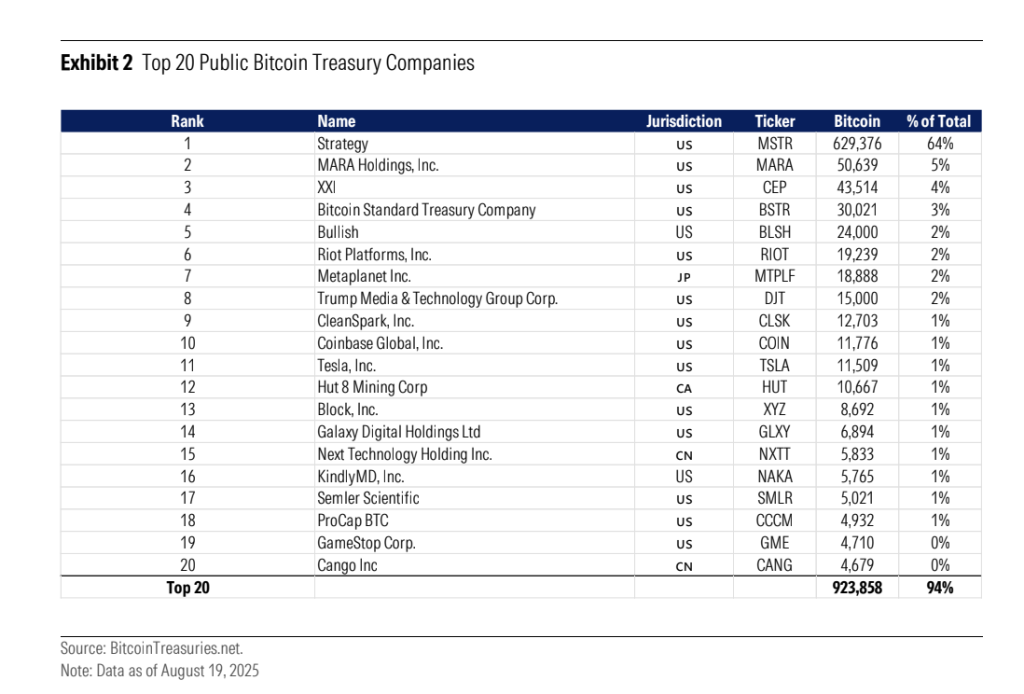
The growing practice of companies holding bitcoin and other cryptocurrencies in their treasuries may heighten credit risks, according to analysts at Morningstar DBRS.Over the past decade, cryptocurrencies such as bitcoin and ethereum have moved steadily into the mainstream, with both small and large companies adopting them for payments and investments. According to Morningstar DBRS analysts many companies are now using cryptocurrencies for treasury functions, effectively positioning bitcoin and other tokens as corporate reserve assets. These “cryptocurrency treasury companies” represent a growing niche within corporate finance, but one that carries heightened risks for credit profiles.Concentration and Market ExposureMorningstar analysts note that corporate bitcoin holdings remain concentrated among a handful of firms, with Strategy Inc. alone holding over 629,000 bitcoins — roughly 64 percent of all public company bitcoin treasury holdings. Michael Saylor’s Strategy has been adding to its reserves at a rapid pace, snapping up bitcoin almost weekly in recent months as part of an aggressive accumulation strategy. Strategy has acquired 430 BTC for ~$51.4 million at ~$119,666 per bitcoin and has achieved BTC Yield of 25.1% YTD 2025. As of 8/17/2025, we hodl 629,376 $BTC acquired for ~$46.15 billion at ~$73,320 per bitcoin. $MSTR $STRC $STRK $STRF $STRDhttps://t.co/8zSHvPTFJO— Strategy (@Strategy) August 18, 2025 The top 20 public companies collectively control an estimated 94 percent of corporate bitcoin reserves, underscoring how concentrated this exposure remains. In total, approximately 3.68 million bitcoins, valued at around $428 billion as of August 2025, are held across corporations, ETFs, governments, and custodians. This represents nearly 18 percent of the current circulating supply, says Morningstar. While the growth in adoption shows confidence among corporates and investors, reliance on such a volatile asset for treasury management introduces substantial challenges. Morningstar analysts caution that concentration risk coupled with the high market volatility of cryptocurrencies could complicate liquidity planning and affect corporate balance sheets during periods of stress.Risks Facing Corporate TreasuriesMorningstar DBRS analysts identify a range of risks for companies adopting a cryptocurrency treasury strategy. Regulatory uncertainty remains one of the most pressing challenges, with no uniform global framework governing cryptocurrencies. Although countries such as the U.S. and those in the eurozone have introduced clearer rules, these remain in flux, leaving corporates exposed to shifting compliance obligations.Liquidity also presents a concern. While digital asset markets have grown considerably, they can still thin out during times of volatility. In such moments, transactions may be delayed, and spreads can widen, undermining the reliability of cryptocurrency reserves as a financial backstop. Counterparty and security risks further complicate the landscape, as many firms depend on centralized exchanges for both trading and custody. Recent disputes, such as the SEC’s lawsuit against Coinbase — which was eventually dropped in 2025 — highlight the evolving and unpredictable regulatory environment surrounding major platforms.Another factor is the materiality of digital asset holdings on corporate balance sheets. Treasury functions are designed to safeguard financial stability and ensure liquidity, but when bitcoin becomes a company’s primary reserve asset, its volatility can undermine these objectives. A June 2024 study found that bitcoin was nearly five times more volatile than the S&P 500 in the short run and four times more volatile in the long run, suggesting significant exposure to price swings, acceding to Morningstar. Custodial considerations add further complexity, with firms needing to weigh the risks of self-custody against the vulnerabilities of third-party custodians.Implications for Corporate Credit ProfilesThe central purpose of corporate treasury management is to maintain stability, support consistent operations, and enable growth. Analysts argue that the incorporation of highly volatile cryptocurrencies into treasury reserves fundamentally alters this role. The volatility of assets such as bitcoin, combined with regulatory and custodial uncertainties, introduces new risks that can directly impact a company’s creditworthiness.Morningstar DBRS analysts conclude that while cryptocurrency adoption by corporates will likely continue to grow, particularly as regulatory clarity improves and integration into payment systems expands, these strategies carry meaningful implications for credit risk. The long-term success of corporate crypto treasuries will depend on whether they can balance the promise of digital assets with the fundamental responsibility of safeguarding financial health.

Author: CryptoNews
Ethereum treasuries hit $17b in holdings, what’s next for price?

Ethereum treasuries hit $17b in holdings, what’s next for price?

ethereum

Author: Crypto.news
Economist Who Predicted Bitcoin Would Go To $100 Before $100,000 Returns

Economist Who Predicted Bitcoin Would Go To $100 Before $100,000 Returns

Harvard economist Kenneth Rogoff, who declared in 2018 that Bitcoin was more likely to crash to $100 than rally to $100,000, has returned. He indirectly admitted he was wrong and outlined reasons why his prediction fell through.  Harvard Economist Breaks Silence On Missed Bitcoin Prediction In an X post, Rogoff identified himself as the Harvard economist who said that Bitcoin was more likely to be worth $100 than $100,000. He then went on to comment on what he missed when he made this prediction. First, the economist said that he was far too optimistic about the U.S. coming to its senses about sensible crypto regulation.  Related Reading: Crypto Founder Predicts The Collapse Of Bitcoin In This Timeframe Rogoff, who was the former chief economist of the International Monetary Fund (IMF), indicated that the Donald Trump administration has gone about Bitcoin and crypto regulation in the wrong way. He questioned why policymakers would want to facilitate tax evasion and illegal activities, likely in reference to regulations such as the GENIUS Act, which have provided regulatory clarity.  It is worth mentioning that one of the reasons the Harvard economist had predicted that Bitcoin was more likely to go to $100 was based on his belief that government regulation would trigger lower prices. He had made this prediction when BTC was trading at around $11,000. Rogoff claimed back then that the flagship crypto needed global regulation to crack down on its use for money laundering.  The former IMF chief believed that if this regulation took away the possibility of money laundering and tax evasion, then Bitcoin’s actual use cases for transactions were very small. As such, he was banking on BTC lacking any demand, which would drive its price lower rather than higher.  However, that hasn’t been the case as government regulation has only boosted Bitcoin’s demand. The flagship crypto rallied to $100,000, a price level Rogoff said it won’t reach, for the first time last year following Donald Trump’s victory. Meanwhile, BTC has reached new highs on the back of regulatory clarity, including its rally to a previous all-time high (ATH) just before the passage of the GENIUS Act last month.  Further Reasons For The Missed Prediction The Harvard economist also stated that he did not appreciate how Bitcoin would compete with fiat currencies to serve as the transaction medium of choice in the $20 trillion global underground economy. He further remarked that this demand puts a floor on its price.  Related Reading: Two Scenarios Map Out Bitcoin Price Crash After Recovery In addition to being a transaction medium of choice, BTC has also gained a reputation as a store of value, which has created demand for it among traditional finance (TradFi) investors. These investors have gained exposure to Bitcoin mainly through the ETFs. Interestingly, Harvard recently revealed a $117 million stake in BlackRock’s BTC ETF.  Lastly, Rogoff said that he did not anticipate a situation where regulators, especially the regulator in chief, would be able to brazenly hold hundreds of millions or even billions of dollars in crypto without consequence, considering the “blatant conflict of interest.”  At the time of writing, the Bitcoin price is trading at around $113,600, up in the last 24 hours, according to data from CoinMarketCap. Featured image from Pixabay, chart from Tradingview.com

Author: NewsBTC
Fed Sees Stablecoins Improving Efficiency but Flags Risks to U.S. Finance

Fed Sees Stablecoins Improving Efficiency but Flags Risks to U.S. Finance

TLDR The Federal Reserve included stablecoins in its recent policy discussions during the FOMC meeting. Officials said stablecoins could improve efficiency in payments and reduce friction across the financial system. The minutes highlighted potential risks such as maturity mismatches and reserve management challenges. Members noted that widespread adoption of stablecoins could influence Treasury markets and [...] The post Fed Sees Stablecoins Improving Efficiency but Flags Risks to U.S. Finance appeared first on CoinCentral.

Author: Coincentral
Why Go Green? Kevin O’Leary Explains Paradigm Shift in Bitcoin Mining: Interview

Why Go Green? Kevin O’Leary Explains Paradigm Shift in Bitcoin Mining: Interview

As Bitcoin continues to breach all-time highs, the debate over Bitcoin mining’s environmental impact grows louder. A Cambridge Centre for Alternative Finance study found that 52.4% of Bitcoin mining now relies on sustainable energy. Among the firms pushing this transition is Bitzero, backed by Shark Tank investor and entrepreneur Kevin O’Leary aka “Mr Wonderful”. In an interview with Cryptonews, O’Leary and Bitzero CEO Mohammed Bakhashwain outlined why the company is betting on power infrastructure, not price, to shape the future of both Bitcoin mining and AI data centers.“Bitzero started as an idea at the end of 2020,” Bakhashwain recalled. “Our core business is power. The more power we can bring online, the more flexibility we have to allocate it – whether for Bitcoin, AI, or HPC.”He pointed to the company’s large-scale sites in Scandinavia, including one in Finland, that could scale to roughly 1 gigawatt over the next five to six years, and another in Norway with capacity for 300 megawatts. Asked whether BitZero leans more toward Bitcoin mining or AI, Bakhashwain described the company as fundamentally “agnostic.” “Our assets are power envelopes. Right now, AI demand is strongest, and with traditional tech hubs facing shortages, we’re seeing rising interest in remote regions like ours.” For Kevin O’Leary, who invested early in Bitzero, that philosophy was key. “My investment strategy in any asset class is to own the infrastructure as well as the asset itself. If you’re going to own Bitcoin, why not own the picks and shovels that make it happen? That’s power, that’s energy, that’s data centers. Bitzero checks all those boxes.” Sustainable Energy and Mining EfficiencyAs the industry sees more pressure to go greener, according to Kevin O’Leary, institutions will accelerate that shift. “Some institutions prefer, or demand, that the Bitcoin they buy be mined sustainably,” he explained. “That’s difficult because tagging coins is complex, but the real driver is efficiency. Miners want the most efficient equipment possible for economic reasons, and that forces sustainability forward.”He argued that Bitcoin mining has had a net benefit in driving energy efficiency. “When a coin is created from surplus electricity, as in Bitzero’s Norway site, it’s capturing the value of that energy in perpetuity. It’s pushing compute forward and making it more efficient for everybody.” Bakhashwain added that Bitzero carefully selects sites with surplus power to avoid affecting local communities. “We want to be as people-friendly as possible. That’s why we focus on areas where our consumption doesn’t raise household costs.” O’Leary noted that while nuclear power may eventually play a role, natural gas is driving much of the immediate demand, especially in the U.S. “You can’t just add one gigawatt of demand to a grid and raise everyone’s bills by 25%,” he said. “That’s politically impossible. The solution right now is natural gas.”Bitzero facility in Namsskogan, NorwayKeeping Bitcoin Mining Profitable and GreenThe cyclical halving of Bitcoin reduces rewards and raises questions about mining profitability. Bakhashwain noted, “even now, we have equipment predating the last halving still running profitably,” he said. “It’s about constantly upgrading, optimizing, and managing operations smartly. Efficient sites remain profitable.” O’Leary added that the industry has matured since the 2022 bear market, when many miners faced existential threats. “Back then, they loaded up on leverage with floating rate debt. It wasn’t Bitcoin’s fault – it was poor management. Those “idiot managers” got wiped out, and better managers took over. That’s healthy. It’s the same thing I’ve seen in real estate my whole career.” Huge Room From Institutional Crypto AdoptionFor O’Leary, Bitcoin’s long-term future is tied to institutional adoption. “Right now, 95% of institutions haven’t allocated to crypto at all,” he said. “And those that have, are allocated through ETFs or treasury stocks.” “If crypto becomes just another alternative asset class like gold, why wouldn’t institutions put 5% of their portfolios in it? The demand could be massive.” That demand is what drives his investment in infrastructure of this asset class. “Energy, permits, fiber, real estate, people – putting it all together is incredibly difficult. Bitzero has proven it can,” O’Leary said. Kevin O’Leary is Finding Ways to Get “Royalties” on Bitcoin HoldingsWhen it comes to his own crypto portfolio, O’Leary sticks to discipline. “I cap my crypto exposure at 20% of my portfolio which is full allocation” he revealed. “We actually had to sell down recently because the run-up pushed us over. That’s our mandate.” Within that allocation, Bitcoin is the cornerstone. “Bitcoin is my granddaddy position – it’s a perpetual holding. Three to five percent is the right allocation for most investors. But Bitcoin doesn’t pay distributions, and that’s what I’m solving for now; finding ways to create yield on my Bitcoin holdings.” He added that new regulations, like the recently passed Genius Act and the upcoming Infrastructure Act, will open the door for new financial products. “There’ll be opportunities to generate “royalties” on Bitcoin.”

Author: CryptoNews
Top 7 Ethereum Altcoins for 2025 — MAGACOIN FINANCE Joins ETH, LINK, UNI, ARB, AAVE, MATIC

Top 7 Ethereum Altcoins for 2025 — MAGACOIN FINANCE Joins ETH, LINK, UNI, ARB, AAVE, MATIC

The post Top 7 Ethereum Altcoins for 2025 — MAGACOIN FINANCE Joins ETH, LINK, UNI, ARB, AAVE, MATIC appeared on BitcoinEthereumNews.com. Crypto News Whale wallets are rotating into Ethereum gems as 2025 approaches. Analysts rank MAGACOIN FINANCE alongside ETH, LINK, UNI, ARB, AAVE, and MATIC, with scarce presale allocations and forecasts of up to 35x ROI. Whale wallets and smart money trackers are turning to Ethereum gems in the hunt for 2025 portfolio leaders. Among the top seven altcoins flagged by analysts, MAGACOIN FINANCE is emerging as the stealth presale play with 35x upside potential, while established names like Ether, Chainlink, and Polygon continue to anchor the Ethereum ecosystem. Together, these projects form a cross-section of the network’s most promising tokens, blending utility, innovation, and strong adoption trends. 1. MAGACOIN FINANCE (MAGACOIN) MAGACOIN FINANCE is quickly becoming one of the most talked-about Ethereum-based presales of 2025. Its viral branding, strong community engagement, and presale scarcity have positioned it as a breakout contender for speculative upside. Analysts highlight whale accumulation and presale demand as early signals of momentum, with forecasts suggesting the project could deliver returns of up to 35x as the next cycle matures. Unlike typical meme launches, MAGACOIN FINANCE benefits from a political–cultural narrative that fuels online attention while also driving serious allocation from both retail traders and larger smart-money wallets. This combination of hype, scarcity, and real adoption metrics has led analysts to include MAGACOIN alongside Ethereum’s established leaders, placing it in the conversation as one of 2025’s portfolio leaders. 2. Ether (ETH) No Ethereum ecosystem list is complete without ETH. As the network’s primary currency, ETH is essential for running decentralized applications, paying gas fees, and securing the protocol. Analysts expect ETH to remain the cornerstone of crypto portfolios thanks to its expanding role in DeFi, smart contracts, and institutional-grade ETFs. 3. Chainlink (LINK) Chainlink powers decentralized oracles, connecting smart contracts with real-world data across blockchains. With its…

Author: BitcoinEthereumNews